TL;DR
Volume analysis studies the number of shares, contracts, or lots traded during a given period to confirm trends, validate breakouts, and identify institutional activity. Volume is often called the only truly leading indicator because it reveals the conviction behind price moves.
Volume analysis is the study of the number of units (shares, contracts, or lots) traded during a specific time period. It is one of the oldest and most fundamental forms of market analysis, dating back to the early days of tape reading in the 1900s. Volume represents the activity and conviction behind price movements. When price moves on high volume, it indicates strong participation and conviction from market participants. When price moves on low volume, it suggests weak conviction and a higher likelihood of reversal. Volume is unique among technical indicators because it is not derived from price; it measures something fundamentally different: participation. This independence is why many traders consider volume the most important confirmation tool available. The principle is simple: legitimate price moves are supported by volume, while false or unsustainable moves occur on weak volume.
The most fundamental application of volume is confirming trends. In a healthy uptrend, volume should increase on rallying days and decrease on pullback days. This pattern shows that buyers are aggressive and plentiful when price rises, while pullbacks are merely profit-taking by a smaller group. When this pattern breaks down, with declining volume on rallies and increasing volume on declines, the uptrend is weakening and may be preparing to reverse. The same logic applies in reverse for downtrends. Charles Dow, one of the founders of modern technical analysis, considered volume confirmation essential: a new high on strong volume is bullish, while a new high on weak volume is suspicious. Volume divergence, where price makes a new high but volume is lower than the previous high, is one of the earliest warning signs of a potential trend reversal.
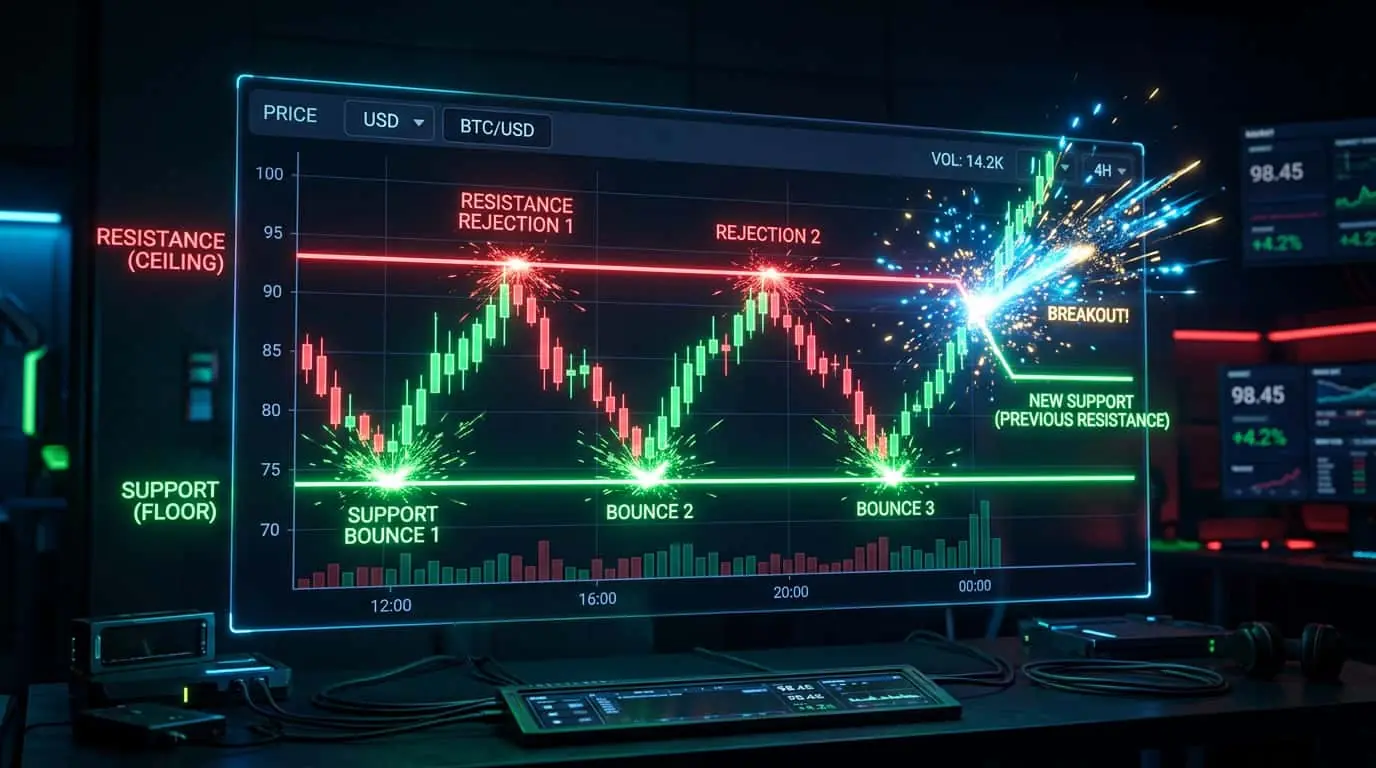
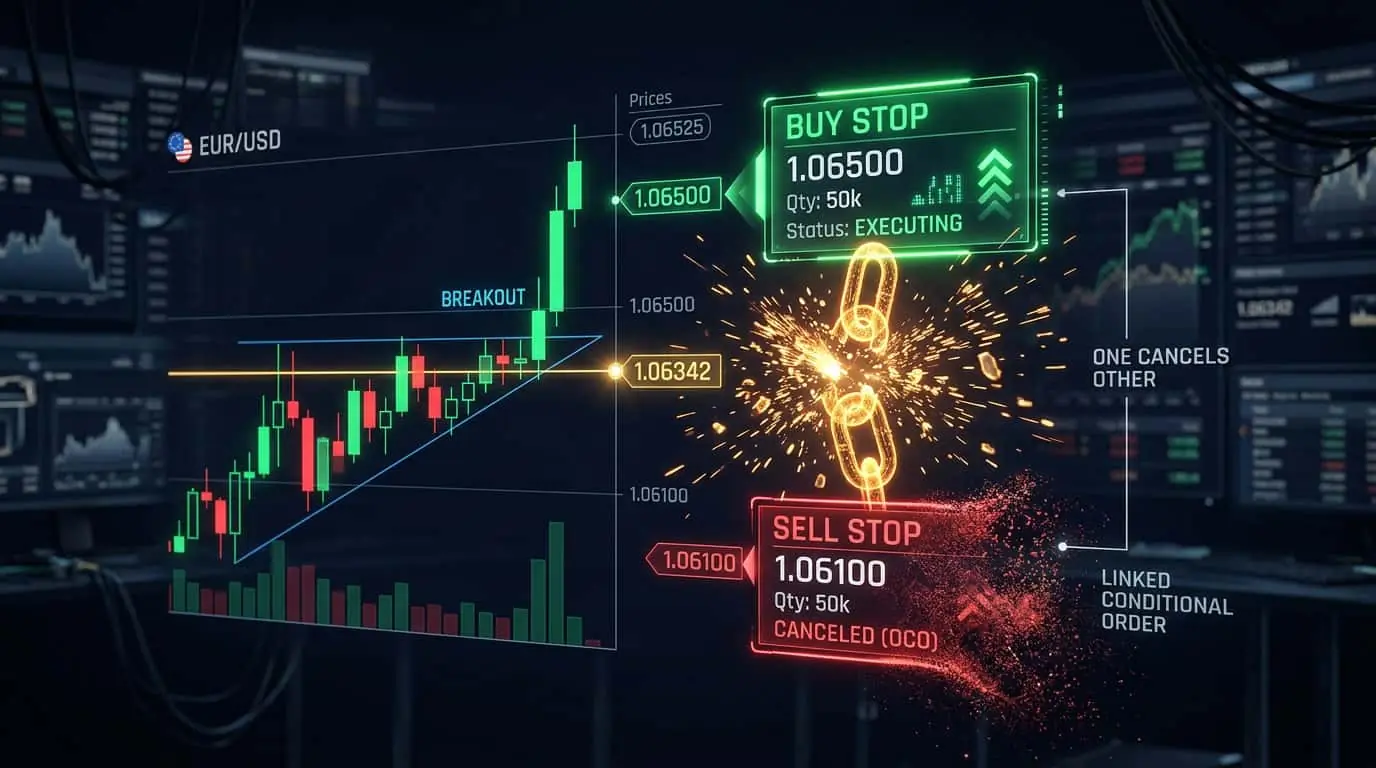
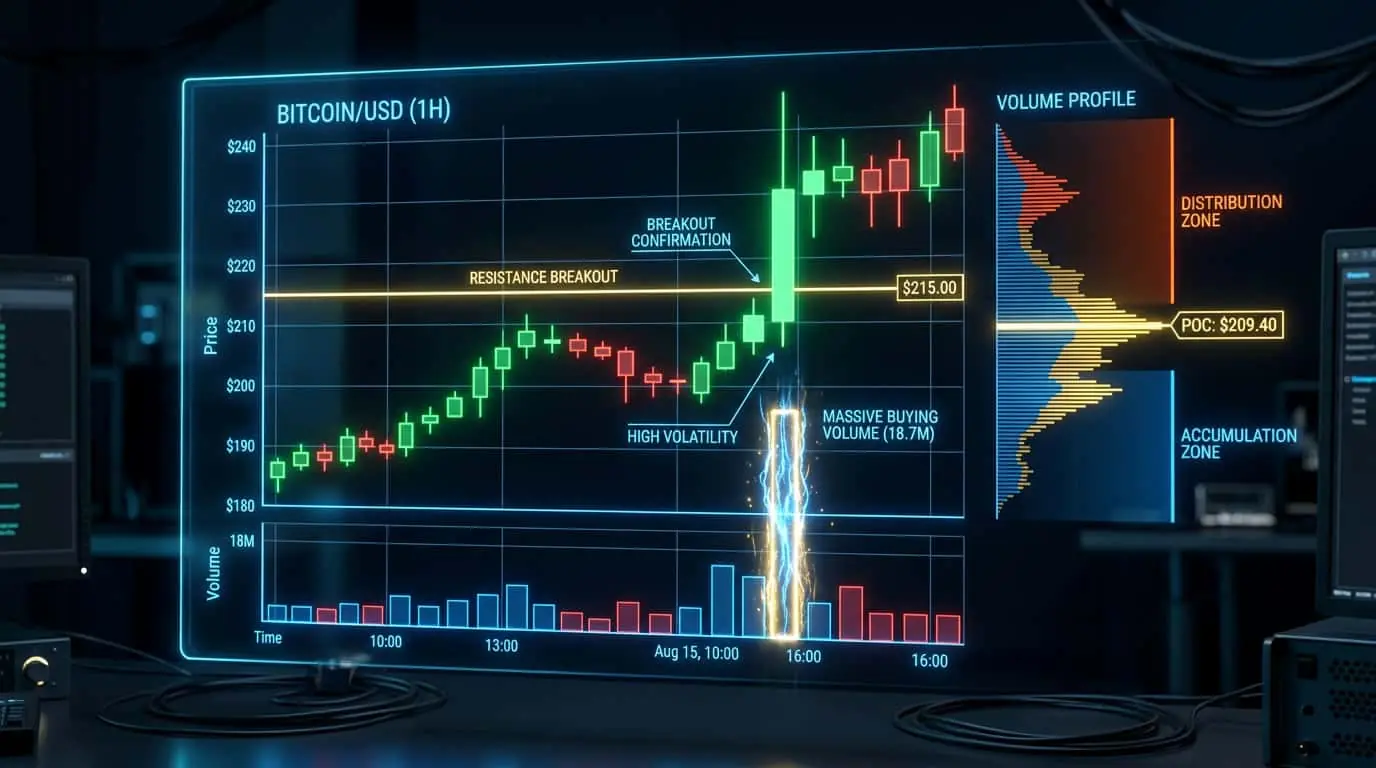
Volume is the most reliable tool for distinguishing between genuine breakouts and false breakouts. When price breaks through a support or resistance level, the volume accompanying that break determines its validity. A genuine breakout should show a significant increase in volume compared to the average, typically at least 50% above the 20-day average volume. This surge indicates that many new participants are entering the market, which provides the fuel for the move to continue. A breakout on low volume, even if the price moves beyond the level, is suspect and has a high probability of failing. False breakouts trap traders on the wrong side and then reverse sharply. By using volume as a filter, traders can avoid many of these traps. Some traders require a volume surge to be at least 2x average volume before they consider a breakout valid, though this varies by market and timeframe.
Pro Tip
For the most reliable breakout trades, wait for a high-volume break of a key level, then look for a low-volume pullback to retest the broken level. The combination of a high-volume break followed by a low-volume retest is one of the highest-probability setups in trading.
Volume profile is an advanced volume analysis technique that displays the amount of volume traded at each price level over a specified period. Unlike traditional volume bars displayed at the bottom of a chart (showing volume over time), volume profile shows volume over price, creating a horizontal histogram on the side of the chart. The most important concept in volume profile is the Point of Control (POC), the price level with the highest traded volume. The POC acts as a magnet for price and a strong support or resistance level because it represents the price at which the most trading activity occurred. High Volume Nodes (HVN) are other price levels with significant volume, also acting as support/resistance. Low Volume Nodes (LVN) are price levels with minimal trading activity; price tends to move quickly through these areas because there is little trading interest to slow it down. Value Area represents the price range containing 70% of the total volume, defining where the market found value.
| Concept | Definition | Trading Implication |
|---|---|---|
| Point of Control (POC) | Price with highest volume | Strong S/R, price magnet |
| High Volume Node (HVN) | Area of significant volume | Price tends to consolidate here |
| Low Volume Node (LVN) | Area of minimal volume | Price moves quickly through |
| Value Area (VA) | 70% of total volume range | Fair value zone, mean reversion target |
On-Balance Volume (OBV) is one of the simplest yet most effective volume indicators, created by Joseph Granville in 1963. The calculation is straightforward: if today's close is higher than yesterday's close, add today's volume to the running OBV total. If today's close is lower, subtract today's volume. If the close is unchanged, OBV stays the same. The formula is: OBV = Previous OBV + Volume (if close > previous close) or OBV = Previous OBV - Volume (if close < previous close). For example, starting with OBV at 0: Day 1 closes up on 100,000 contracts, OBV = 100,000. Day 2 closes down on 80,000 contracts, OBV = 20,000. Day 3 closes up on 120,000 contracts, OBV = 140,000. Day 4 closes down on 60,000 contracts, OBV = 80,000. The absolute value of OBV is meaningless; what matters is its direction. Rising OBV confirms that volume is heavier on up days, supporting the uptrend. Falling OBV confirms that volume is heavier on down days, supporting the downtrend. The most powerful OBV signal is divergence: if price makes a new high but OBV fails to make a new high, accumulation is weakening and a reversal may be approaching. Granville considered OBV the leading indicator of price because smart money (institutions) often accumulates shares before a significant price move, causing OBV to rise before price does. Watching for OBV breakouts ahead of price breakouts can give you an early entry advantage. For example, if OBV breaks to a new 20-day high while price is still consolidating, the breakout is building momentum beneath the surface.
OBV = Previous OBV + Volume (if Close > Previous Close) or - Volume (if Close < Previous Close)OBV — Cumulative On-Balance Volume running total
Volume — Current period's trading volume
Close — Current and previous period closing prices
Volume Weighted Average Price (VWAP) is the single most important price level for institutional traders and algorithmic execution. VWAP is calculated by summing the product of price and volume for each bar, then dividing by the cumulative volume: VWAP = Cumulative(Price x Volume) / Cumulative(Volume). The typical price used is (High + Low + Close) / 3. VWAP is reset at the start of each trading session. If ES futures trades 500 contracts at 5,000, then 300 contracts at 5,010, and then 200 contracts at 5,005, the VWAP would be: [(5,000 x 500) + (5,010 x 300) + (5,005 x 200)] / (500 + 300 + 200) = (2,500,000 + 1,503,000 + 1,001,000) / 1,000 = 5,004. Institutions use VWAP as their execution benchmark: buying below VWAP and selling above VWAP is considered good execution. This creates a self-reinforcing dynamic where institutional algorithms generate buying pressure below VWAP and selling pressure above it. For retail traders, VWAP provides an intraday directional bias: price above VWAP is bullish, below is bearish. Pullbacks to VWAP in a trending day provide low-risk entry opportunities because institutional flow supports price at this level. VWAP standard deviation bands (similar to Bollinger Bands but calculated around VWAP instead of a SMA) provide additional intraday support and resistance levels. The first standard deviation band from VWAP captures approximately 68% of price action, and the second deviation captures approximately 95%, making extreme moves beyond 2 standard deviations from VWAP statistically significant mean-reversion signals.
VWAP = Sum(Typical Price x Volume) / Sum(Volume)Typical Price — (High + Low + Close) / 3 for each bar
Volume — Volume for each bar in the session
Pro Tip
In NinjaTrader, add the OrderFlowVWAP indicator to your intraday chart. Configure it with 1, 2, and 3 standard deviation bands. Use the VWAP line as your intraday trend filter and the bands as overbought/oversold levels. This single indicator replaces several others for intraday futures trading.
Several technical indicators are specifically designed to analyze volume patterns. On Balance Volume (OBV), created by Joseph Granville, keeps a running total by adding volume on up days and subtracting volume on down days. A rising OBV confirms an uptrend, while OBV divergence from price warns of potential reversal. The Volume Weighted Average Price (VWAP) calculates the average price weighted by volume and is the most important intraday benchmark used by institutional traders. Price above VWAP is considered bullish on the day, while below is bearish. The Accumulation/Distribution Line measures the relationship between price and volume to determine whether a security is being accumulated (bought) or distributed (sold). Money Flow Index (MFI) applies the RSI formula to volume rather than price, creating a volume-weighted momentum oscillator. These indicators transform raw volume data into actionable signals that complement price-based analysis.
Mistake
Ignoring volume and relying solely on price patterns and indicators
Correction
Always check volume when evaluating a price signal. A breakout, reversal pattern, or trend move without supporting volume is significantly less reliable. Volume should be a standard part of every trade evaluation.
Mistake
Comparing volume across different instruments without normalization
Correction
Volume is relative to each instrument. The ES futures trade millions of contracts daily while other markets may trade thousands. Always compare current volume to that instrument's own historical average rather than comparing absolute volumes across different markets.