

Visualize 100 possible futures of your strategy. Discover your real risks before risking your actual capital.
For every $1 risked, you earn on average $0.65
Average Outcome
$
Median Outcome
$
Worst Drawdown
-%
Average Drawdown
-%
Each line represents a complete simulation of your strategy. If 30% of lines end below your starting capital, it means that even with a winning strategy, you have a 30% chance of losing money over that period. Monte Carlo does not predict the future; it shows you the range of possibilities.
Understanding variance so you are never surprised by the market again
You backtested your strategy. It shows +40% over the last two years. Confident, you start trading live. Three weeks later, you are down -15%. Is your strategy broken? Has the market changed? Probably not.
You are simply a victim of variance -- the natural dispersion of results around their mean. A strategy with a 55% win rate will inevitably experience streaks of 5, 6, or even 10 consecutive losses. It is mathematically guaranteed. The question is not "if" but "when".
Monte Carlo simulation is the tool that lets you visualize all possible futures of your strategy. Instead of seeing a single equity line (your backtest), you see 100, 1,000, or 10,000 lines -- each representing a different sequence of wins and losses with the same statistics. It is the difference between looking at yesterday's weather and understanding the climate.
The name "Monte Carlo" evokes the glamorous casinos of Monaco, but its origin is far darker. The method was invented during World War II by two mathematical geniuses: Stanislaw Ulam and John von Neumann.
Ulam and von Neumann were working at Los Alamos on the most secret project in history: the atomic bomb. They needed to model the behavior of neutrons in fissile material -- how they bounce, get absorbed, or trigger further fissions.
The differential equations were impossible to solve analytically. Ulam, recovering from surgery, spent his time playing Solitaire. He realized that instead of calculating the exact probability of winning (a complex calculation), he could simply play hundreds of games and count the winning percentage.
Ulam applied this idea to neutrons: instead of solving equations, simulate thousands of individual neutrons, each following a random path based on known probabilities. The average of all these paths gave an excellent approximation of actual behavior.
The code name "Monte Carlo" was chosen in reference to Ulam's uncle, a compulsive gambler who regularly borrowed money to go to the Monte Carlo casino. The irony was perfect: using randomness to solve deterministic problems.
1944
Invented at Los Alamos for the atomic bomb
1950s
Adopted by nuclear physicists
1980s
Entered finance (Value at Risk)
Today
Standard for all risk management
Imagine your strategy as a loaded die:
The simulator "rolls this die" for each trade, then starts over 100 times from scratch. This gives you 100 different equity curves, all based on the same statistics.
Over 10,000 trades, luck cancels out and only expectancy matters. But over 100 trades, variance dominates. This is the zone where Monte Carlo reveals the real dangers.
Win rate, risk/reward ratio, risk per trade, number of trades. These are your actual statistics.
For each simulation, generate a random sequence of wins/losses based on your probabilities.
Look at the worst case, best case, median, and percentage of losing scenarios.
Backtesting shows you what happened, not what could have happened.
Monte Carlo shows you everything that can happen with your statistics.
Win Rate
35%
R:R
1:3
Risk
2%
Monte Carlo Diagnosis
Despite a positive expectancy (+0.40R), this profile regularly suffers streaks of 8-12 consecutive losses. The simulator shows that in 25% of cases, it will hit a -35% drawdown before taking off.
Risk: Psychological breakdown before the statistics materialize.
Win Rate
68%
R:R
1:1
Risk
0.5%
Monte Carlo Diagnosis
Very smooth and steady equity curve. The simulator shows a worst drawdown of only -12% across 100 simulations. Slow but consistent growth.
Ideal for: Prop Firms, large capital management, risk-averse traders.
If you trade for a Prop Firm (FTMO, The Funded Trader, etc.), Monte Carlo is not a luxury -- it is an absolute necessity. Why? Because your "ruin" is not at $0. It is at your Max Allowed Drawdown (typically 10%).
If "Worst Drawdown" > 10%, you are playing Russian roulette with your funded account.
Even with a long-term profitable strategy, you have a non-zero probability of losing your account before the statistics materialize.
Reduce your risk per trade until the simulated "Worst Drawdown" is comfortably below your Prop Firm limit. If your limit is 10%, aim for a worst drawdown of 6-7% maximum to have a safety margin.
Monte Carlo is a powerful tool, but it is not a crystal ball. Here are its important limitations:
Monte Carlo assumes each trade is independent of the previous one. In reality, markets have regimes (trending vs ranging) and your psychology changes after a losing streak.
If your input statistics are wrong (overestimated win rate, inflated ratio), the simulations will be misleading. Use data from 100+ trades minimum.
A flash crash, a war, a broker bankruptcy... Monte Carlo cannot simulate events it has never seen.
The basic simulator uses a binomial distribution (win or loss). In reality, your wins and losses vary. Advanced versions use log-normal distributions.
Analyze your last 100 trades minimum. Calculate your real win rate, average win, and average loss. Be honest -- embellished numbers only lie to yourself.
Input your capital, win rate, R:R ratio, and risk per trade. The risk should be what you actually use, not what you think you use.
Look at the 'Worst Drawdown'. Are you psychologically and financially capable of enduring this decline? If not, reduce your risk per trade.
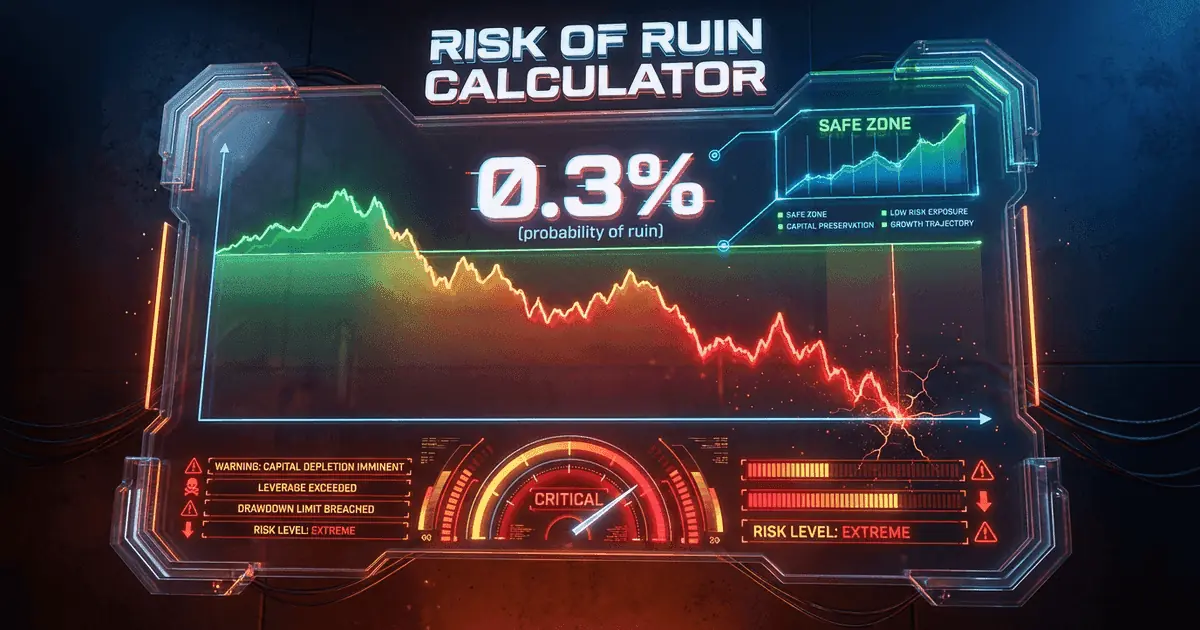
For a Prop Firm with 10% max DD, your risk of ruin should be 0% or close to 0%. For your own capital, aim for less than 5%.
If the average is very different from the median, it means a few exceptional simulations are pulling the average up. Trust the median more.
Adjust risk per trade until you find the sweet spot: acceptable growth + bearable drawdown. It is often more conservative than you think.
Monte Carlo is a tool of vision. It lets you see what your backtest does not show: the alternate paths, the worst scenarios, the true distribution of your possible outcomes.
Nuclear physicists used it to understand the invisible (neutron behavior). Traders use it to understand the unpredictable (market variance). In both cases, the goal is the same: making informed decisions in the face of uncertainty.
Remember these three principles:
Use this simulator before every major decision: going live, changing position size, attempting a Prop Firm challenge. Your future self will thank you.
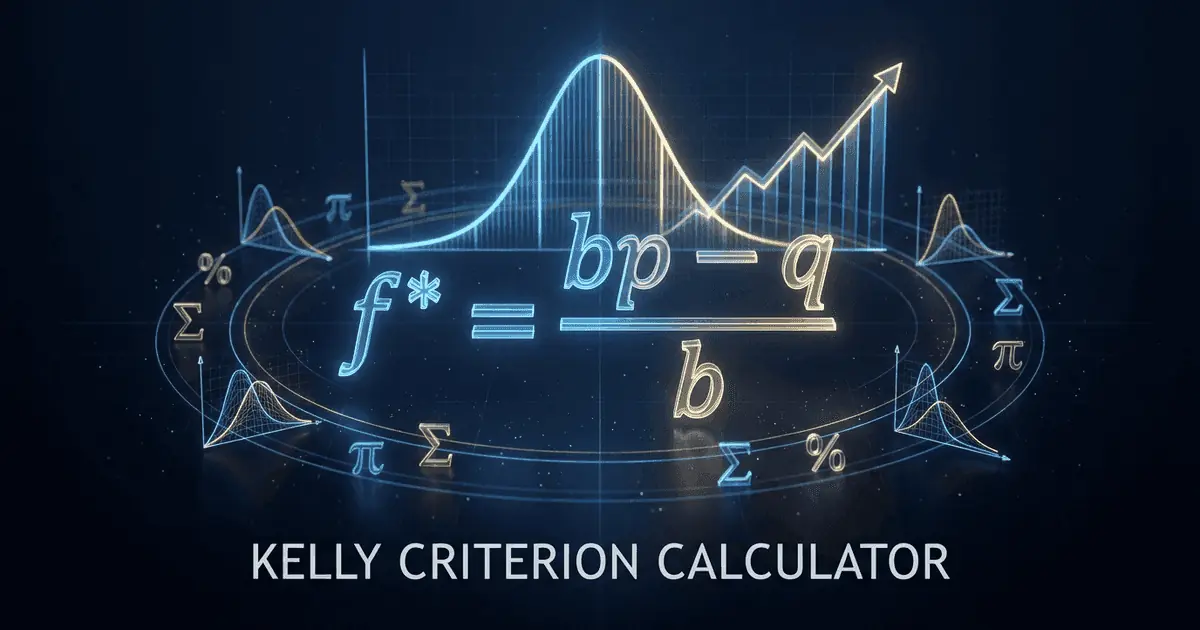
Monte Carlo has shown you your risks. Now use the Kelly Criterion to calculate your optimal position size and the position calculator to apply it.
Discover our premium NinjaTrader 8 indicators — precision-coded tools that do the heavy lifting for you.
Browse Indicators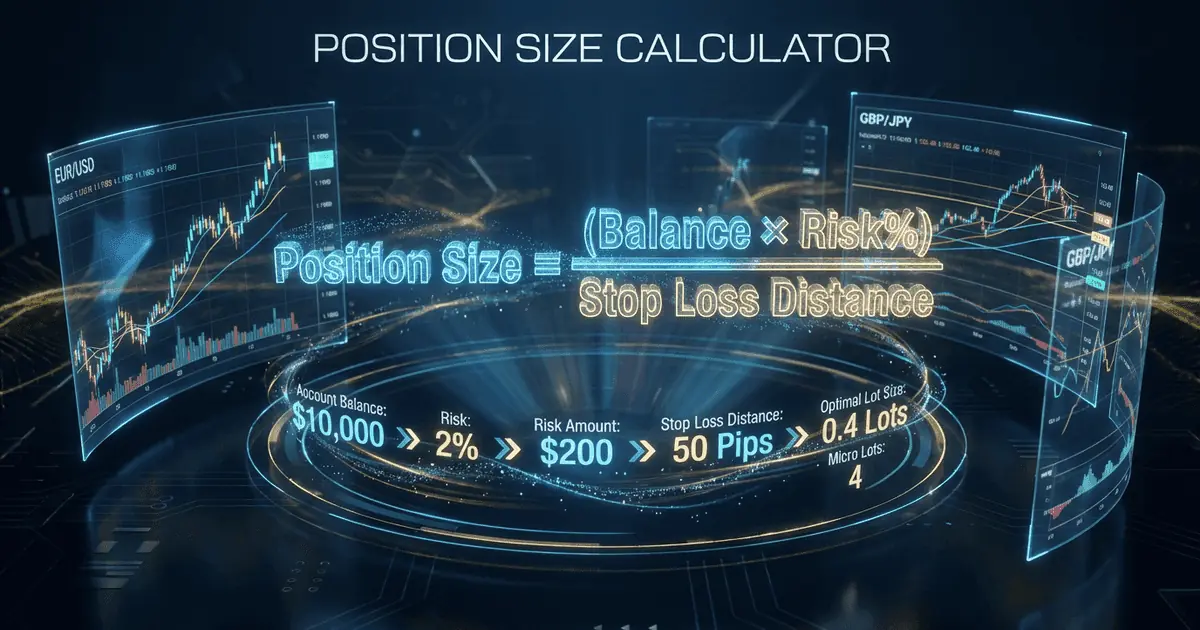



Loading reviews...
Loading reviews