
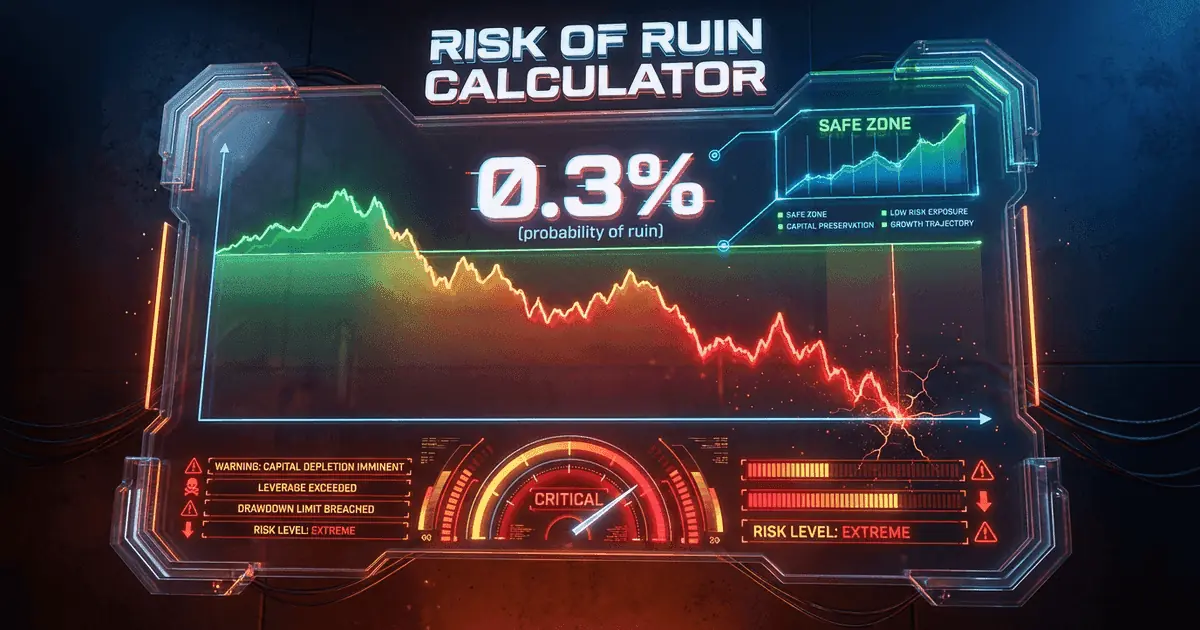
Calculate the probability of losing your capital based on your win rate, R:R, and risk per trade.
If you risk 1 to gain 2, enter 2
50% = you lose half of your capital
+65.00%
Average gain of 1.30% per trade
0.00%
Excellent - Near-zero risk
32.5%
16.3%
Same win rate and R:R, only the risk per trade changes
Near-zero risk of ruin. You can trade with confidence over the long term.
Controlled but present risk. Maintain your money management discipline.
Significant risk. Reduce your risk per trade or improve your stats.
High probability of blowing your account. Urgent corrective action needed.
Risk of Ruin (RoR) is perhaps the most important concept in money management that most traders ignore. While many focus on their latest winning trade or their win rate, RoR answers a fundamental question: what is the probability that I lose all (or a significant portion) of my capital before I can profit from it?
Imagine two traders with the same profitable system (55% win rate, 2:1 R:R). The first risks 1% per trade, the second risks 5%. Over 1,000 simulations, the first almost never reaches ruin. The second sees his account blow up in 20-30% of cases. Same system, radically different outcomes.
RoR forces you to think in terms of probability and the long term. It's not "will I lose?" but "across how many possible scenarios do I lose everything?". This perspective fundamentally changes your approach to risk.
Your Risk of Ruin depends on three main factors, each having a different impact on the final outcome:
Your edge is the combination of your win rate and your R:R. The formula: Edge = (Win Rate x R:R) - (1 - Win Rate)
This is the factor you control most directly. It determines how many consecutive losses you can absorb before reaching ruin.
At what level of loss do you consider yourself "ruined"? It's not necessarily 100% - 50% is often used because recovery becomes very difficult beyond that point.
The Kelly Criterion, developed by John Kelly in 1956 for telecommunications, proved revolutionary for money management. It calculates the optimal fraction of your capital to risk in order to maximize geometric growth over the long term.
The formula: Kelly % = Win Rate - (Lose Rate / Risk:Reward)
For example, with a 55% win rate and 2:1 R:R: Kelly = 0.55 - (0.45 / 2) = 0.55 - 0.225 = 0.325 or 32.5%
However, full Kelly is VERY aggressive. The slightest overestimation of your edge can lead to ruin. That is why professionals use "Half Kelly" or even "Quarter Kelly". In our example, Half Kelly = 16.25%, Quarter Kelly = 8.1%.
The practical rule: if your current risk is well below Half Kelly, you are probably very safe (low RoR). If you are above Full Kelly, you are playing with fire.
A system with a 60% win rate and 2:1 R:R looks excellent on paper. The edge is clearly positive. Yet traders with such systems go bankrupt. How is that possible?
The answer: variance. Even with a 60% chance of winning, you will experience losing streaks. The probability of 5 consecutive losses is (0.4)^5 = 1%. It seems rare, but over 500 trades per year, it will likely happen several times.
If you risk 10% per trade, 5 consecutive losses = -50% of your account. Suddenly, your excellent system has put you in a very difficult position. At 2% per trade, those 5 losses = -10%, easily recoverable.
Risk of Ruin quantifies this reality. It incorporates the probability of these losing streaks and calculates their potential consequences. A good system with poor money management is still a path to ruin.
If your RoR is too high, here are the actions ranked by effectiveness:
This is the most powerful lever. Going from 3% to 1% can divide your RoR by 50 or more. It is the fastest action and the one you fully control.
Look for setups with better ratios. Going from 1:1 to 2:1 doubles your edge at the same win rate. This requires adjusting your entry criteria and targets.
More difficult since it depends on your skills and the quality of your analysis. Focus on high-conviction setups and eliminate marginal trades.
More capital allows you to withstand the same percentage losses with less psychological stress. It does not change the mathematical RoR but helps with discipline.
If your calculated edge is negative, NO money management will save you. It is mathematically impossible. With a negative edge, every trade costs you money on average. The more you trade, the more you lose.
Casinos operate on this principle: they have a (slightly) positive edge, and over millions of games, mathematics guarantees their profit. If you have a negative edge, you are the casino... on the wrong side.
Before even calculating your RoR, check your edge. If it is negative or zero, the absolute priority is to improve your trading system, not your money management.
Risk of Ruin embodies a fundamental truth of trading: survival comes before performance. You cannot benefit from an excellent system if you went bankrupt before the probabilities played in your favor.
The best traders are not those with the biggest gains on a single trade. They are those who are still standing after 10 years, having survived crashes, black swans, and the inevitable losing streaks.
Use this calculator regularly. Keep your RoR under control. And remember: in this business, the first rule is not to lose. The second rule is not to forget the first one.
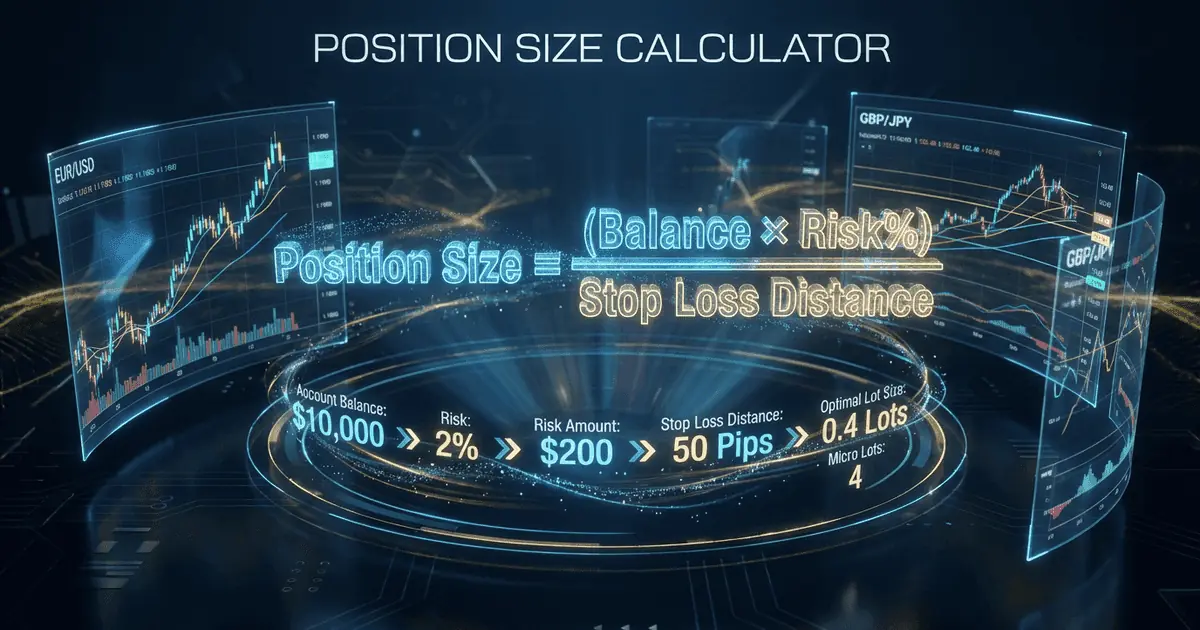
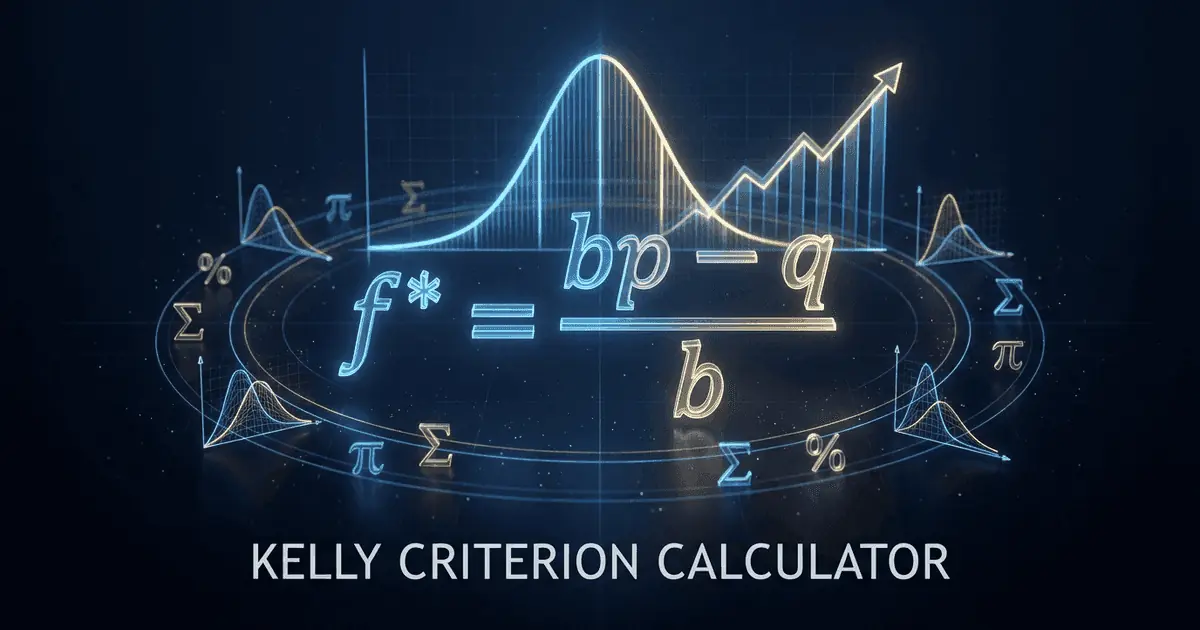
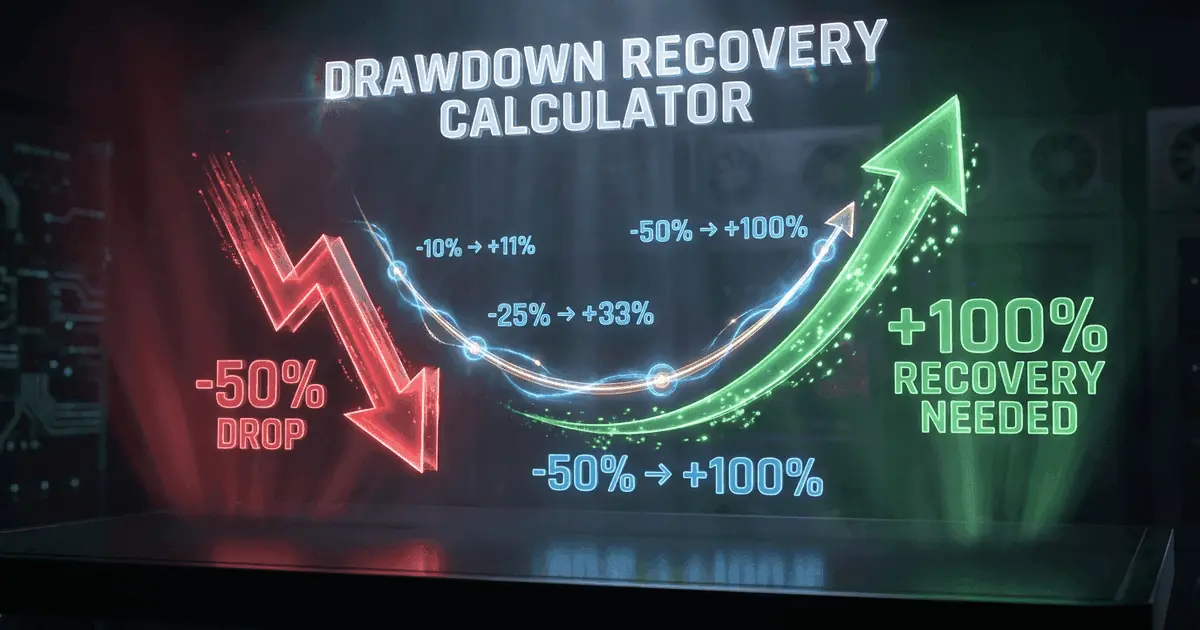






Discover our other money management tools
Discover our premium NinjaTrader 8 indicators — precision-coded tools that do the heavy lifting for you.
Browse IndicatorsLoading reviews...
Loading reviews