
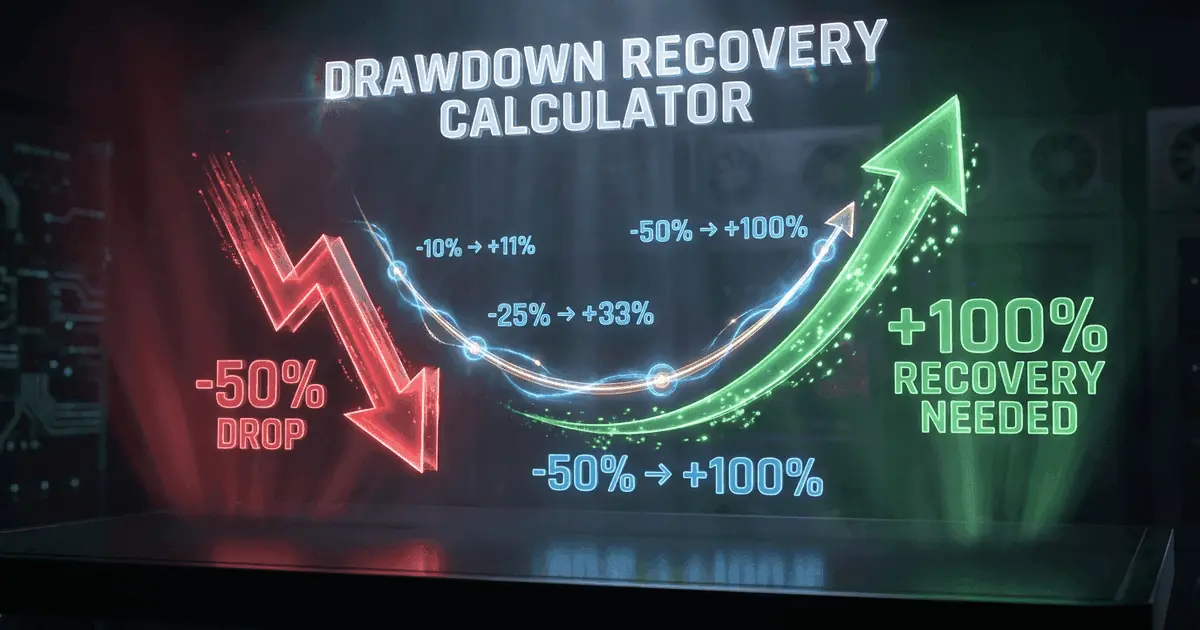
Discover the cruel mathematics of losses. A 50% loss requires a 100% gain to recover. Prevention is better than cure.
To estimate the number of trades needed
Loss asymmetry: To recover from a 20% loss, you need to achieve a gain of 25.0% — that is 1.3x more than what you lost.
| Drawdown | Recovery | Trades (1%) | Trades (2%) |
|---|---|---|---|
| -5% | +5.3% | 5 | 3 |
| -10% | +11.1% | 11 | 6 |
| -15% | +17.6% | 18 | 9 |
| -20% | +25.0% | 25 | 13 |
| -25% | +33.3% | 33 | 17 |
| -30% | +42.9% | 43 | 21 |
| -35% | +53.9% | 54 | 27 |
| -40% | +66.7% | 67 | 33 |
| -45% | +81.8% | 82 | 41 |
| -50% | +100.0% | 100 | 50 |
| -60% | +150.0% | 150 | 75 |
| -70% | +233.3% | 233 | 117 |
| -80% | +400.0% | 400 | 200 |
| -90% | +900.0% | 900 | 450 |
Here is a truth every trader must engrave in their mind: losses and gains are not symmetrical. A 50% loss does not require a 50% gain to recover — it requires a gain of 100%.
This asymmetry is one of the main reasons why risk management is more important than chasing gains. A trader who protects their capital does not need spectacular wins to succeed. A trader who neglects their losses will need miracles just to get back to breakeven.
The formula is simple but brutal:
For a 20% loss: 20 / 80 x 100 = 25% gain needed.
For a 50% loss: 50 / 50 x 100 = 100% gain needed.
For an 80% loss: 80 / 20 x 100 = 400% gain needed.
Manageable
Normal fluctuations for any trader. A 10% loss only requires an 11.1% gain. This is the zone where you should spend 90% of your time.
Action: Continue your strategy normally. Nothing alarming.
Attention Required
The warning signal. A 20% loss already requires a 25% gain. Many prop firms set their limits here. It is time to reduce position sizes.
Action: Reduce your risk per trade by 50%. Analyze your mistakes.
Danger
Dangerous territory. A 35% loss requires a 54% gain to recover. Psychologically, this is where many traders panic and make fatal mistakes.
Action: STOP. Take a break. Re-evaluate your entire strategy.
Critical / Game Over
The point of no return for many. A 50% loss requires a 100% gain. At this stage, the probability of recovery without major changes is near zero.
Action: Stop trading. Completely retrain before resuming.
The fundamental problem is that the calculation base changes. When you lose 50%, you start from 100 and end up at 50. But when you need to recover, you start from 50, not 100.
This is why professional traders are obsessed with capital preservation. They know that every loss requires a disproportionate effort to recover. The best strategy is not knowing how to recover from drawdowns — it is to never fall into them.
Here is the classic story of an account that implodes, and why drawdowns cascade:
Normal loss. Recovery needed: 5.3%. No stress.
The trader increases risk to "recover fast". Bad idea.
Revenge trading. Position too large. Recovery needed: 56%.
"All-in" to recover. Catastrophe. Recovery needed: 212%.
The vicious cycle: small loss → revenge trading → big loss → panic → all-in → game over. The initial $10,000 account evaporated in 6 trades.
Lesson: It is not the first loss that kills. It is the emotional reaction to losses.
Even 10 consecutive losses only put you at -20%. Survivable.
A trade without a stop loss is a lottery ticket. You are not here to gamble.
Set a daily limit (e.g., -3%). Reached = end of day. Non-negotiable.
After 2 consecutive losses, cut your position size in half.
30-minute rule: after a loss, do not trade for at least 30 minutes.
If you reach -10% for the week, stop until next Monday.
Document every trade. Destructive patterns become visible.
Prop firms understand this math better than anyone. That is why their drawdown rules are strict:
Recovery needed at -10%: 11.1%
Recovery needed at -8%: 8.7%
Recovery needed at -6%: 6.4%
Insight: Prop firms set "low" limits (5-10%) because they know that is the zone of possible recovery. Beyond that, statistically, the trader does not recover.
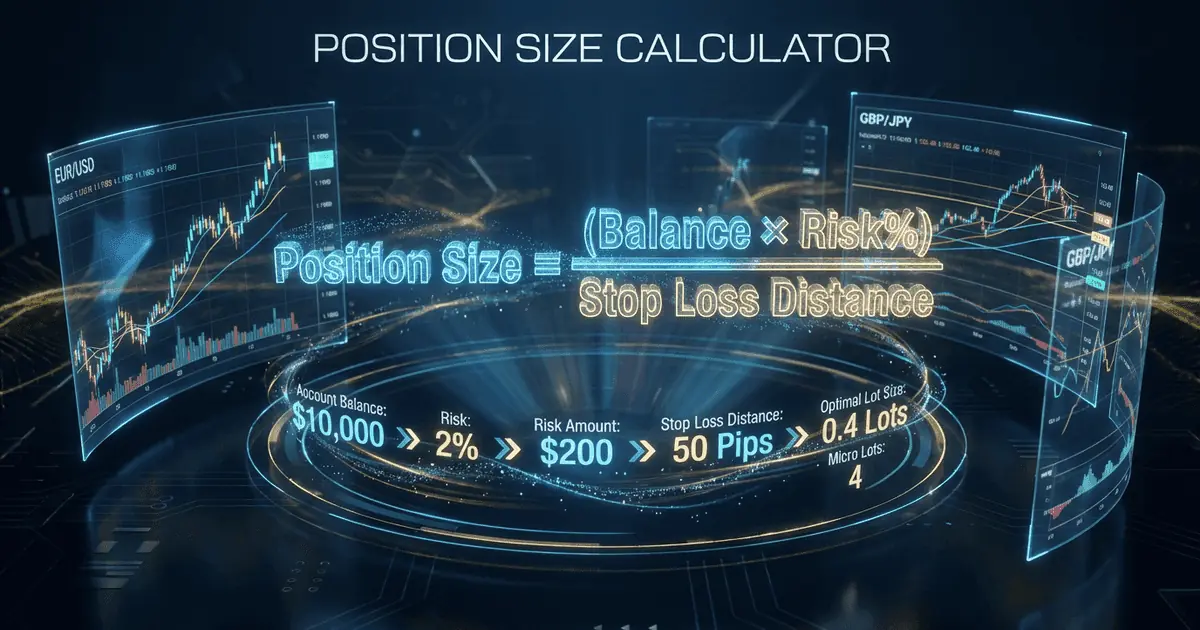
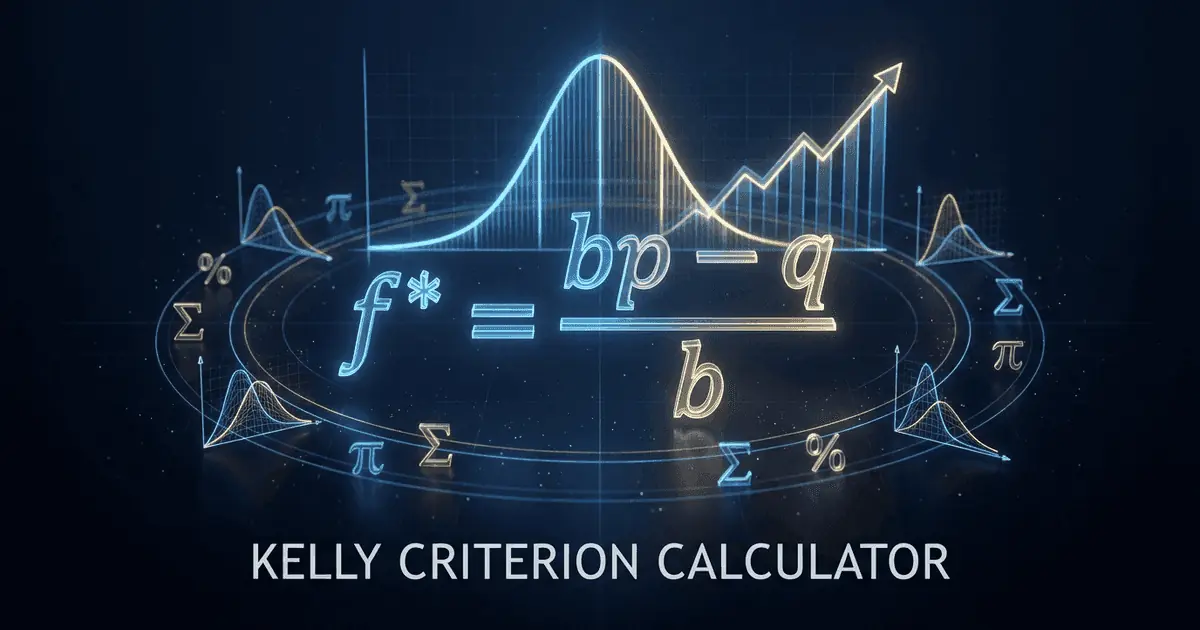
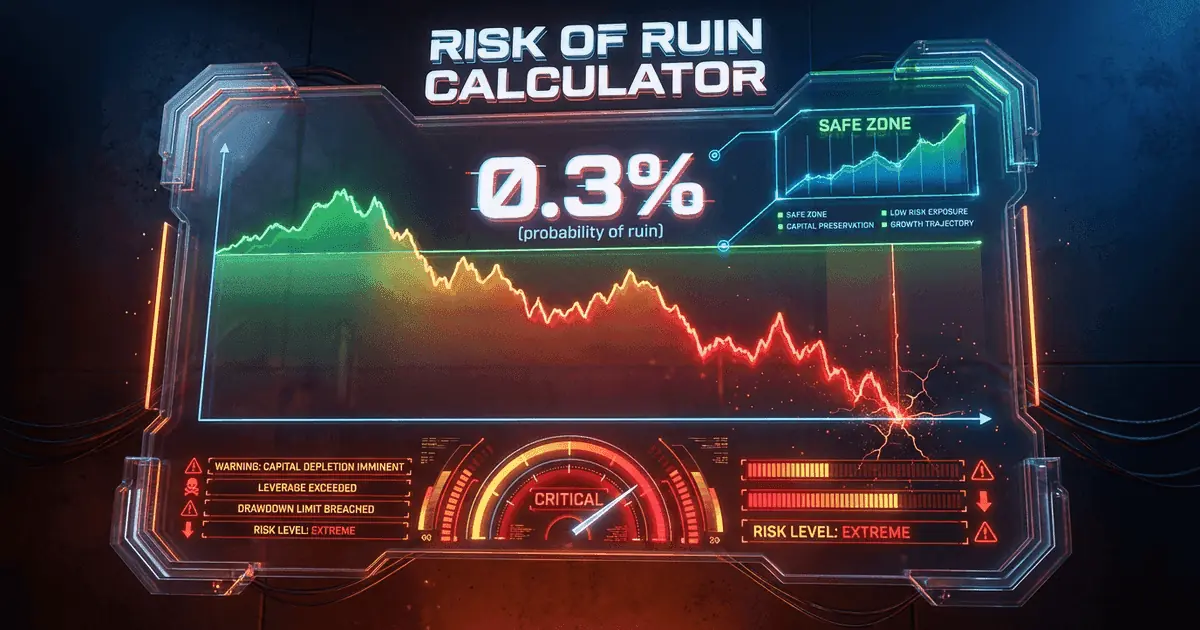


Protect your capital. Use stop losses. Limit your risk per trade. A trader who survives is a trader who can succeed tomorrow.
Discover our premium NinjaTrader 8 indicators — precision-coded tools that do the heavy lifting for you.
Browse IndicatorsLoading reviews...
Loading reviews