
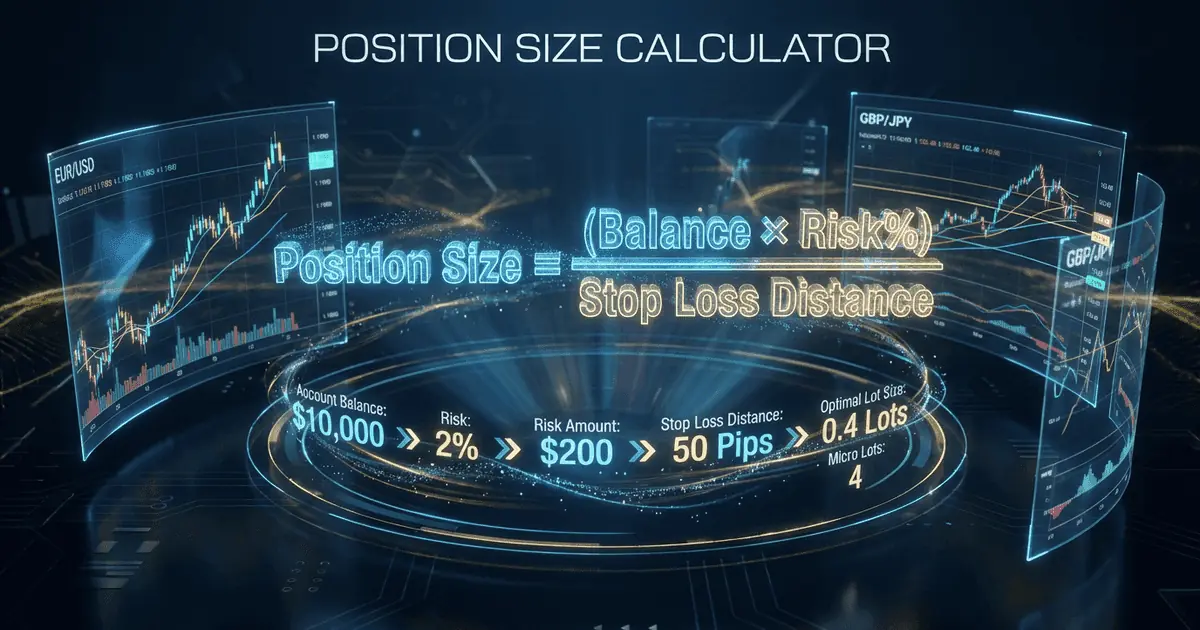
The most important calculation in trading. Determine exactly how many lots to risk so you never exceed your loss limit.
Your total capital available for trading
In pips (e.g., 20 pips)
100
consecutive trades$10
per standard lotThis is the maximum you can lose on this trade
Pip/point values may vary depending on your broker, your account currency, and market conditions. This calculator uses standard values for a USD account. If your account is in a different currency, adjust accordingly.
The art and science of sizing your trades to survive and thrive
Imagine two traders with exactly the same strategy, the same starting capital, and the same market conditions. After one year, one has doubled their account, the other has lost it. The only difference? Position sizing.
Position size calculation is probably the most underestimated concept in trading. Beginners spend hours looking for the best indicator, the best entry strategy, the best time to trade... but completely neglect the "how much" -- which is infinitely more important than the "when".
This guide will transform you from a trader who "guesses" their position size to one who calculates it scientifically. By the end, you will understand why Van Tharp, legendary trading coach, said: "Position sizing is responsible for 90% of the variation in performance between traders."
The Universal Formula
Capital × % Risk per trade
Ex: 10,000$ × 1% = 100$
Distance in pips or points
Ex: 25 pips on EUR/USD
Monetary value of a pip/point
Ex: $10/pip for 1 lot EUR/USD
Determine your risk in dollars
Capital: $25,000 | Risk: 2% → $500 at risk
Identify your stop loss
Technical analysis indicates SL at 40 pips from entry price
Find the pip value
EUR/USD with USD account: $10/pip per standard lot
Apply the formula
Size = $500 ÷ (40 pips × $10/pip)
Size = $500 ÷ $400
Size = 1.25 lots
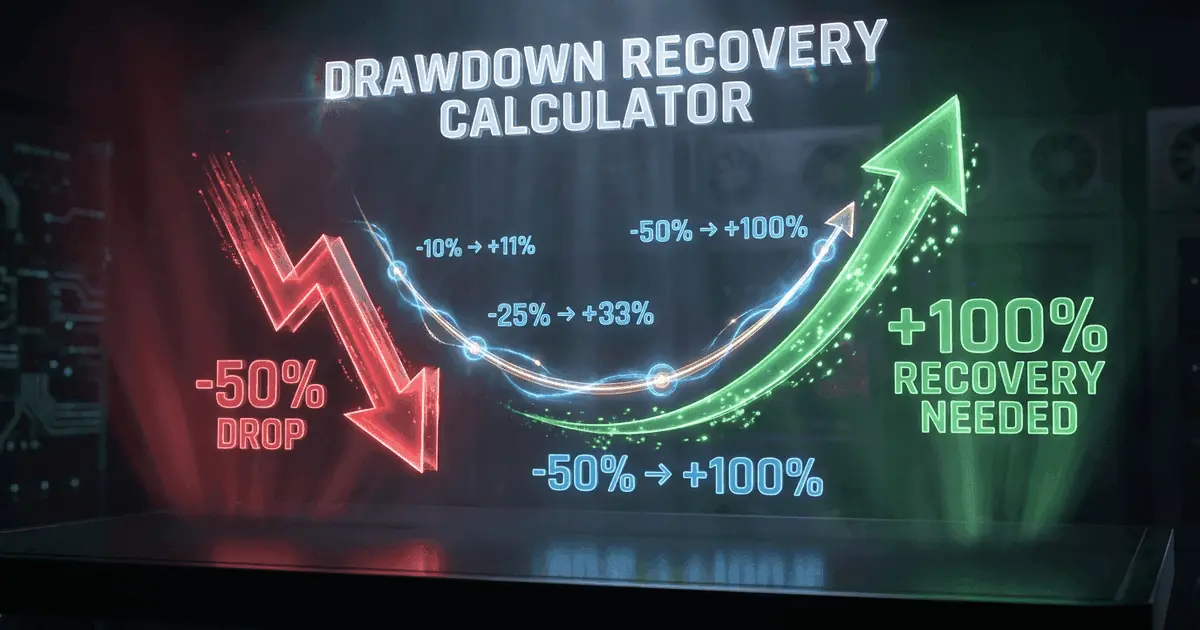
Here is a mathematical truth that few traders understand: a 50% loss requires a 100% gain to get back to breakeven. Not 50%. 100%.
| Loss | Gain required to recover | Difficulty |
|---|---|---|
| 10% | 11% | Easy |
| 20% | 25% | Moderate |
| 30% | 43% | Difficult |
| 50% | 100% | Very Difficult |
| 75% | 300% | Nearly Impossible |
| 90% | 900% | Game Over |
This is why pros limit their risk to 0.5-2% per trade. Even 10 consecutive losses (rare but possible) won't wipe them out.
Capital: 10,000$
Risk: $1,000 per trade
5 consecutive losses:
Trade 1: 10,000$ → 9,000$
Trade 2: 9,000$ → 8,100$
Trade 3: 8,100$ → 7,290$
Trade 4: 7,290$ → 6,561$
Trade 5: 6,561$ → 5,905$
-41% drawdown
Need +69% to recover
Capital: 10,000$
Risk: $100 per trade
5 consecutive losses:
Trade 1: 10,000$ → 9,900$
Trade 2: 9,900$ → 9,801$
Trade 3: 9,801$ → 9,703$
Trade 4: 9,703$ → 9,606$
Trade 5: 9,606$ → 9,510$
-4.9% drawdown
Need only +5.2% to recover
Always risk the same percentage (e.g., 1%) on every trade. This is the method used by this calculator.
Always risk the same dollar amount (e.g., $100) per trade, regardless of capital.
Calculates optimal size based on your win rate and risk/reward ratio.
Adjusts size based on market volatility (ATR - Average True Range).
Funded account with strict drawdown rules
Recommended risk
0.25% - 0.5%
With 10% max DD, you can absorb 20-40 consecutive losses. This is your life insurance.
Trades lasting several days to weeks
Recommended risk
1% - 2%
Wider stop losses = fewer trades = can afford slightly more risk per position.
Many intraday trades
Recommended risk
0.25% - 0.5%
Many trades = high cumulative risk. Stay ultra conservative per position.
If you recalculate after each loss, you can technically never reach zero, but you will be stuck with a tiny capital. Use a fixed % or recalculate monthly.
3 open trades on EUR/USD, GBP/USD and AUD/USD? You don't have 3 positions at 1% - you effectively have 1 position at 3% on the dollar.
Doubling your position on a losing trade doubles your risk. This is how 5% drawdowns become 50% catastrophes.
In volatile conditions, your stop loss can be executed well beyond your price. Allow for a 5-10% margin on your risk calculation.
Post-win euphoria pushes traders to oversize. The next loss will be even more devastating. Maintain constant discipline.
Just because you have 100:1 leverage doesn't mean you should use it. Leverage is a tool, not a goal. Always calculate in real risk terms.
You identify a long setup on GBP/USD. Your technical analysis places the stop loss below the last swing low, at 35 pips from your entry.
// Calculation
Risk = $15,000 × 1.5% = $225
SL Cost = 35 × $10 = $350/lot
Size = $225 ÷ $350
= 0.64 lots (6.4 mini lots)
Short setup on gold after a resistance rejection. Stop loss at 800 pips ($8.00) above entry.
// Calculation
Risk = $50,000 × 1% = $500
SL Cost = 800 × $1 = $800/lot
Size = $500 ÷ $800
= 0.625 lots
Quick scalp on the Dow Jones index. Tight stop loss at 25 points.
// Calculation
Risk = $25,000 × 0.5% = $125
SL Cost = 25 × $1 = $25/contract
Size = $125 ÷ $25
= 5 contracts
Position sizing isn't sexy. It's not a revolutionary indicator, not a secret strategy, not a miracle bot. It's just simple mathematics. But it's precisely what separates traders who survive from those who blow up.
Remember the golden rule: your number one goal is to survive. Not to get rich tomorrow. Not to double your account this month. Just survive long enough for your edge to manifest.
The three principles to remember:
Use this calculator religiously before every trade. Make it a reflex. The day you are tempted to "take a big trade" because you are "sure of yourself," this calculation will save you.
Position sizing is the first step. Use our other tools to optimize your risk management and maximize your chances of success.
Discover our premium NinjaTrader 8 indicators — precision-coded tools that do the heavy lifting for you.
Browse Indicators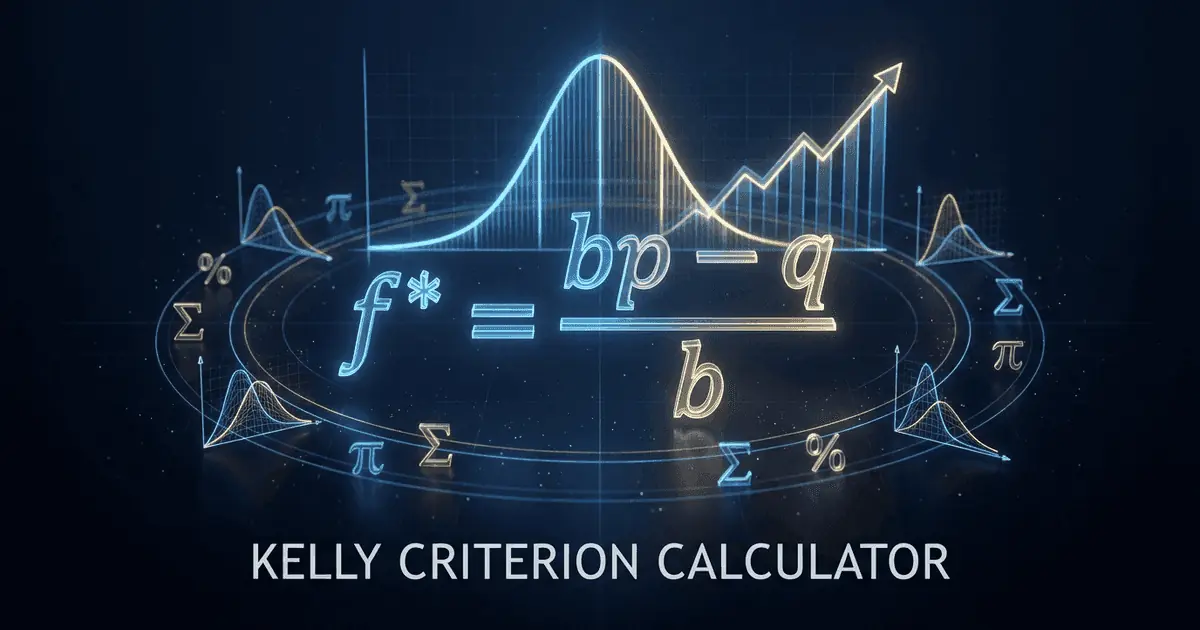



Loading reviews...
Loading reviews