
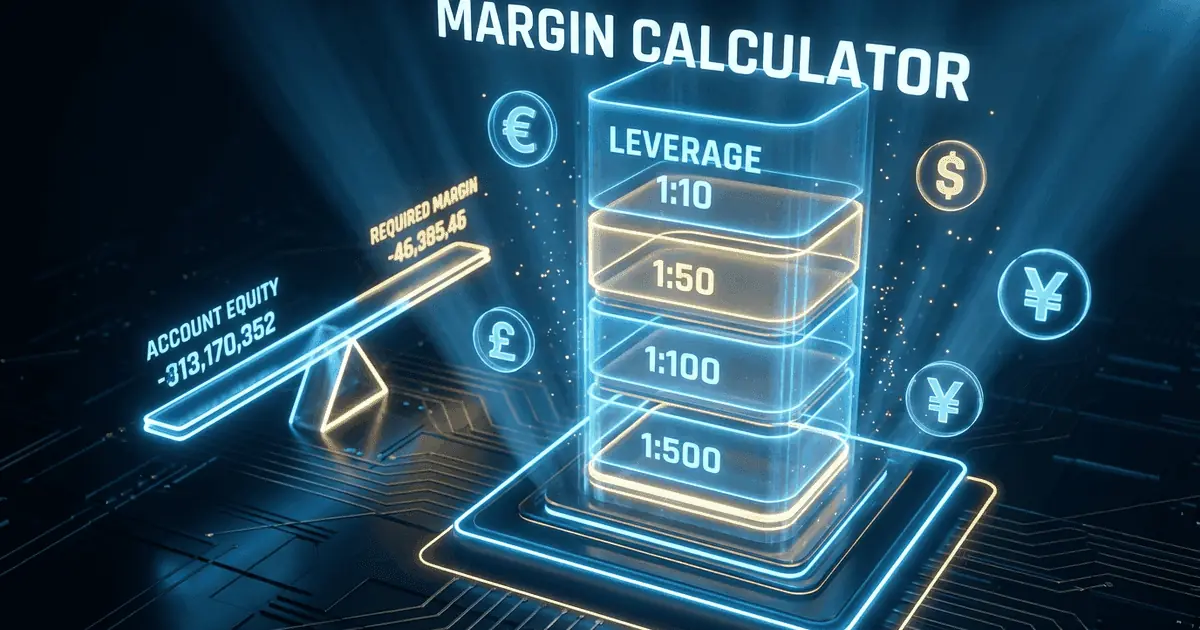
Calculate the required margin, margin level, and associated risks for your positions on Forex, Crypto, Stocks, and more.
1 lot = 100,000 units of the base currency
$110,000.00
$3,666.67
273%
$6,333.33
With this leverage, you can open up to 2 positions of this size
Excellent level. You have plenty of margin room for market fluctuations.
Adequate level for most strategies. Keep an eye on significant movements.
Close to the danger zone. Avoid adding positions or reduce exposure.
Critical zone. Risk of automatic liquidation. Close positions or add funds.
Margin is the capital you must deposit to open and maintain a leveraged position. It is essentially a good faith deposit that the broker holds to cover potential losses. The higher the leverage, the less margin you need to control a position of the same value.
For example, to control a 100,000 USD position on EUR/USD: with 1:100 leverage, you only need 1,000 USD in margin. With 1:30 leverage, you will need about 3,333 USD. The rest is "lent" by the broker for the duration of the position.
It is crucial to understand that margin is NOT a cost - it is locked capital. Your gains and losses are calculated on the total value of the position, not on the margin. This is what makes leverage both powerful and dangerous.
Leverage multiplies your market exposure. If you have 1,000 USD and use 1:100 leverage, you can control 100,000 USD. A 1% move then represents 1,000 USD - or 100% of your initial capital.
Capital: $1,000 | Leverage: 1:100 | Position: 1 lot (100,000 USD)
+$500 (+50%)
-$500 (-50%)
-$1,000 (LIQUIDATED)
Capital: $1,000 | Leverage: 1:10 | Position: 0.1 lot (10,000 USD)
+$50 (+5%)
-$50 (-5%)
-$100 (-10%)
Same capital, two different leverages, two radically different trajectories.
Capital required to open a position. This is the minimum amount the broker requires before letting you enter the market.
Minimum level to maintain an open position. If your equity drops below this threshold, you receive a margin call.
Your account balance +/- the unrealized profits/losses of your open positions. This is your current net value.
(Equity / Used Margin) x 100. The higher this percentage, the further you are from a margin call.
A margin call occurs when your margin level drops below the critical threshold set by your broker (typically 100% or 50%). It is the signal that your unrealized losses have eroded your ability to maintain open positions.
When you receive a margin call, several things can happen depending on your broker: you receive a warning to add funds, some positions are automatically closed (stop-out), or in the worst case, all your positions are liquidated.
Regulators worldwide have imposed leverage limits to protect retail investors. Here are the main restrictions:
Professional traders have strict rules for managing their margin and avoiding critical situations:
Leverage is a powerful tool that can accelerate the growth of your capital... or its destruction. The difference between the two scenarios lies entirely in risk management and understanding margin mechanics.
Use this calculator before every significant trade. Verify that your margin level will remain comfortable even in case of an adverse movement. And remember: traders who survive in the long run are those who respect their margin as the precious resource it is.
The best leverage is the one that lets you sleep peacefully, not the one that maximizes your theoretical gains.








Discover our other essential calculators
Discover our premium NinjaTrader 8 indicators — precision-coded tools that do the heavy lifting for you.
Browse IndicatorsLoading reviews...
Loading reviews