
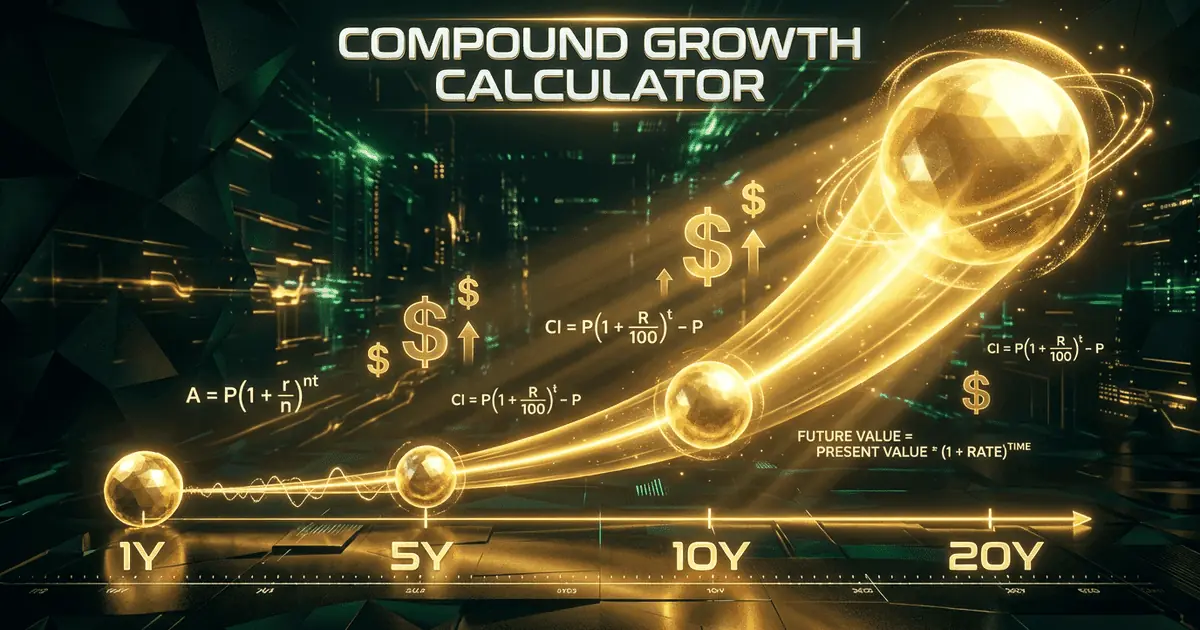
Visualize the exponential power of compound interest. The secret to wealth is not timing, it's time.
Albert Einstein reportedly once said: "Compound interest is the eighth wonder of the world. He who understands it, earns it... he who doesn't, pays it."
Why such fascination? Because the human brain is fundamentally incapable of graspingexponential growth. We think linearly (1+1+1...), while wealth builds multiplicatively (1.1 x 1.1 x 1.1...).
At first, the snowball is small. It seems to not be moving. But after a "critical mass" of time, it becomes an unstoppable force. This tool shows you exactly whenyour curve will go vertical -- and how much you lose by waiting.
Upon his death in 1790, Benjamin Franklin left an unusual gift to the cities of Boston and Philadelphia: 1,000 pounds sterling to each (about $4,400 at the time).
But there was a condition: the money had to be invested for 200 yearswithout being touched. Franklin, one of the Founding Fathers of the United States, wanted to prove a theory.
In 1990, after two centuries of compound interest, the Philadelphia fund was worth over $2 million, and the Boston fund over $5 million.
Franklin was not a magician. He was simply patient. He proved that even a small sum, multiplied by time, could fund libraries, museums, and schools for entire generations.
The mathematical formula for compound interest is:
A = Final Amount
P = Initial Capital (Principal)
r = Annual interest rate (as decimal)
n = Number of compounding periods per year
t = Number of years
The most powerful element is "t" (time), because it is in the exponent!
If you wait 10 more years to start, you will need to invest 2x to 3x moremoney each month to achieve the same result.
Someone who starts at 25 with $200/month will end up with more than someone who starts at 35 with $500/month. Time is your greatest ally.
The Rule of 72 is a powerful mental shortcut used by investors for centuries. It answers a simple question: how long does it take to double my money?
Warren Buffett, the Oracle of Omaha, is often cited as the perfect example of the snowball effect. What few people realize is that 99% of his wealth was accumulated after age 50.
The last 40 years represent 99.7% of his current wealth. Buffett started investing at age 11 and never stopped. Time did the rest.
Lesson: Patience is not simply a virtue in investing, it is the main ingredient.
20 years old, starting with $200/month. Their advantage is pure time -- 40+ years ahead.
Verdict
They will end up with more than a 50-year-old investing $1000/month. Time beats capital.
Targeting 15-20% per year via active trading, crypto, or options. High volatility.
Risk
Their snowball grows 3x faster, but a single Black Swan can break everything. Consistency is critical.
Prefers the safety of stock market indices (S&P 500, MSCI World). 8-10%/year historically.
Strategy
Uses DCA (Dollar Cost Averaging). Their wealth is a statistical certainty if they never sell in panic.
The silent enemy. If your return is 8% but inflation is 3%, your real purchasing power only grows by 5%. Always aim for assets that beat inflationover the long term (Stocks, Real Estate, Bitcoin).
Every dollar paid in taxes is a dollar that no longer compounds. That's why tax-deferred accounts (401k/IRA in the US, ISA in the UK) are massive wealth-building weapons.
A fund with 2% annual fees vs an ETF at 0.1% = hundreds of thousands of dollars in difference over 30 years. Fees compound too, but against you.
Withdrawing $10,000 at age 30 is withdrawing $100,000+ at age 60 (after compounding). Every withdrawal has a future cost you don't see.
Selling during a crash (2008, 2020, 2022) irreversibly destroys the snowball effect. Markets have always recovered historically. Those who sold lost; those who held on won.
Use the calculator above. Do you want 1 million? 500k? Calculate the required monthly contribution.
Set up an automatic transfer on payday. What you don't see, you don't spend.
401k/IRA for tax advantages, brokerage accounts for flexibility. Maximize tax benefits first.
80% in world indices (MSCI World), 10% in emerging markets, 10% in crypto if risk-tolerant.
Don't check your portfolio every day. Review once a year. Time will do the work.
The best time to plant a tree was 20 years ago. The second best time is now.
Use our trading tools to optimize your entries and maximize your annual return. Every percentage point matters when time is in the exponent.
Discover our premium NinjaTrader 8 indicators — precision-coded tools that do the heavy lifting for you.
Browse Indicators



Loading reviews...
Loading reviews