TL;DR
A pip (percentage in point) is the smallest standard unit of price movement in forex, equal to 0.0001 for most pairs and 0.01 for JPY pairs. A standard lot pip is worth approximately $10 for EUR/USD. Pips are used to measure price changes, calculate profits, and compare spreads.
Table of Contents
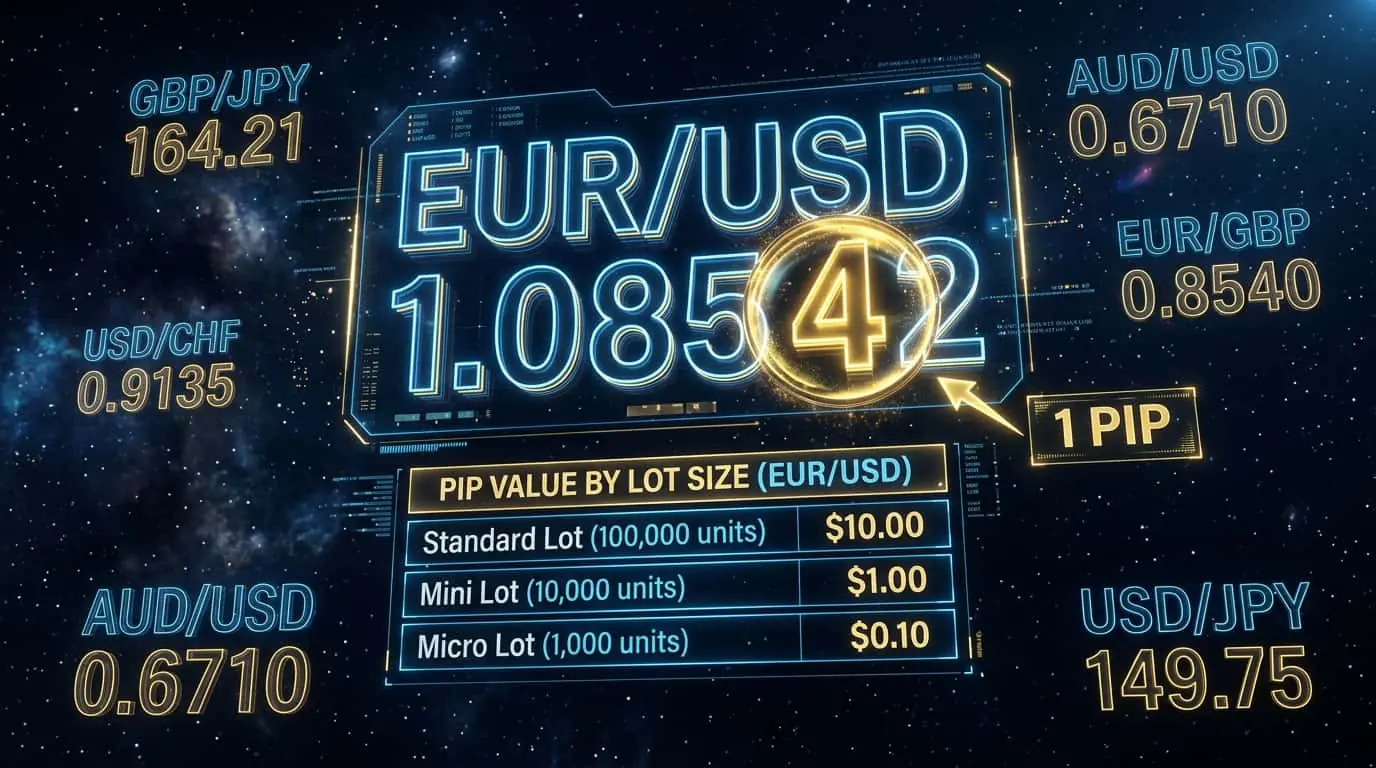
A pip (percentage in point, or price interest point) is the smallest standard unit of price movement in forex trading. For most currency pairs, a pip equals 0.0001, which is the fourth decimal place. For Japanese yen (JPY) pairs, a pip equals 0.01 (the second decimal place) because JPY is quoted with fewer decimal places. Pips are the universal language of forex trading, used to express price changes, calculate profit and loss, measure spread costs, and define stop loss and take profit distances. Understanding pip values is fundamental to forex trading because every risk and reward calculation depends on knowing how much a pip is worth in dollar terms for a given position size.
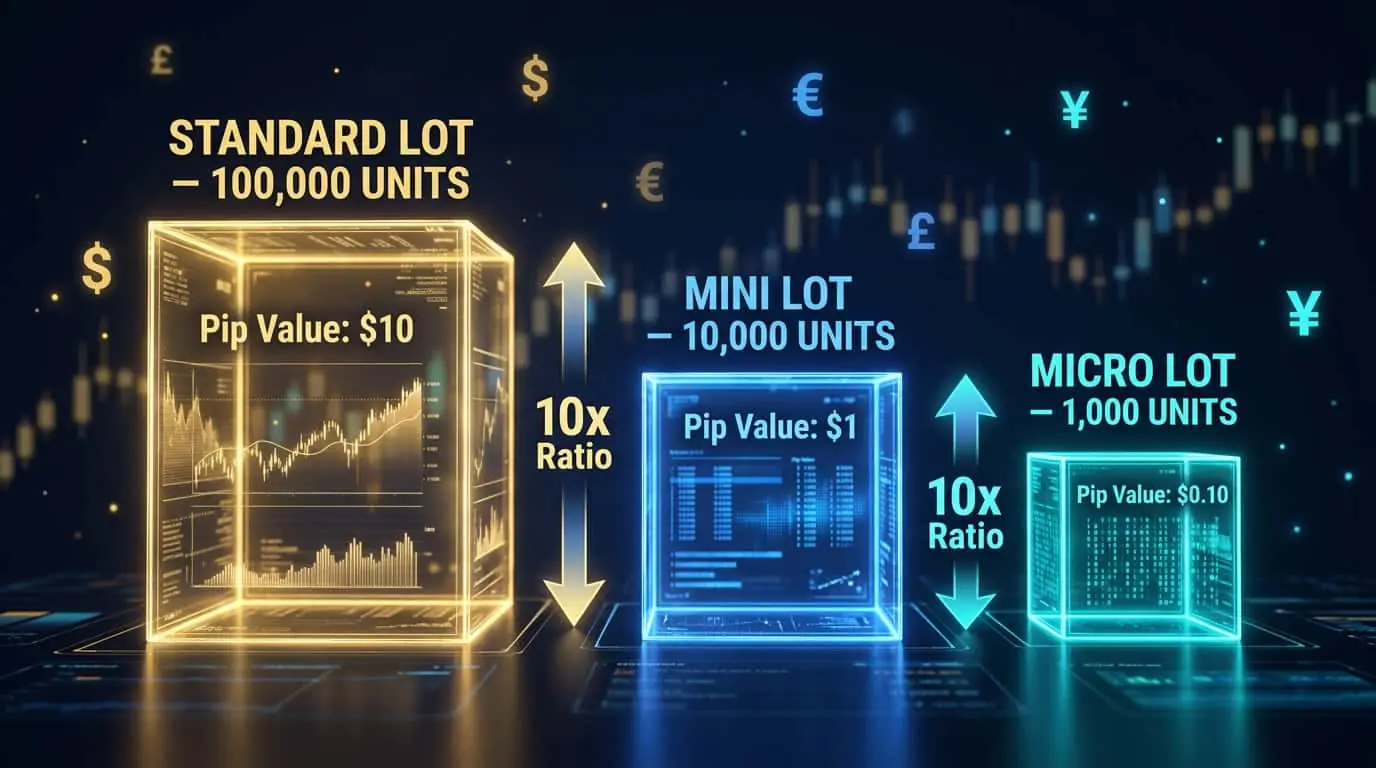
The monetary value of a pip depends on the lot size and the currency pair being traded. In forex, lot sizes are standardized: a standard lot is 100,000 units, a mini lot is 10,000 units, and a micro lot is 1,000 units. For EUR/USD (and other pairs where USD is the quote currency), the pip value is straightforward: 1 pip = 0.0001 x lot size. For a standard lot, 1 pip = 0.0001 x 100,000 = $10. For a mini lot, 1 pip = $1. For a micro lot, 1 pip = $0.10. When USD is the base currency (e.g., USD/CHF), the pip value must be converted by dividing by the current exchange rate. For cross pairs (e.g., EUR/GBP), the pip value is in the quote currency and must be converted to USD using the current exchange rate.
Pip Value = (0.0001 / Exchange Rate) x Lot Size [then convert to account currency]0.0001 — One pip (use 0.01 for JPY pairs)
Exchange Rate — Current exchange rate of the pair
Lot Size — Number of units in the position (100,000 for standard lot)
| Lot Type | Units | Pip Value (EUR/USD) | Example: 50 Pip Move |
|---|---|---|---|
| Standard | 100,000 | $10.00 | $500 |
| Mini | 10,000 | $1.00 | $50 |
| Micro | 1,000 | $0.10 | $5 |
| Nano | 100 | $0.01 | $0.50 |
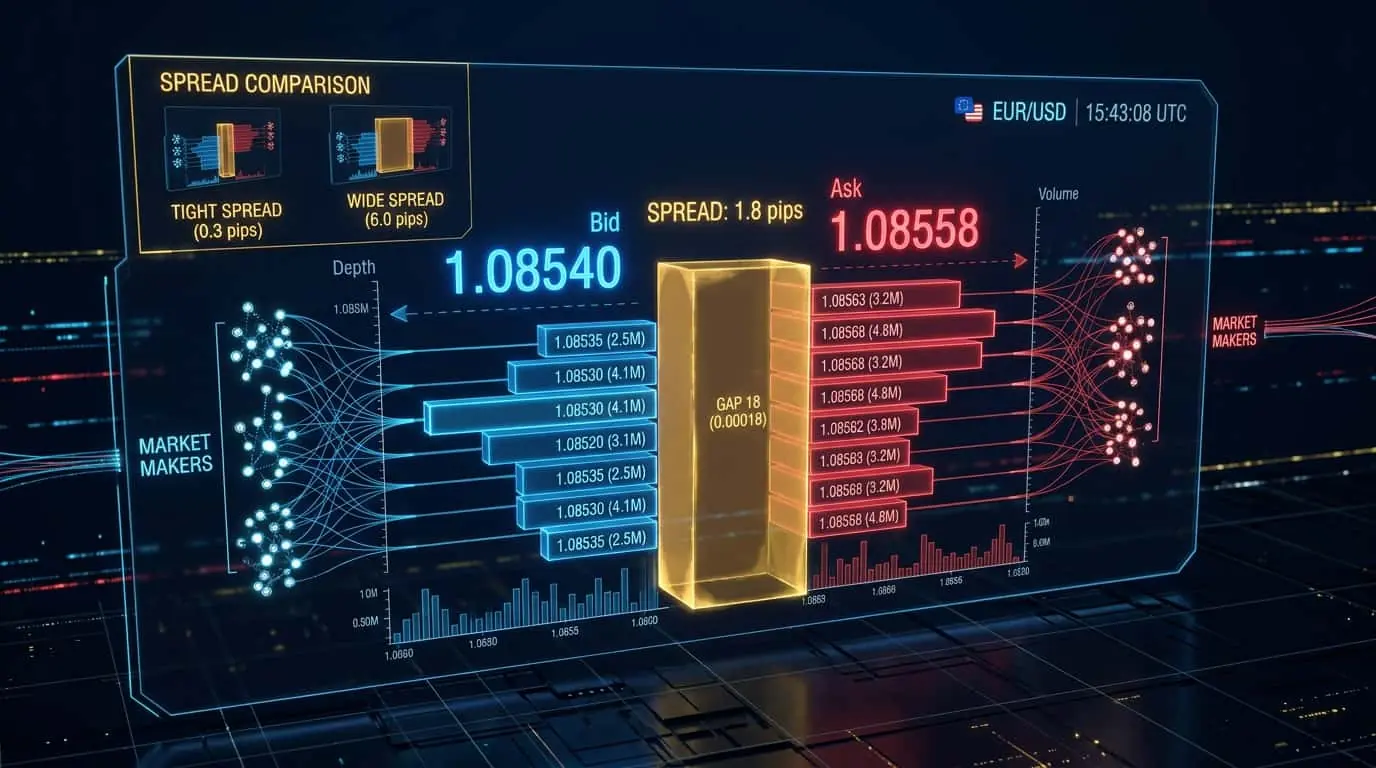
Many modern forex brokers quote prices to five decimal places (or three for JPY pairs) instead of the traditional four. The fifth decimal place is called a pipette, which equals 1/10th of a pip, or 0.00001. For example, if EUR/USD moves from 1.10505 to 1.10515, it has moved 1 pip (10 pipettes). Pipettes provide more precise pricing and tighter spreads. A broker advertising a 0.7-pip spread on EUR/USD might show this as a 7-pipette spread in the five-decimal pricing (e.g., 1.10500 ask vs. 1.10507 bid). While pipettes allow for more granular pricing, traders generally still measure their trades in full pips because pipettes are too small to be meaningful for position sizing and risk calculations.
Pro Tip
When calculating position sizes and risk, round to whole pips. Pipettes are useful for comparing broker spreads but too granular for trade management. A 23.7-pip stop should be calculated as 24 pips for position sizing.
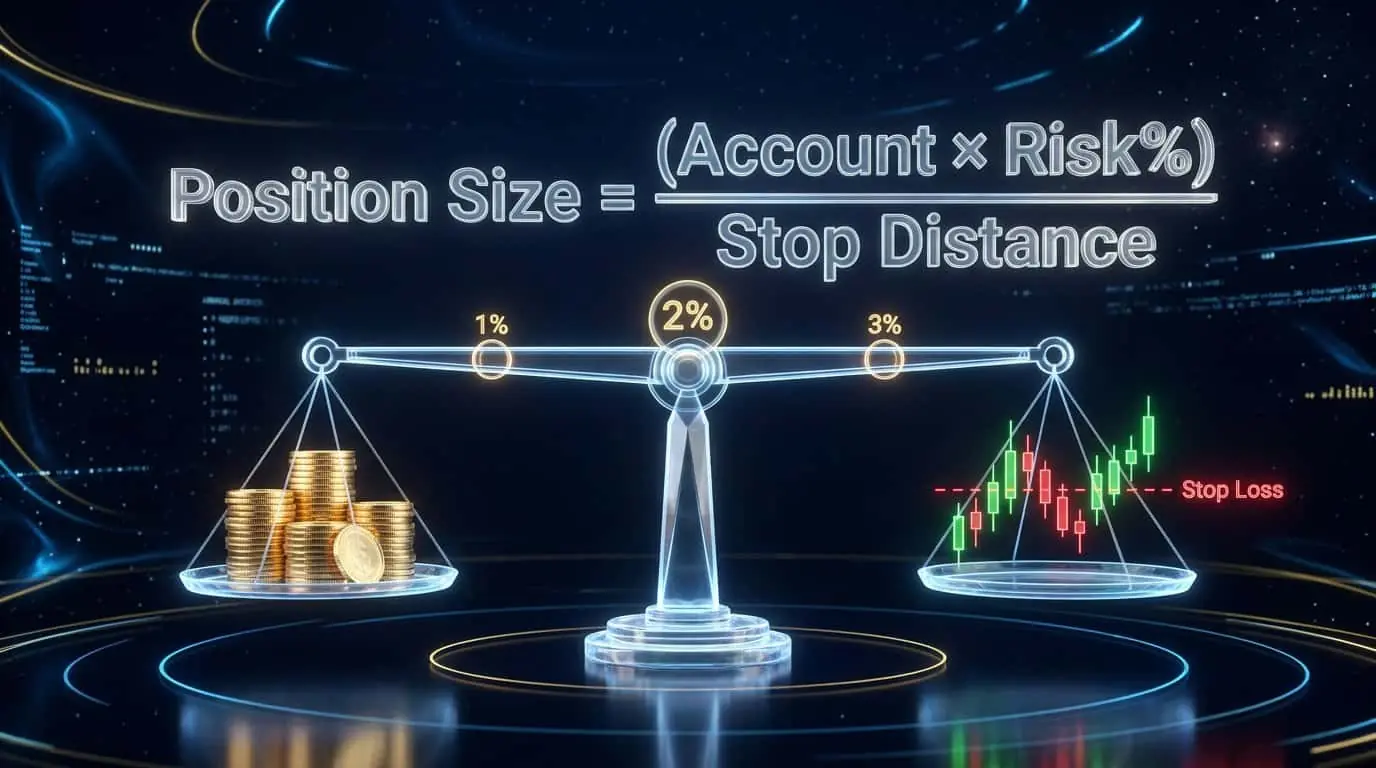
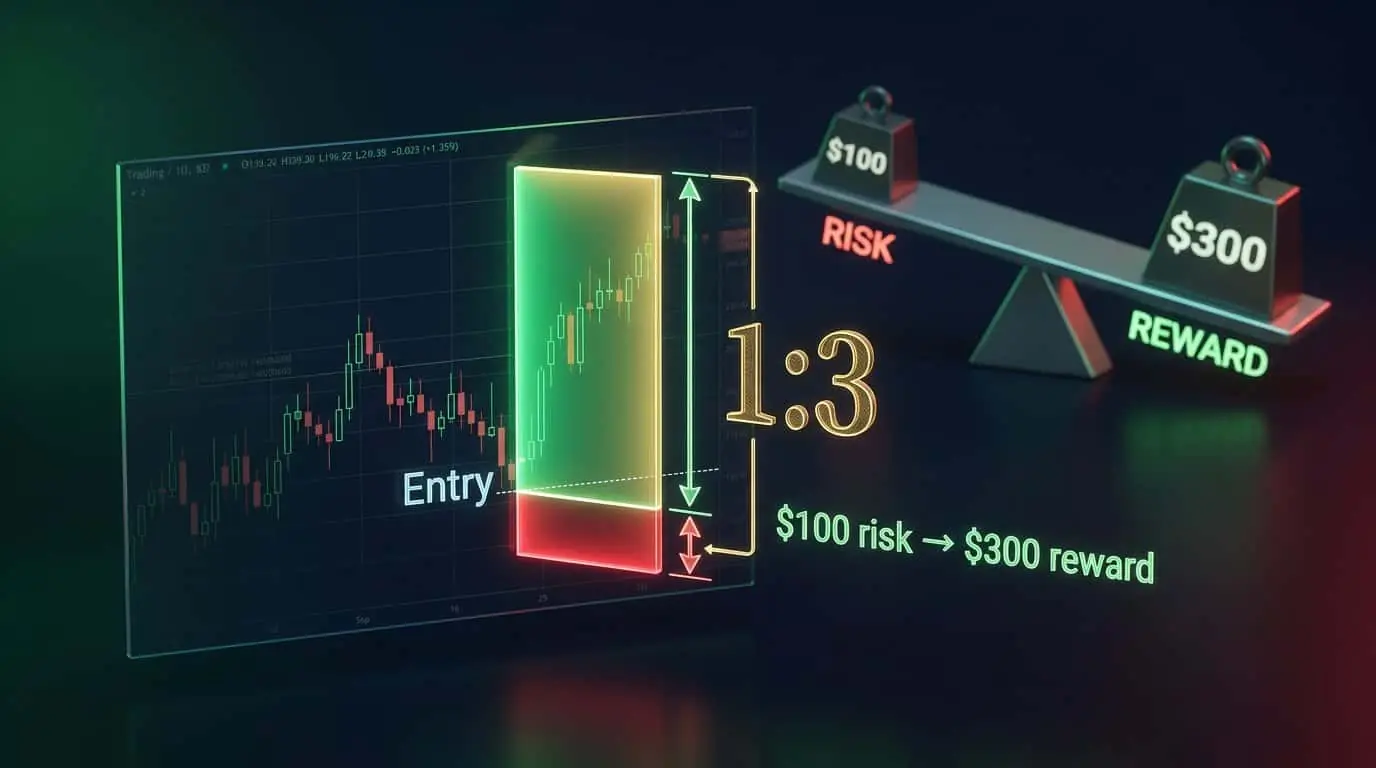
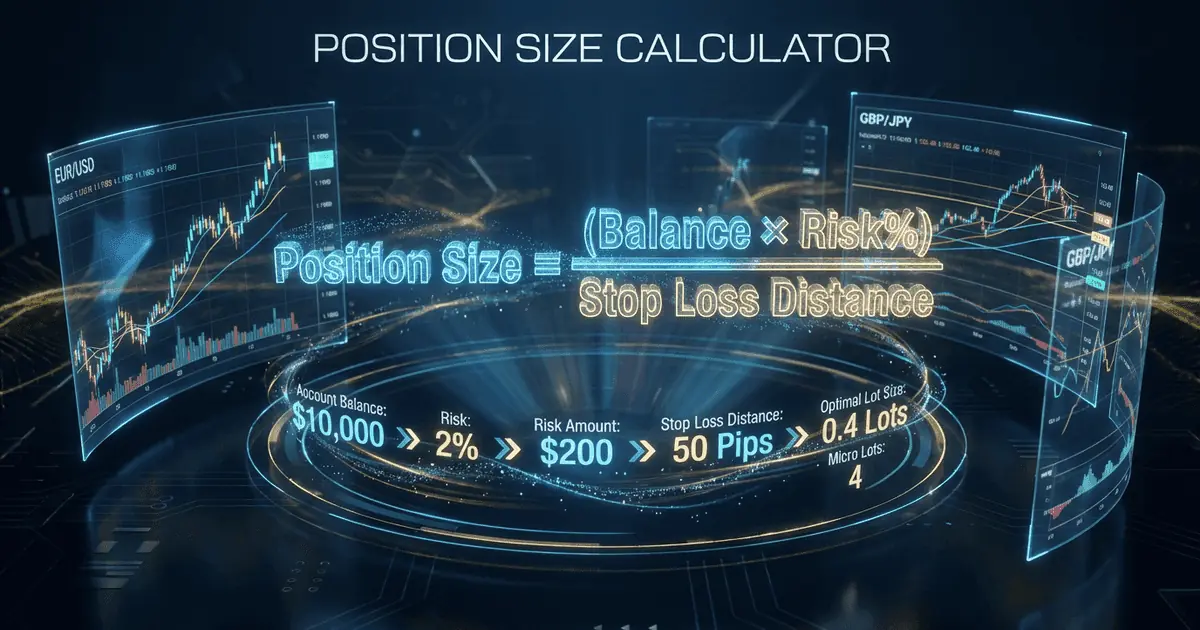
Pips are essential for three core calculations every forex trader must perform. First, profit and loss: multiply the number of pips gained or lost by the pip value for your position size. A 35-pip gain on 2 standard lots of EUR/USD = 35 x $10 x 2 = $700 profit. Second, spread cost: the spread is the difference between the bid and ask price, expressed in pips. A 1.2-pip spread on 1 standard lot costs $12 per trade. Over 200 trades per month, that is $2,400 in spread costs alone. Third, stop loss and take profit distances: a 30-pip stop loss on 1 standard lot of EUR/USD represents $300 of risk. Knowing this, you can calculate the position size needed to risk exactly 2% of a $15,000 account: $300 risk / ($15,000 x 0.02 = $300 target risk) = 1 standard lot, which is a perfect fit.
While pips are specific to forex, equivalent concepts exist in other markets. In futures, the minimum price movement is called a tick. For the E-mini S&P 500 (ES), one tick = 0.25 points = $12.50 per contract. For Crude Oil (CL), one tick = $0.01 = $10 per contract. In stocks, price movements are measured in cents (or fractions of a cent). In cryptocurrency, price movements vary by exchange and pair but are typically measured in the smallest decimal unit quoted. The concept behind pips translates to all these markets: understanding the minimum price increment and its dollar value is essential for calculating risk, position size, and profit/loss in any tradeable instrument.
| Market | Unit | Example Instrument | Dollar Value |
|---|---|---|---|
| Forex | Pip (0.0001) | EUR/USD | $10 per standard lot |
| Forex (JPY) | Pip (0.01) | USD/JPY | ~$6.50 per standard lot |
| E-mini S&P 500 | Tick (0.25 pts) | ES | $12.50 per contract |
| Crude Oil | Tick ($0.01) | CL | $10 per contract |
| E-mini Nasdaq | Tick (0.25 pts) | NQ | $5 per contract |
Calculating pip value for cross currency pairs (pairs that do not include USD) requires an extra conversion step that many traders overlook. For a pair like EUR/GBP, the pip value is denominated in GBP (the quote currency), which must then be converted to your account currency (typically USD). The formula is: Pip Value = (0.0001 / Exchange Rate of the Cross Pair) x Lot Size x Quote Currency to Account Currency Rate. For example, trading 1 standard lot of EUR/GBP at a rate of 0.8600 with GBP/USD at 1.2700: the pip value in GBP is 0.0001 / 0.8600 x 100,000 = 11.63 GBP. Converting to USD: 11.63 x 1.2700 = $14.77 per pip. This is significantly higher than the $10 pip value on EUR/USD, which surprises many traders. Similarly, for a pair like AUD/NZD at 1.0800 with NZD/USD at 0.6100: pip value = 0.0001 / 1.0800 x 100,000 = 9.26 NZD, converted to USD: 9.26 x 0.6100 = $5.65 per pip. The variation in pip values across pairs has real consequences for position sizing. A trader who always trades 1 standard lot without adjusting for different pip values is taking inconsistent risk. On EUR/GBP, a 30-pip stop represents $443 of risk, while the same 30-pip stop on AUD/NZD represents only $170. Accurate position sizing requires knowing the exact pip value for each pair at the current exchange rate before every trade. Most trading platforms calculate this automatically, but traders should verify the calculations and understand the underlying math to catch any errors.
| Cross Pair | Rate | Quote/USD Rate | Pip Value (Std Lot) | 30-Pip Risk |
|---|---|---|---|---|
| EUR/GBP | 0.8600 | GBP/USD 1.2700 | $14.77 | $443 |
| EUR/AUD | 1.6500 | AUD/USD 0.6500 | $3.94 | $118 |
| GBP/JPY | 188.00 | JPY to USD (1/150) | $5.32 | $160 |
| AUD/NZD | 1.0800 | NZD/USD 0.6100 | $5.65 | $170 |
| EUR/CHF | 0.9700 | CHF to USD (1/0.88) | $11.71 | $351 |
Pro Tip
Before trading any cross pair, check the current pip value in your account currency. Platforms like NinjaTrader display this automatically, but verifying manually prevents position sizing errors that could double or halve your intended risk.
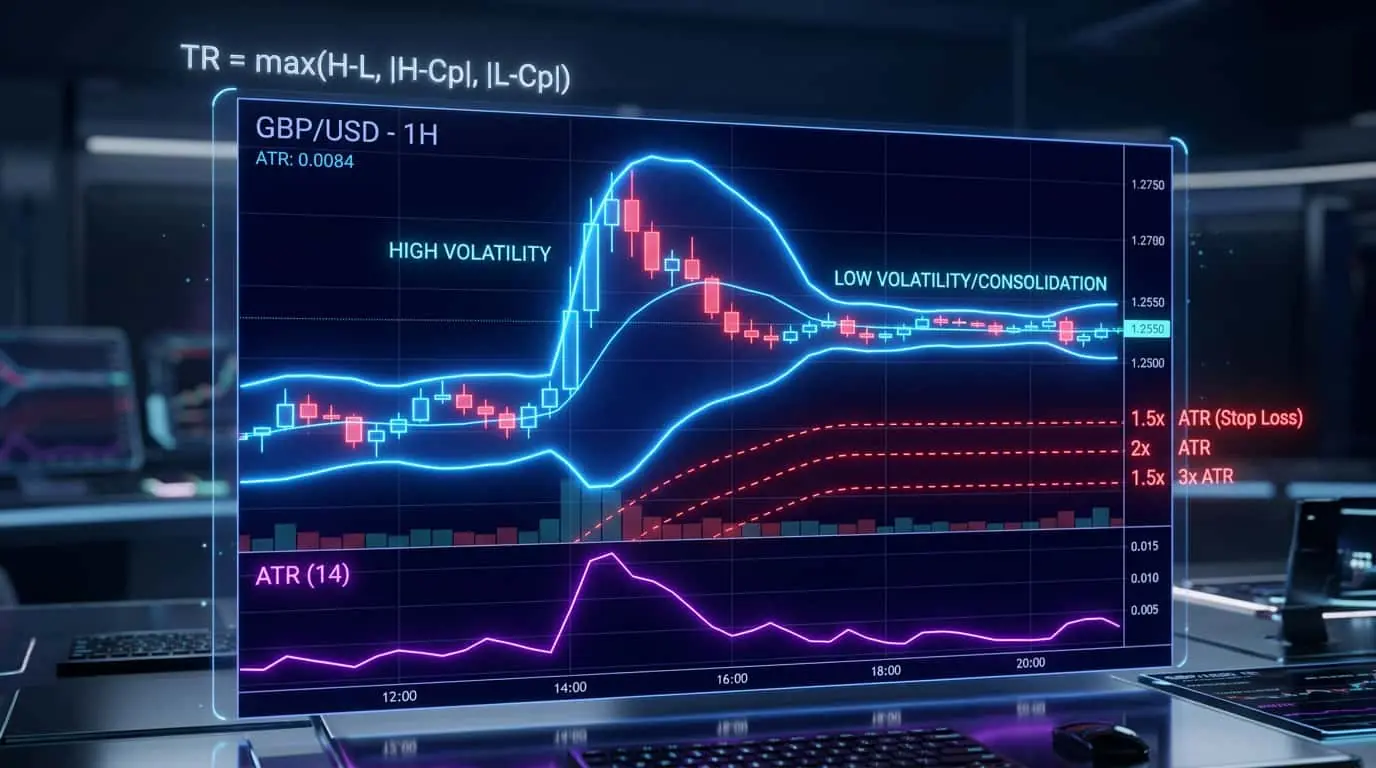
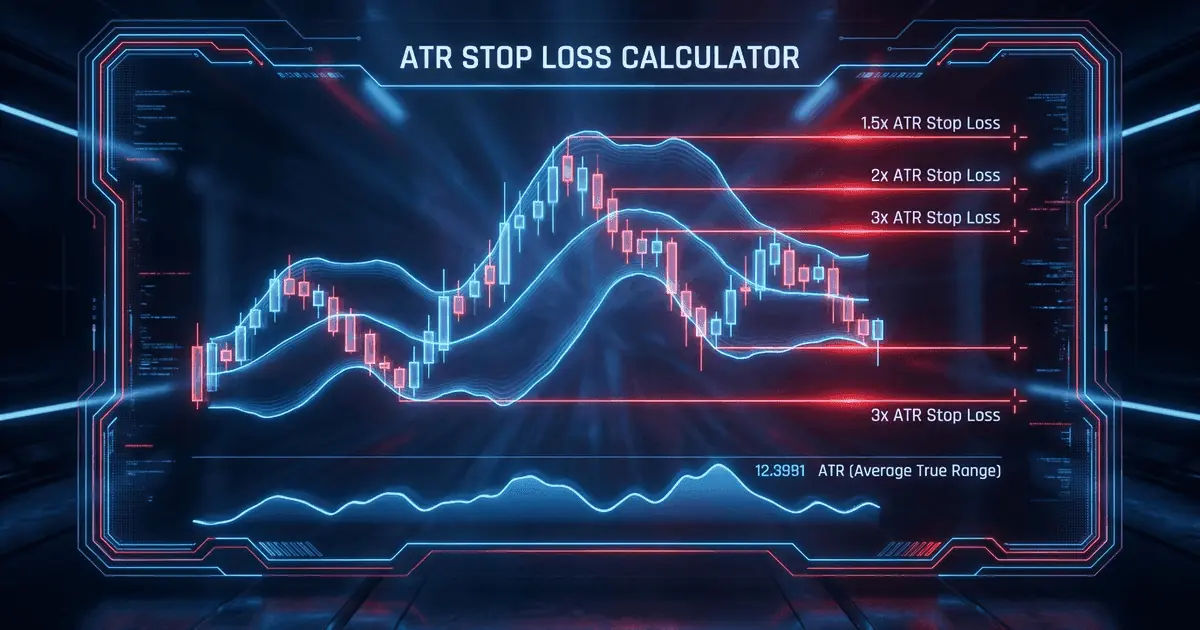
Experienced traders use pip-based benchmarks to evaluate strategy performance, set realistic goals, and compare results across different instruments and account sizes. A common professional benchmark for forex day trading is 10-30 pips of net profit per day on average. This sounds modest, but consistency is the key: 20 pips per day on a single standard lot equals $200 per day, $4,000 per month, and $48,000 per year. On two standard lots, those same 20 pips generate $96,000 annually. The power of small, consistent pip gains compounded over time is often underestimated. Spread costs should also be benchmarked in pip terms. A competitive broker offers 0.1-0.5 pip spreads on EUR/USD during London/New York sessions. If your strategy targets 10 pips per trade with a 0.3-pip spread, you are paying 3% of your target to costs. If the spread is 1.5 pips, you are paying 15% — a fivefold difference that significantly impacts profitability. Stop loss distances in pip terms reveal a strategy's sensitivity to market noise. A 5-pip stop on EUR/USD is extremely tight and will be triggered frequently by normal market fluctuations, resulting in many unnecessary losses. A 20-30 pip stop provides room for normal price oscillation while still maintaining reasonable risk. Studies of retail forex traders consistently show that most losses come from stops that are too tight (under 10 pips) relative to the volatility of the pair being traded. The Average True Range (ATR) indicator, which measures a pair's typical daily range in pips, is the best tool for calibrating stop distances. If EUR/USD has a 60-pip daily ATR, a 10-pip stop represents only 16% of the daily range, meaning it will likely be hit by noise. A stop of 1.0-1.5x ATR (60-90 pips in this case) provides adequate breathing room for swing trades.
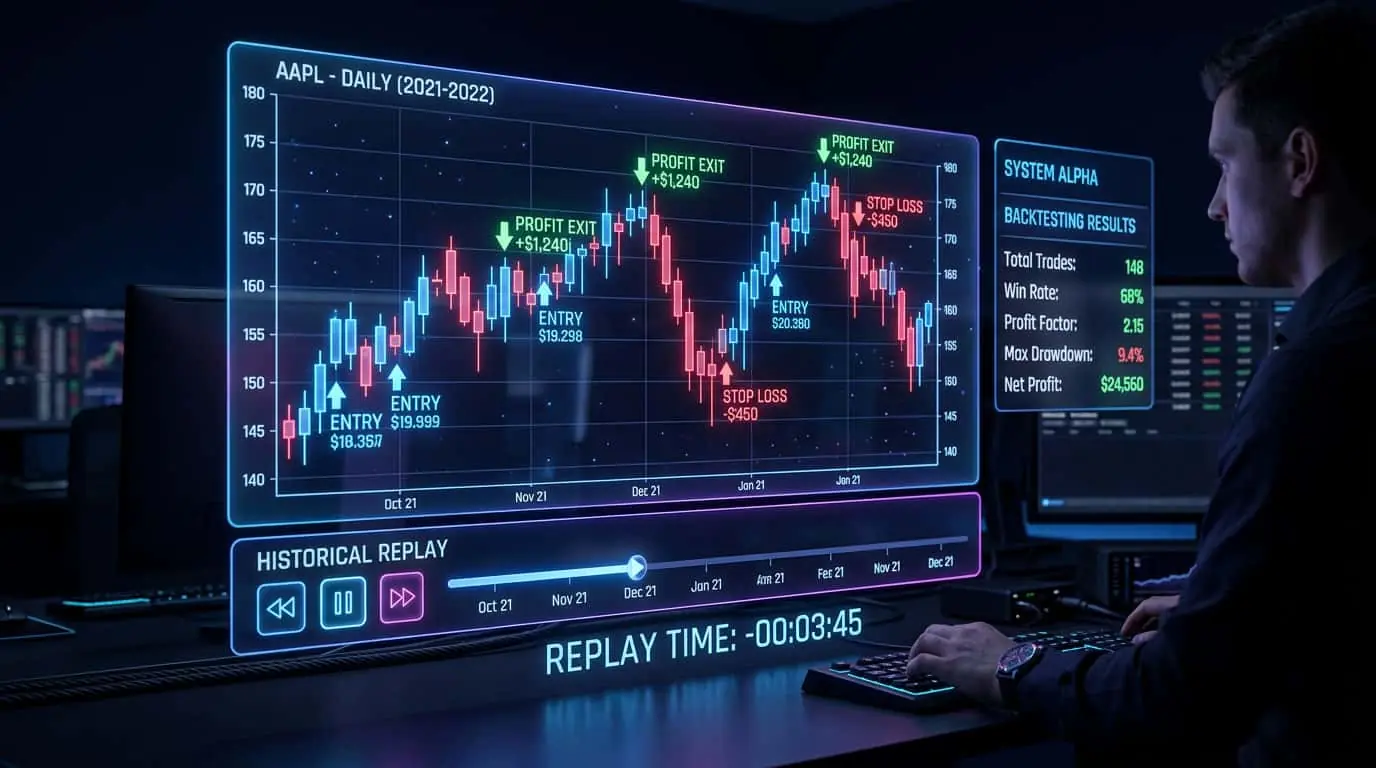
The pip system evolved alongside the forex market itself. In the early days of electronic forex trading in the 1990s, most pairs were quoted to four decimal places, and the pip (the fourth decimal) was the smallest tradeable increment. Spreads were wide by modern standards — often 3-5 pips on EUR/USD even for institutional traders, and 5-10 pips for retail clients. The introduction of ECN (Electronic Communication Network) platforms in the early 2000s brought interbank liquidity directly to retail traders, compressing spreads dramatically. By 2010, competitive brokers were offering sub-1-pip spreads on major pairs. The move to five-decimal pricing (pipettes) around 2005-2010 allowed even more granular quoting, enabling spreads of 0.1-0.3 pips during liquid sessions. This evolution has fundamentally changed the economics of forex trading. Strategies that were unprofitable 20 years ago due to wide spreads are now viable because of dramatically reduced costs. Scalping, which requires ultra-tight spreads, was essentially impossible for retail traders before ECN pricing. Today, a retail trader can access the same 0.1-pip spreads that were once exclusive to major banks. However, this evolution also means that historical backtest data from pre-2010 may include spreads that are much wider than current conditions, making those backtest results look worse than the strategy would perform today. When backtesting strategies on historical data, adjust the spread assumptions to reflect the era of the data: use 3-5 pips for pre-2005 data, 1-2 pips for 2005-2015, and 0.1-0.5 pips for 2015 and later on major pairs.
Pro Tip
When running backtests on older data, adjust spread assumptions to match the era. Using modern 0.2-pip spreads on year-2000 data will overestimate performance. Conversely, using old 3-pip spreads on modern data will underestimate it. Match the cost assumptions to the data period for accurate results.
Mistake
Confusing pips with pipettes (points) when calculating position size
Correction
Verify whether your platform displays prices in 4 or 5 decimal places. A 50-point move on a 5-decimal platform equals only 5 pips. Miscounting can lead to position sizes that are 10x too large or too small.
Mistake
Ignoring spread costs in profitability calculations
Correction
The spread is a cost paid on every trade. A 1.5-pip spread on 200 trades per month with mini lots costs $300 per month. Include spread costs when calculating your net profit factor and expectancy.