TL;DR
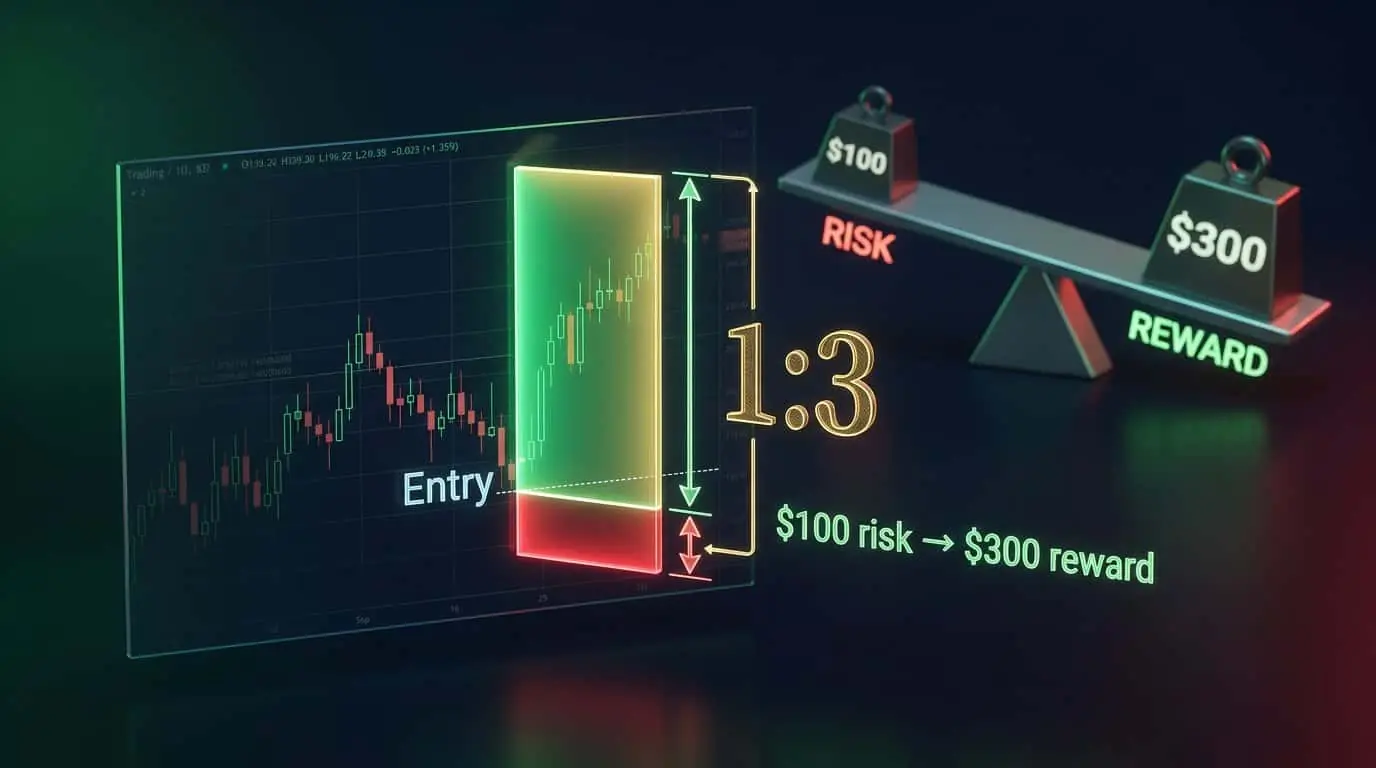
Risk-reward ratio (R:R) compares the potential loss to the potential profit of a trade. A 1:3 R:R means you risk $1 to make $3. Combined with win rate, it determines whether a strategy is mathematically profitable over time.
Table of Contents
Risk-reward ratio (R:R) is a measure that compares the potential loss of a trade to its potential profit. It is expressed as a ratio such as 1:2 or 1:3, meaning you risk one unit to potentially gain two or three units. The risk-reward ratio is a foundational concept for evaluating whether a trade is worth taking, and it is one of the two variables (along with win rate) that determine whether a trading strategy has positive expectancy. When traders refer to a 1:2 R:R, they mean the potential reward is twice the potential risk. Some traders express this as simply '2R,' where R represents one unit of risk. A trade that returns 3R means it made three times the original risk amount. This R-multiple framework allows traders to compare results across different instruments and account sizes because everything is normalized to units of risk rather than dollar amounts.
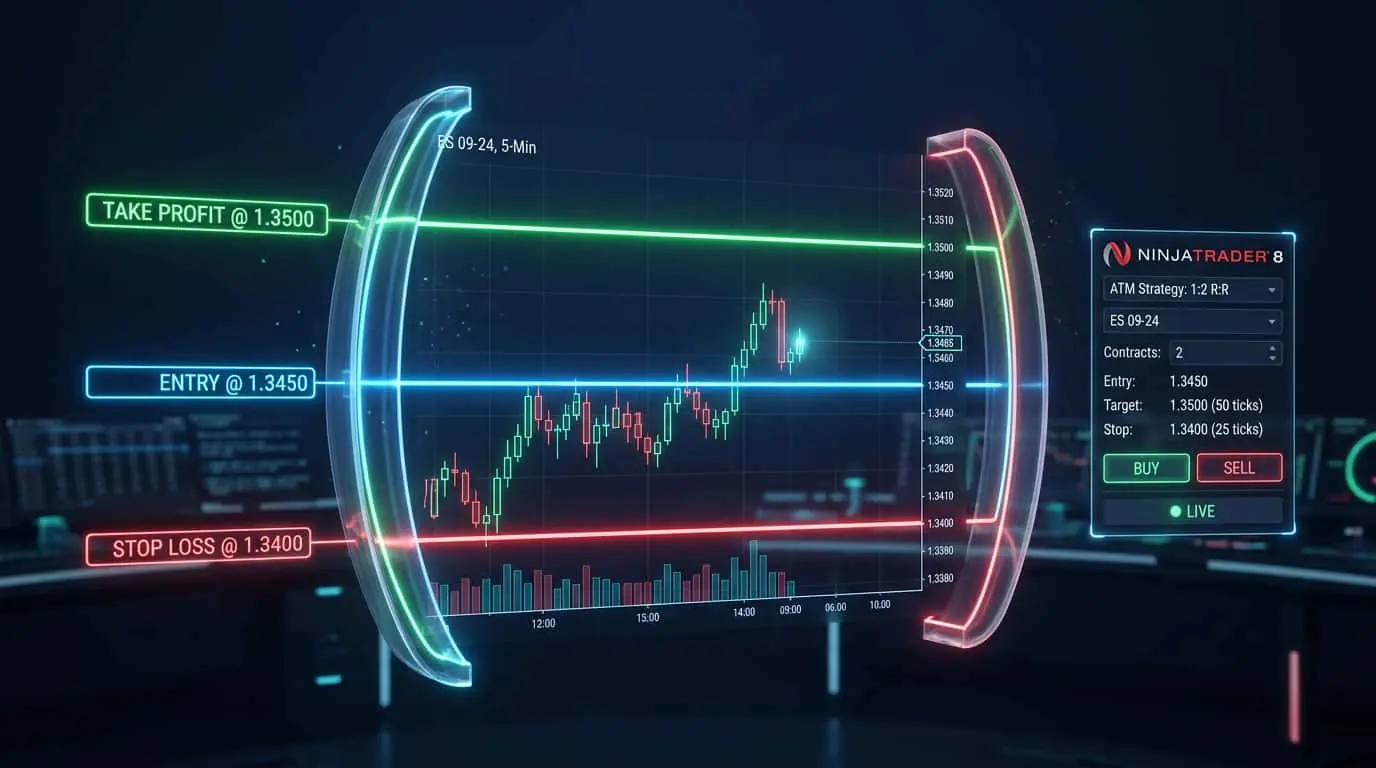
The risk-reward ratio is calculated by dividing the distance between your entry and stop loss (risk) by the distance between your entry and take profit (reward). The calculation is purely based on price levels and is independent of position size. For a long trade, risk is the entry price minus the stop loss price, and reward is the take profit price minus the entry price. For a short trade, risk is the stop loss price minus the entry price, and reward is the entry price minus the take profit price. It is important to measure the actual distances in the same unit (pips, points, or dollars) to get an accurate ratio.
R:R = Risk / Reward = (Entry - Stop Loss) / (Take Profit - Entry)Entry — The price at which you enter the trade
Stop Loss — The price at which you exit if the trade goes against you
Take Profit — The price at which you exit with a profit
Pro Tip
Most professional traders will not take a trade with a risk-reward ratio worse than 1:1.5. Aiming for 1:2 or better gives you a significant mathematical edge over time.
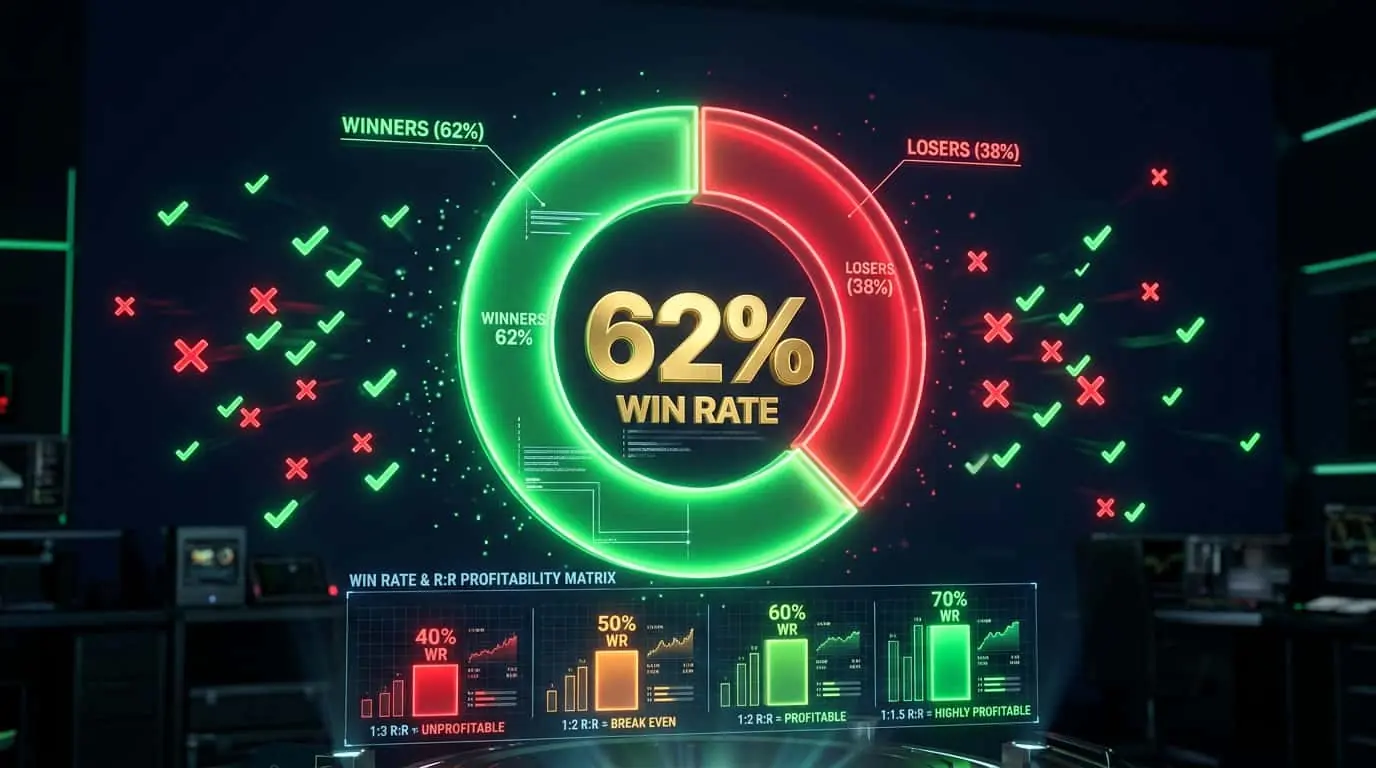
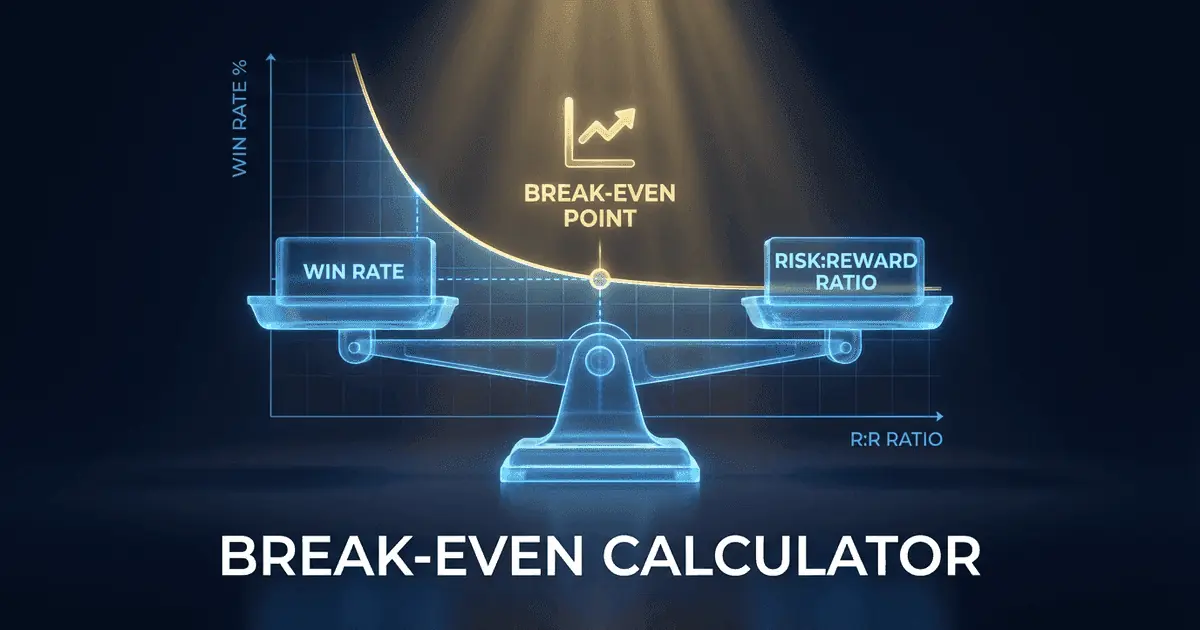
Risk-reward ratio and win rate are inseparable. Neither metric is meaningful in isolation. A 90% win rate sounds impressive, but if the average loss is 10 times the average win, the strategy is a net loser. Conversely, a 30% win rate can be highly profitable if the average win is 5 times the average loss. The break-even win rate for any given R:R can be calculated, and understanding this relationship is what separates professional traders from amateurs. At a 1:1 R:R, you need to win more than 50% of trades to be profitable (slightly more than 50% to cover commissions). At 1:2 R:R, you only need a 33.3% win rate to break even. At 1:3 R:R, the break-even win rate drops to 25%. This mathematical reality means that traders with favorable R:R ratios can be wrong most of the time and still make money.
Break-Even Win Rate = 1 / (1 + R:R)R:R — The reward-to-risk ratio (e.g., 2 for a 1:2 ratio)
| Risk:Reward | Break-Even Win Rate | Strategy Type |
|---|---|---|
| 1:1 | 50.0% | Scalping, high-frequency |
| 1:1.5 | 40.0% | Day trading |
| 1:2 | 33.3% | Swing trading |
| 1:3 | 25.0% | Trend following |
| 1:5 | 16.7% | Position trading |
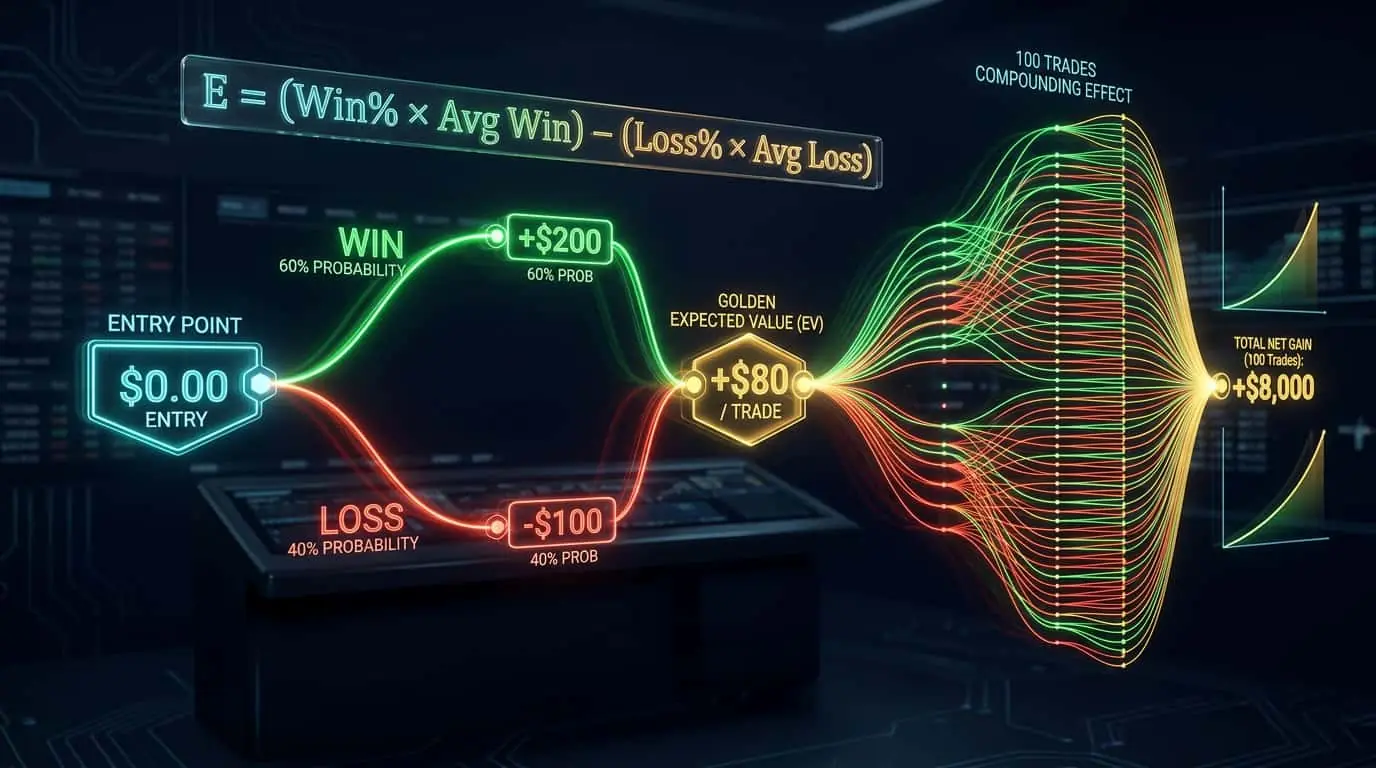
Expectancy is the average amount you expect to win (or lose) per trade, expressed in R-multiples. It is the ultimate measure of whether a strategy is worth trading. The formula combines win rate and R:R into a single number. A positive expectancy means the strategy makes money over time; a negative expectancy means it loses money. For example, a strategy with a 45% win rate and 1:2 R:R has an expectancy of (0.45 x 2) - (0.55 x 1) = 0.90 - 0.55 = 0.35R. This means for every dollar risked, you expect to earn $0.35 on average over many trades. Over 100 trades risking $200 each, expected profit is 100 x $200 x 0.35 = $7,000. Expectancy must be calculated after commissions and slippage to be meaningful. A strategy with 0.35R expectancy before costs might drop to 0.20R or less after accounting for real trading expenses.
Expectancy = (Win Rate x Average Win in R) - (Loss Rate x Average Loss in R)Win Rate — Percentage of winning trades as a decimal
Average Win in R — Average winning trade expressed as a multiple of risk
Loss Rate — 1 minus the win rate
Average Loss in R — Typically 1R if using consistent stop losses
Different trading styles naturally gravitate toward different risk-reward ratios. Scalpers typically aim for 1:1 to 1:1.5 R:R with high win rates (60-75%) because they take many trades per day and need quick, reliable profits. Day traders usually target 1:1.5 to 1:2.5 R:R with moderate win rates (45-60%), balancing frequency with reward size. Swing traders often seek 1:2 to 1:4 R:R because they hold trades for days to weeks and can capture larger price moves. Trend followers may target 1:3 to 1:10+ R:R ratios, accepting very low win rates (25-35%) in exchange for occasional massive winners that more than compensate for frequent small losses. The key is that your target R:R must match your trading style and psychological profile. A trend follower who cannot handle losing 7 out of 10 trades will abandon their strategy during a losing streak, regardless of its mathematical edge.
Pro Tip
Choose a trading style whose R:R profile matches your personality. If you hate being wrong, pursue higher win rate strategies with lower R:R. If you can tolerate frequent losses, trend following with high R:R may suit you better.
The most common mistake with risk-reward ratio is using it as the sole criterion for taking trades. A 1:10 R:R looks amazing on paper, but if the take profit target is unrealistic, the trade will almost never reach its target. The R:R must be based on logical price levels (support, resistance, Fibonacci levels) rather than arbitrary targets. Another pitfall is moving stop losses further away to create a more favorable R:R on paper. This defeats the purpose because you are now risking more per trade while creating an illusion of better reward. Similarly, some traders move their take profit closer to guarantee a win, destroying their R:R in the process. The risk-reward ratio should be determined by the market structure and your analysis before you enter the trade, not adjusted after entry to make the numbers look better.
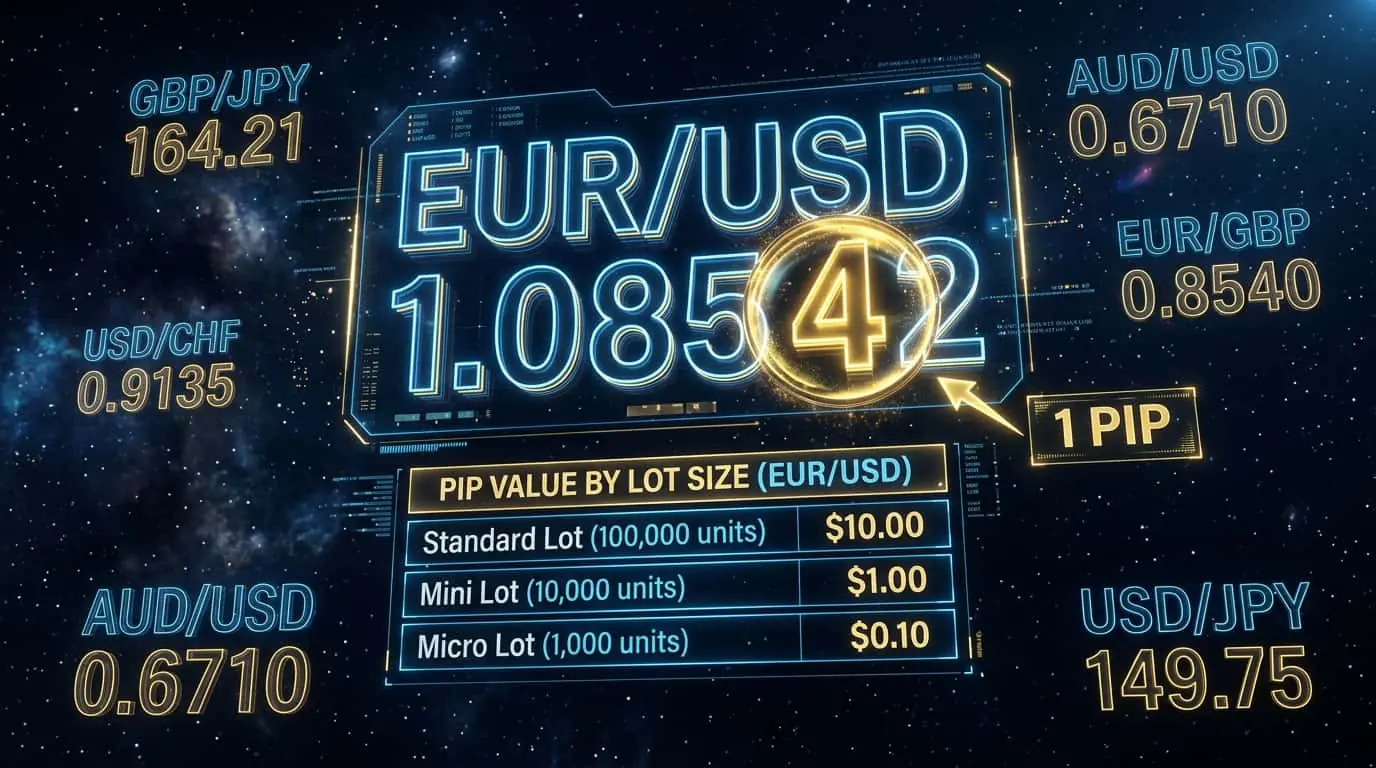
Understanding risk-reward ratio in practice requires seeing how it applies across different instruments and setups. Consider a futures day trader working on the E-mini S&P 500 (ES) using NinjaTrader. They identify a long setup at 5,050 with a stop loss at 5,042 (8 points of risk, or $400 per contract at $50/point). If their take profit target is 5,066 (16 points of reward, or $800 per contract), the R:R is 1:2. They need to win only 34% of these trades to break even before commissions. Now consider a forex swing trader going long EUR/USD at 1.0850 with a stop at 1.0800 (50 pips of risk) and a target at 1.1000 (150 pips of reward). This creates a 1:3 R:R, meaning the trader only needs a 25% win rate to break even. Over 20 such trades, if 7 win (35% win rate), the result is: 7 wins x 150 pips = 1,050 pips gained, minus 13 losses x 50 pips = 650 pips lost, for a net gain of 400 pips. A crude oil (CL) scalper might use tighter parameters: entry at $72.50, stop at $72.40 (10 ticks of risk, or $100 per contract at $10/tick), and a target at $72.65 (15 ticks of reward, or $150 per contract). This 1:1.5 R:R requires a 40% win rate to break even. The scalper compensates for the lower R:R by achieving a higher win rate of 55-65% through precise intraday entries.
| Market | Entry | Stop Loss | Take Profit | R:R | Break-Even WR |
|---|---|---|---|---|---|
| ES (futures) | 5,050 | 5,042 (-8 pts) | 5,066 (+16 pts) | 1:2 | 33.3% |
| EUR/USD (forex) | 1.0850 | 1.0800 (-50 pips) | 1.1000 (+150 pips) | 1:3 | 25.0% |
| CL (crude oil) | $72.50 | $72.40 (-10 ticks) | $72.65 (+15 ticks) | 1:1.5 | 40.0% |
| NQ (Nasdaq futures) | 18,200 | 18,175 (-25 pts) | 18,275 (+75 pts) | 1:3 | 25.0% |
| Gold (GC) | $2,340 | $2,335 (-50 ticks) | $2,350 (+100 ticks) | 1:2 | 33.3% |
Pro Tip
When planning trades in NinjaTrader, use the ruler tool on your chart to measure the exact distance from entry to stop loss and entry to take profit. This gives you the precise R:R before you commit capital, eliminating guesswork.
One of the most powerful applications of risk-reward ratio is using R-multiples as the foundation of your trading journal. Instead of tracking results in dollar amounts (which vary with position size and account balance), record every trade outcome as a multiple of R, where 1R is the amount you risked. A trade that hit your stop loss is -1R. A trade that reached a 1:2 target is +2R. A trade you exited early at half the target is +1R. This normalization allows you to evaluate your strategy independently of account size and provides a universal language for comparing performance across time periods, instruments, and strategies. To calculate your system's expectancy in R-multiples, sum all R-values and divide by the total number of trades. For example, over 50 trades with results of: 20 wins averaging +2.1R and 30 losses averaging -1R, the expectancy is [(20 x 2.1) + (30 x -1)] / 50 = [42 + (-30)] / 50 = 12 / 50 = 0.24R. This means you earn $0.24 for every $1 risked on average. Track your R-multiple distribution over time: a strategy with consistent positive expectancy (0.2R or higher) across 200+ trades is a strategy worth scaling up. If expectancy dips below 0.1R over a rolling 100-trade window, it may signal that market conditions have shifted and the strategy needs adjustment.
For traders using NinjaTrader 8, risk-reward ratio is deeply integrated into both discretionary and automated trading workflows. In the NinjaTrader Strategy Builder and NinjaScript, you can define your stop loss and profit target in ticks, points, or currency, and the platform automatically calculates and enforces the R:R for every trade. When backtesting a strategy in NinjaTrader's Strategy Analyzer, the performance report includes metrics directly tied to R:R: the ratio of average winning trade to average losing trade (which is the realized R:R), profit factor (gross profits divided by gross losses), and the payoff ratio. A strategy with an average winning trade of $600 and an average losing trade of $300 has a realized R:R of 1:2, regardless of the target R:R you set in the code. Comparing your target R:R to your realized R:R reveals important information: if your target is 1:2 but your realized R:R is only 1:1.3, it means many trades are being closed before hitting the full target (due to trailing stops, time exits, or manual intervention). This gap between target and realized R:R is a key diagnostic metric. In NinjaScript, you set the R:R directly using SetStopLoss and SetProfitTarget methods. For example, SetStopLoss(CalculationMode.Ticks, 20) combined with SetProfitTarget(CalculationMode.Ticks, 40) creates a 1:2 R:R. You can then use the Strategy Analyzer's optimization feature to test different R:R ratios (1:1.5, 1:2, 1:2.5, 1:3) and identify the ratio that maximizes net profit or profit factor for your specific entry logic.
Pro Tip
In NinjaTrader's Strategy Analyzer, run an optimization on your profit target parameter while keeping the stop loss fixed. This reveals the R:R ratio that maximizes expectancy for your specific entry signals and the instruments you trade.
Mistake
Setting unrealistic take profit targets to inflate the R:R
Correction
Base take profit levels on market structure such as support/resistance zones, Fibonacci levels, or ATR multiples. The target must be a price the market can realistically reach.
Mistake
Evaluating R:R without considering win rate
Correction
Always calculate expectancy by combining R:R with your strategy's historical win rate. A 1:5 R:R is worthless if your win rate is only 10%.
Mistake
Moving stop losses after entry to change the R:R
Correction
Determine your stop loss and take profit before entering the trade. Moving stops further away increases risk; moving targets closer reduces reward. Both destroy the edge your analysis identified.