TL;DR
Commission is the fee charged by a broker for executing a trade. It can be a fixed amount per trade, per lot, or per contract. Combined with spread and slippage, commissions form the total cost of trading. High-frequency strategies are most sensitive to commission costs.
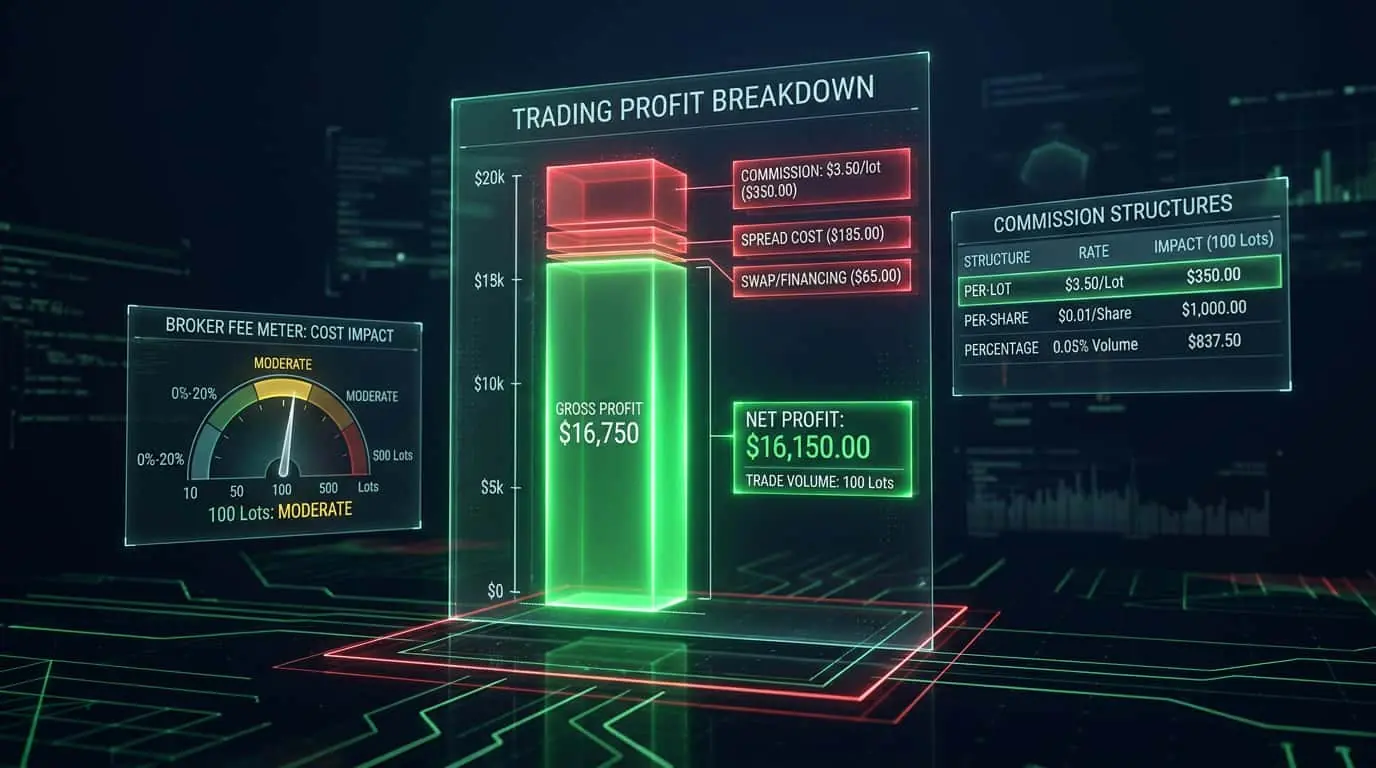
A commission is a fee charged by a broker for executing a buy or sell order on behalf of a trader. Commissions are one of the three main trading costs (alongside spread and slippage) and directly reduce trading profits. Commission structures vary by broker, market, and account type. Some brokers charge commissions on both entry and exit (round trip), while others include the cost in a wider spread (zero-commission models). Understanding your broker's commission structure is essential for accurate profitability calculations. For high-frequency traders and scalpers, the difference between $3 and $7 per round trip per lot can mean the difference between a profitable and unprofitable strategy.
Different markets have different typical commission structures. In forex, ECN brokers charge commissions per lot per side (typically $2.50-$5.00 per standard lot per side, or $5-$10 round trip) in addition to raw spreads. Standard account brokers typically charge no commission but widen the spread to compensate. In futures, commissions are charged per contract per side. NinjaTrader Brokerage charges approximately $0.53 per side for micro contracts and $1.29 per side for standard contracts. Interactive Brokers charges $0.85 per side for standard contracts. In stocks, many US brokers now offer zero-commission trading (Robinhood, Charles Schwab, Fidelity), though they may receive payment for order flow. Options typically carry per-contract commissions of $0.50-$0.65 plus a base fee. Crypto exchanges charge a percentage of trade value (0.01%-0.10% for makers, 0.02%-0.20% for takers).
| Market | Typical Commission | Commission Per |
|---|---|---|
| Forex (ECN) | $5-$10 | Round trip per standard lot |
| Forex (standard) | $0 (spread markup) | Included in spread |
| Futures (standard) | $2.00-$4.50 | Round trip per contract |
| Futures (micro) | $0.50-$1.50 | Round trip per contract |
| US Stocks | $0 (most brokers) | Per trade (zero commission) |
| Options | $0.50-$0.65 | Per contract plus base fee |
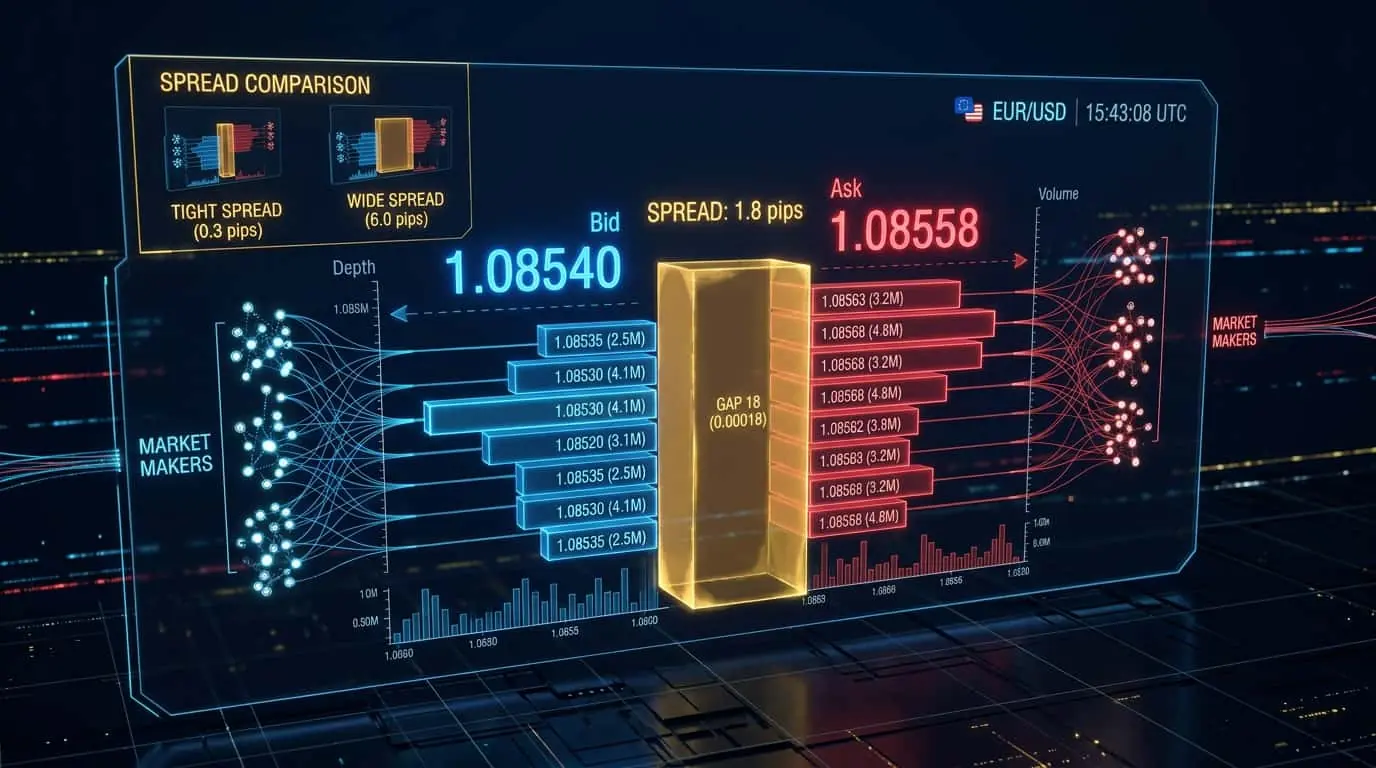
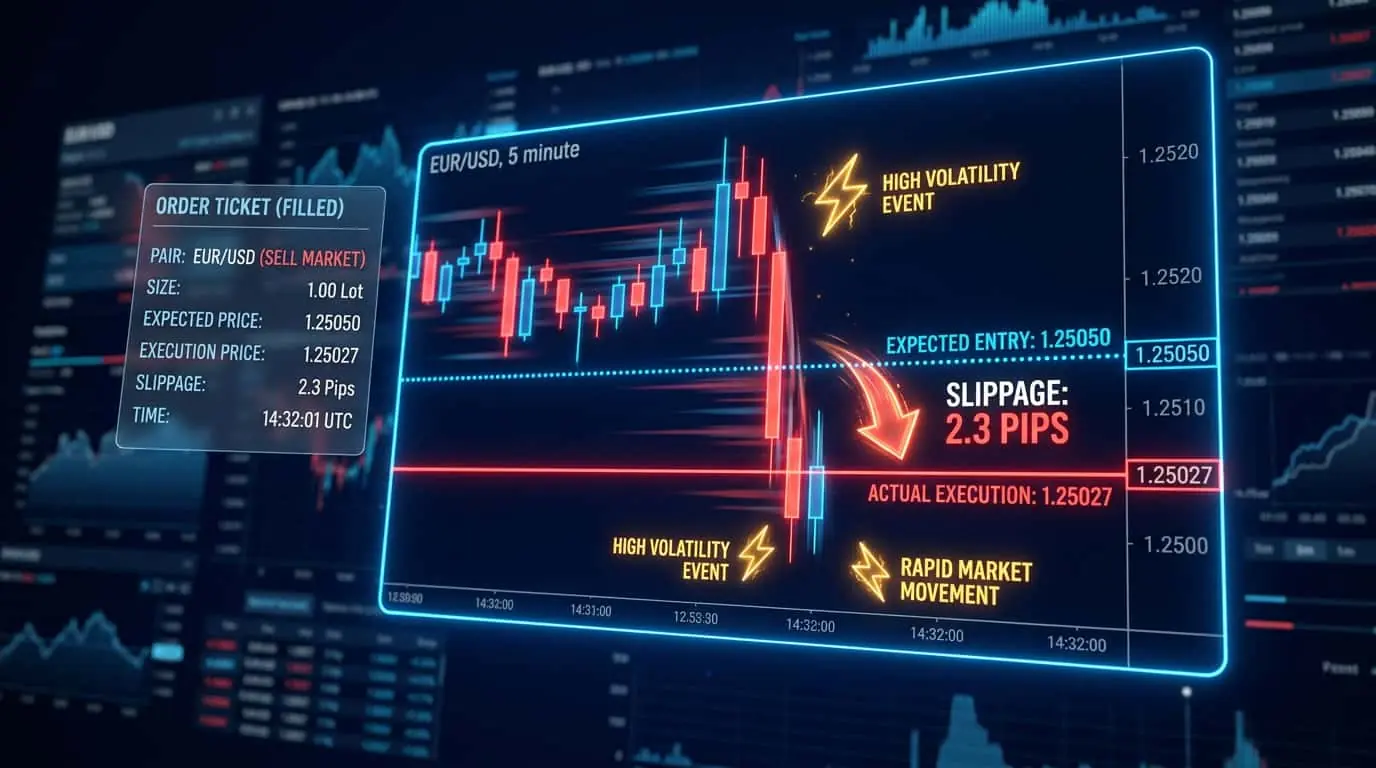
To understand the true cost of trading, you must combine all three cost components: spread, commission, and slippage. The formula converts everything to the same unit (typically pips or dollars) for comparison. For a forex ECN account with a 0.3-pip average spread, $7 round-trip commission per standard lot (0.7 pips), and 0.5 pips expected slippage, the total cost per trade is 0.3 + 0.7 + 0.5 = 1.5 pips. For a standard account with 1.5-pip average spread, $0 commission, and 0.5 pips slippage, the total cost is 2.0 pips. In this comparison, the ECN account is 25% cheaper despite having a commission. For futures, a trader paying $4.00 round trip per ES contract with 1 tick slippage ($12.50) has a total cost of $16.50 per round trip. Over 5 trades per day for 20 trading days, the monthly cost is 5 x 20 x $16.50 = $1,650.
Total Cost per Trade = Spread + Commission (in pips) + Expected SlippageSpread — The bid-ask spread in pips or dollars
Commission — Broker commission converted to pips or dollars
Expected Slippage — Average slippage per trade in pips or dollars
Pro Tip
Convert all costs to the same unit and multiply by your trade frequency to calculate monthly and annual costs. If total costs exceed 20% of your expected gross profit, look for ways to reduce costs (lower-spread broker, fewer trades, or larger price targets).
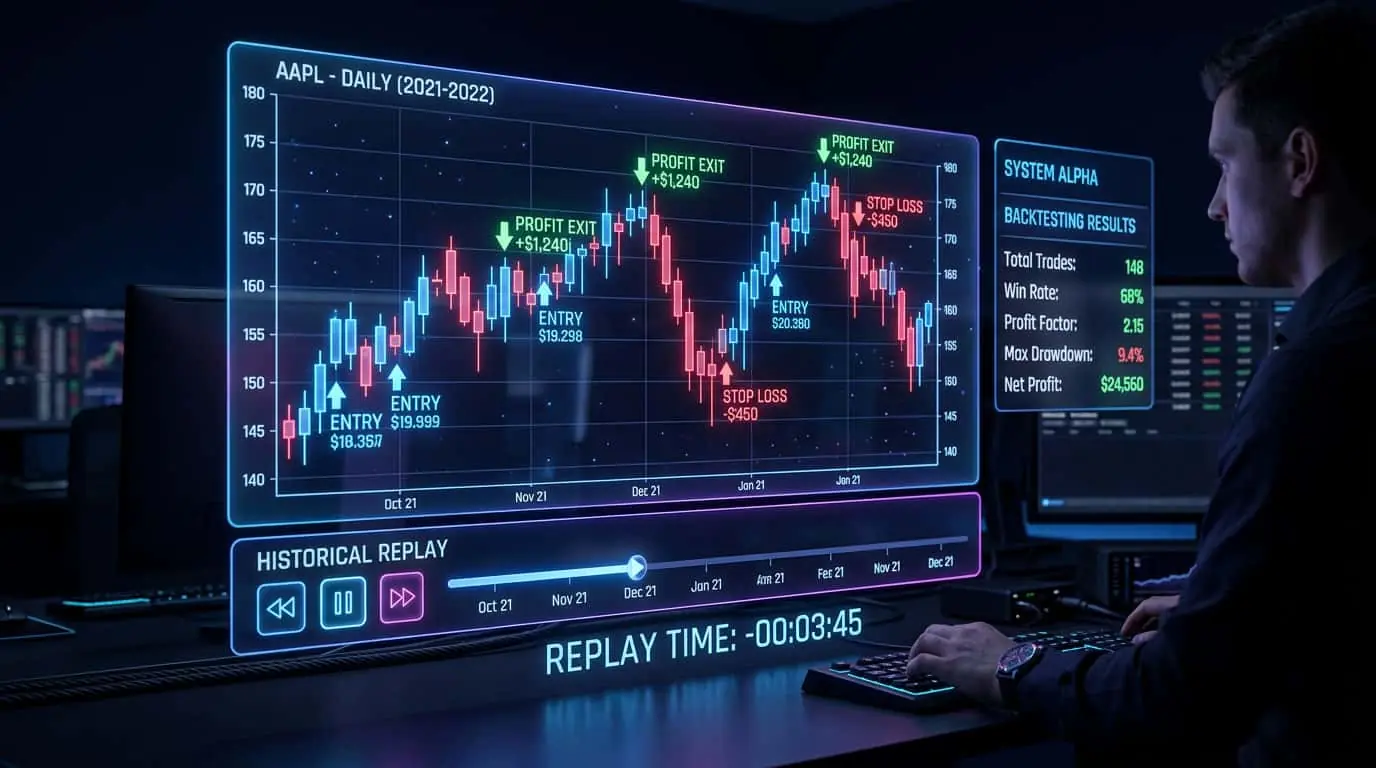
Commission costs have different impacts depending on your trading style and target size. A scalper targeting 3-pip moves with 1.5 pips in total costs loses 50% of each potential win to costs. The same costs have minimal impact on a swing trader targeting 100-pip moves (only 1.5% of the target). This is why high-frequency strategies require the lowest possible trading costs to be viable. When designing or selecting a strategy, calculate the ratio of total costs to average target size. If costs exceed 10-15% of your average winning trade, the strategy may not be viable after costs. Many promising strategies that look profitable in backtesting without costs become unprofitable when realistic commissions, spreads, and slippage are included.
| Strategy Type | Avg Target | Total Cost 1.5 pips | Cost as % of Target |
|---|---|---|---|
| Scalping | 3-5 pips | 1.5 pips | 30-50% |
| Day trading | 15-30 pips | 1.5 pips | 5-10% |
| Swing trading | 50-200 pips | 1.5 pips | 0.75-3% |
| Position trading | 200-1000+ pips | 1.5 pips | < 0.75% |
Many traders accept their broker's default commission rate without realizing that rates are often negotiable, especially for active traders. Most brokers offer tiered commission structures where higher monthly trading volume qualifies for lower rates. For example, a futures broker might charge $4.00 per round trip for fewer than 500 contracts per month, $3.50 for 500-2,000 contracts, and $2.50 for 2,000+ contracts. The savings at higher tiers are substantial: a trader executing 1,000 contracts per month saves ($4.00 - $3.50) x 1,000 = $500 per month by qualifying for the next tier. Over a year, that is $6,000 in savings from the same trades. In forex, ECN brokers often have negotiable rates for accounts that generate significant monthly volume. A trader generating $5 million+ in monthly notional volume can typically negotiate commissions from the standard $7 per round trip per standard lot down to $4-$5. Some brokers also offer rebate programs that return a portion of the spread or commission to high-volume traders. Beyond volume-based discounts, consider these strategies for reducing commission costs: consolidate all trading with a single broker to maximize volume tier benefits, use a broker that specializes in your market (futures-focused brokers typically offer lower futures commissions than multi-asset brokers), compare total costs (commission plus spread) rather than commission alone, and consider the commission structure (per-share vs. per-trade for stocks, per-lot vs. per-trade for forex). For NinjaTrader users, NinjaTrader Brokerage offers some of the lowest commission rates for futures trading: $0.09 per micro contract per side with a NinjaTrader license, which is approximately $0.18 round trip. At this rate, trading 50 MES contracts per day costs only $9.00 in commissions — a significant advantage for active futures traders.
| Volume Tier (Futures) | Commission/RT | Monthly Trades (1000) | Annual Savings vs Base |
|---|---|---|---|
| Base rate (< 500/mo) | $4.00 | $4,000 | $0 (baseline) |
| Tier 2 (500-2000/mo) | $3.50 | $3,500 | $6,000 |
| Tier 3 (2000-5000/mo) | $3.00 | $3,000 | $12,000 |
| Tier 4 (5000+/mo) | $2.50 | $2,500 | $18,000 |
| NinjaTrader (MES) | $0.18 | $180 | $45,840 |
Pro Tip
Contact your broker directly and ask about volume-based discounts. Many brokers have unpublished rates for active traders. If you trade 500+ contracts per month, you have significant negotiating leverage. Get quotes from multiple brokers and use the best offer as leverage in negotiations.
Trading commissions are tax-deductible business expenses in most jurisdictions, which means proper record-keeping can reduce your effective tax burden. In the United States, commissions paid on investment trades are included in the cost basis of purchases and reduce the proceeds of sales, directly reducing taxable gains. For active traders who qualify for trader tax status (Section 475 mark-to-market election), commissions can be deducted as ordinary business expenses on Schedule C, which provides more favorable treatment than capital gains adjustments. To maintain proper records, download monthly commission reports from your broker (most provide downloadable CSV or PDF statements). Track commissions separately for each account and instrument. For futures traders using Section 1256 contracts (which receive the 60/40 tax treatment: 60% long-term capital gains, 40% short-term), commissions reduce the net gain subject to this favorable treatment. A trader who pays $15,000 in annual commissions and faces a 30% combined tax rate effectively reduces their commission cost to $10,500 after the tax deduction — a $4,500 savings. For this reason, accurate commission tracking is not just a performance analysis tool but a financial necessity. Use your broker's annual tax documents (Form 1099-B in the US) combined with your own records to ensure all commissions are properly accounted for when filing taxes. Consider consulting a tax professional who specializes in trader taxation, especially if you trade in multiple markets or jurisdictions, as the rules for commission deductibility can vary significantly.
Mistake
Choosing a broker based on zero commissions without comparing total costs
Correction
Compare total trading costs (spread + commission + slippage) across brokers. A $7 round-trip commission with a 0.2-pip spread is cheaper than zero commission with a 2-pip spread.
Mistake
Ignoring commissions in profit/loss calculations
Correction
Subtract commissions from every winning trade and add them to every losing trade. A $200 winning trade with $14 in round-trip commissions is actually a $186 win. Track net P&L, not gross P&L.