TL;DR
Candlestick patterns are visual representations of price action within a specific time period, showing the open, high, low, and close. Specific patterns like hammers, engulfing candles, and dojis signal potential reversals or continuations that traders use to time entries and exits.
Candlestick patterns are formations on price charts that consist of one or more Japanese candlesticks, used to predict future price direction. Japanese candlestick charting was developed by Japanese rice trader Munehisa Homma in the 18th century, making it one of the oldest forms of technical analysis. Each candlestick displays four data points: the opening price, closing price, highest price, and lowest price for a specific time period. The rectangular body of the candle represents the range between the open and close, while the thin lines extending from the body (called wicks or shadows) show the high and low. If the close is above the open, the candle is bullish (typically displayed as green or white). If the close is below the open, the candle is bearish (typically displayed as red or black). Individual candlesticks and multi-candle patterns provide insights into market psychology and the balance of power between buyers and sellers.
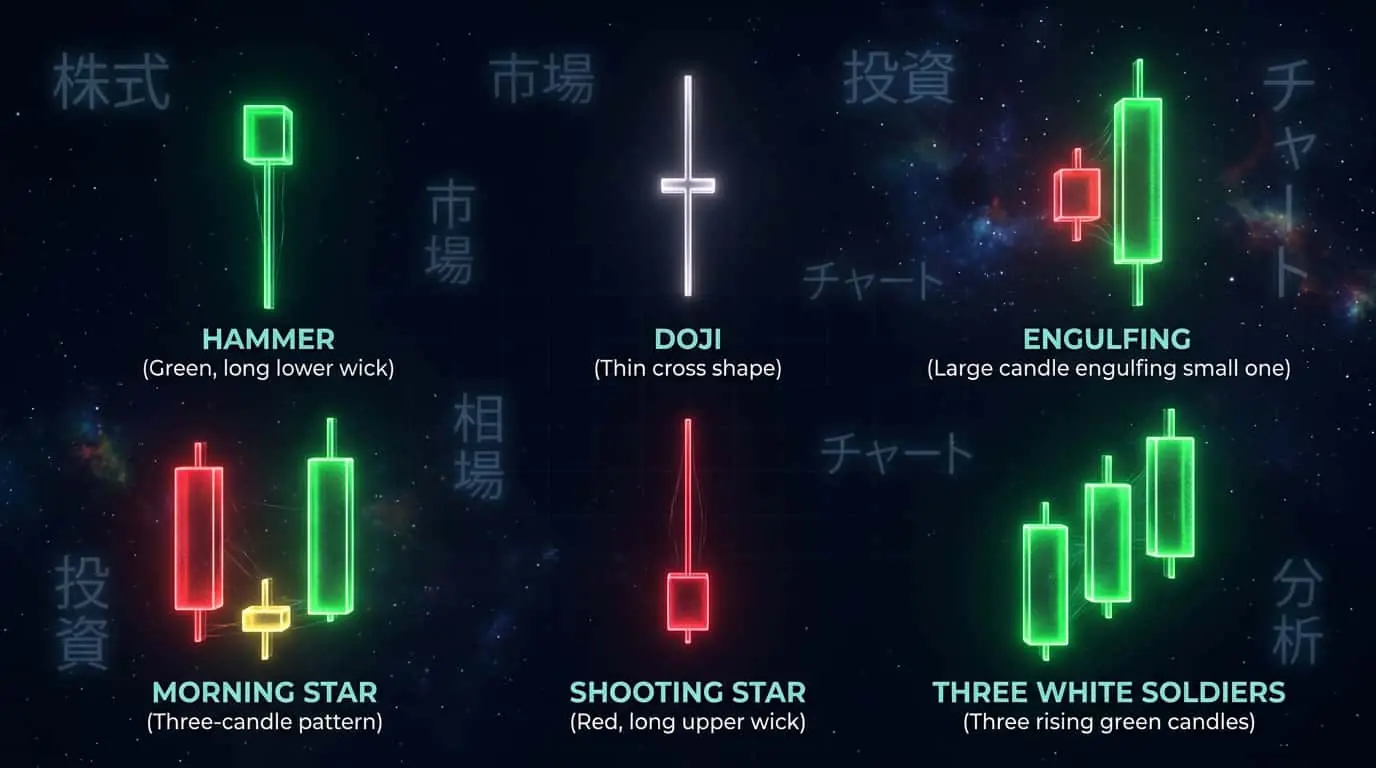
Single candlestick patterns are the foundation of candlestick analysis. The Hammer appears at the bottom of a downtrend and has a small body at the top with a long lower wick (at least twice the body length). It indicates that sellers pushed price down significantly during the period, but buyers stepped in and pushed it back near the open, signaling potential bullish reversal. The Shooting Star is the inverse of a hammer and appears at the top of an uptrend: a small body at the bottom with a long upper wick. The Doji has nearly equal open and close prices, creating a cross shape. It represents indecision and is significant when it appears after a strong move, suggesting the trend may be exhausting. The Marubozu is a long candle with no wicks, indicating complete domination by buyers (bullish) or sellers (bearish) with no intra-period reversal.
| Pattern | Location | Signal | Key Feature |
|---|---|---|---|
| Hammer | Bottom of downtrend | Bullish reversal | Long lower wick, small body at top |
| Shooting Star | Top of uptrend | Bearish reversal | Long upper wick, small body at bottom |
| Doji | After extended moves | Indecision/reversal | Open and close nearly equal |
| Marubozu | Any position | Strong continuation | Full body, no wicks |
| Inverted Hammer | Bottom of downtrend | Bullish reversal | Long upper wick at bottom |
Multi-candlestick patterns involve two or three candles and provide stronger signals than single candle patterns. The Bullish Engulfing pattern consists of a small bearish candle followed by a larger bullish candle whose body completely engulfs the previous candle's body. This indicates that buying pressure has overwhelmed selling pressure. The Bearish Engulfing is the opposite: a small bullish candle followed by a larger bearish candle. The Morning Star is a three-candle bullish reversal pattern: a long bearish candle, a small-bodied candle (showing indecision), and a long bullish candle that closes well into the first candle's body. The Evening Star is the bearish equivalent. The Tweezer pattern consists of two candles with matching highs (tweezer top, bearish) or matching lows (tweezer bottom, bullish). These multi-candle patterns are more reliable than single candle patterns because they show a clear shift in market control over multiple periods.
Pro Tip
Engulfing patterns are the most reliable multi-candle reversal patterns, especially when they occur at key support or resistance levels with above-average volume. The bigger the engulfing candle relative to the previous candle, the stronger the signal.
Not all candlestick patterns signal reversals. Continuation patterns indicate that the current trend is likely to resume after a brief pause. The Three White Soldiers pattern consists of three consecutive long bullish candles, each closing near its high and opening within the previous candle's body. It signals strong buying pressure and trend continuation in an uptrend. The Three Black Crows is the bearish equivalent: three consecutive long bearish candles, each closing near its low. The Rising Three Methods pattern shows a long bullish candle, followed by three small-bodied bearish candles that stay within the range of the first candle, and then another long bullish candle that closes above the high of the first. This represents a temporary pause in buying before the uptrend resumes. Falling Three Methods is the bearish equivalent. These patterns are less common than reversal patterns but are very reliable when they appear.
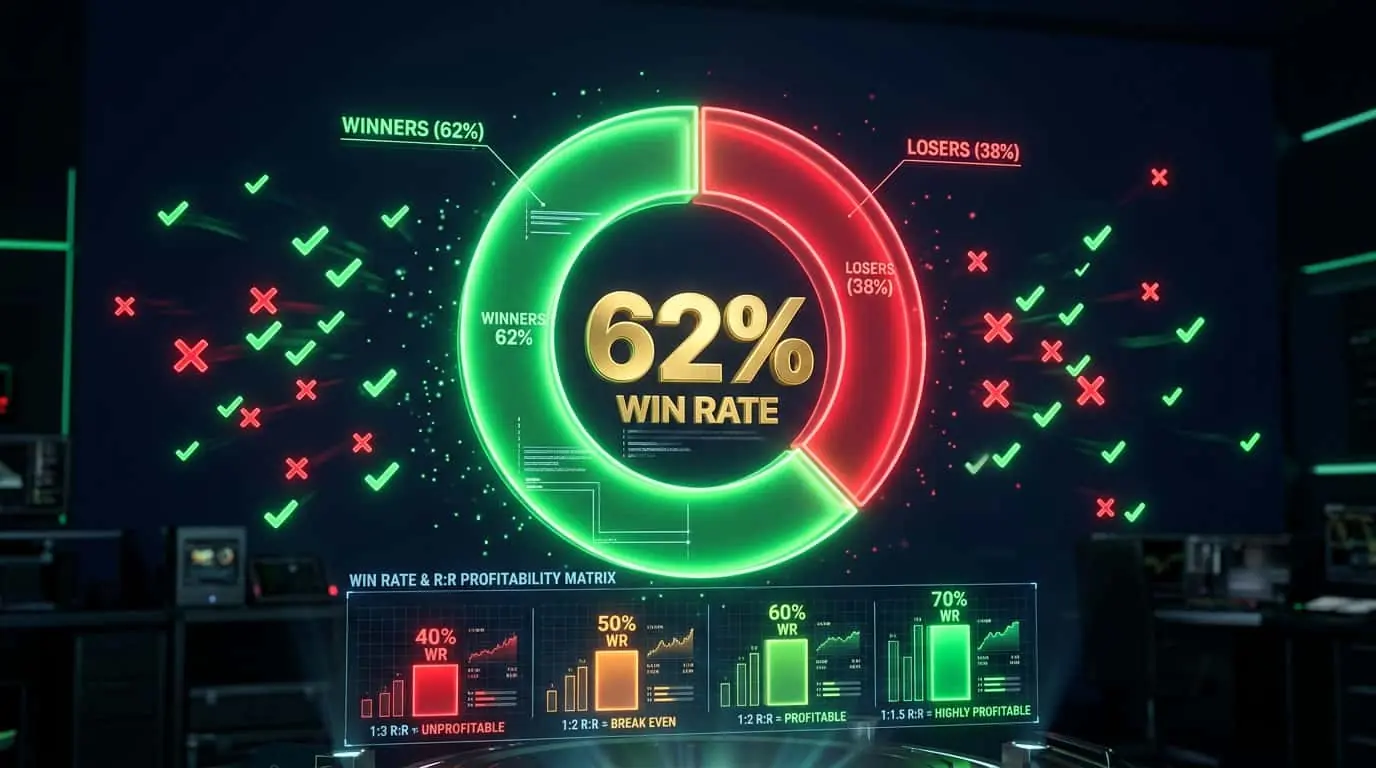
Knowing the statistical reliability of different candlestick patterns helps traders prioritize which patterns to trade. Research by Thomas Bulkowski, who analyzed over 100,000 candlestick patterns across multiple markets, provides the most comprehensive reliability data available. Among single-candle patterns, the Hammer at support has an approximate reversal success rate of 60% on daily charts, meaning price moves in the expected direction within the next 5-10 bars about 60% of the time. The Shooting Star at resistance shows approximately 59% reliability. The Doji alone has a much lower reliability of about 50-52%, which is essentially a coin flip without additional confirmation. Among two-candle patterns, the Bullish Engulfing at support achieves approximately 63% success, and the Bearish Engulfing at resistance approximately 62%. These are among the highest single-signal success rates in technical analysis. Three-candle patterns perform even better: the Morning Star shows approximately 65-70% reliability, and the Evening Star approximately 65-68%. The Three White Soldiers continuation pattern achieves about 62% accuracy for continued upward movement. However, these success rates come with critical caveats. They apply to daily charts with adequate volume. On lower timeframes (5-minute, 15-minute), reliability drops by 10-15 percentage points because there are more noise patterns. Additionally, these statistics assume the pattern appears in the correct context (at a key level after a trend). Without proper context, all pattern success rates drop to near 50%, which is random. The takeaway is clear: focus on the top 5-6 patterns with the highest reliability, trade them only at significant price levels, and always confirm with volume.
| Pattern | Type | Daily Chart Success Rate | With Confluence |
|---|---|---|---|
| Morning Star | 3-candle bullish reversal | 65-70% | 75-80% |
| Evening Star | 3-candle bearish reversal | 65-68% | 73-78% |
| Bullish Engulfing | 2-candle bullish reversal | 63% | 70-75% |
| Bearish Engulfing | 2-candle bearish reversal | 62% | 70-74% |
| Hammer | 1-candle bullish reversal | 60% | 68-72% |
| Shooting Star | 1-candle bearish reversal | 59% | 67-71% |
| Doji | 1-candle indecision | 50-52% | 60-65% |
| Three White Soldiers | 3-candle continuation | 62% | 70-74% |
Candlestick patterns are only meaningful within the proper context. A hammer candlestick at the bottom of a downtrend near a major support level is a significant signal. The exact same candlestick shape in the middle of a range with no nearby support is meaningless noise. Three critical context factors determine whether a candlestick pattern is worth trading. First, location: patterns must appear at significant price levels such as support, resistance, Fibonacci levels, or moving averages. Second, preceding trend: reversal patterns require a prior trend to reverse. A bullish reversal pattern needs a prior downtrend. Third, volume: patterns accompanied by above-average volume are more reliable because they reflect genuine conviction rather than low-liquidity noise. Without these context factors, candlestick patterns are just shapes on a chart with no predictive value. Professional traders never trade candlestick patterns in isolation; they always confirm with the broader technical picture.
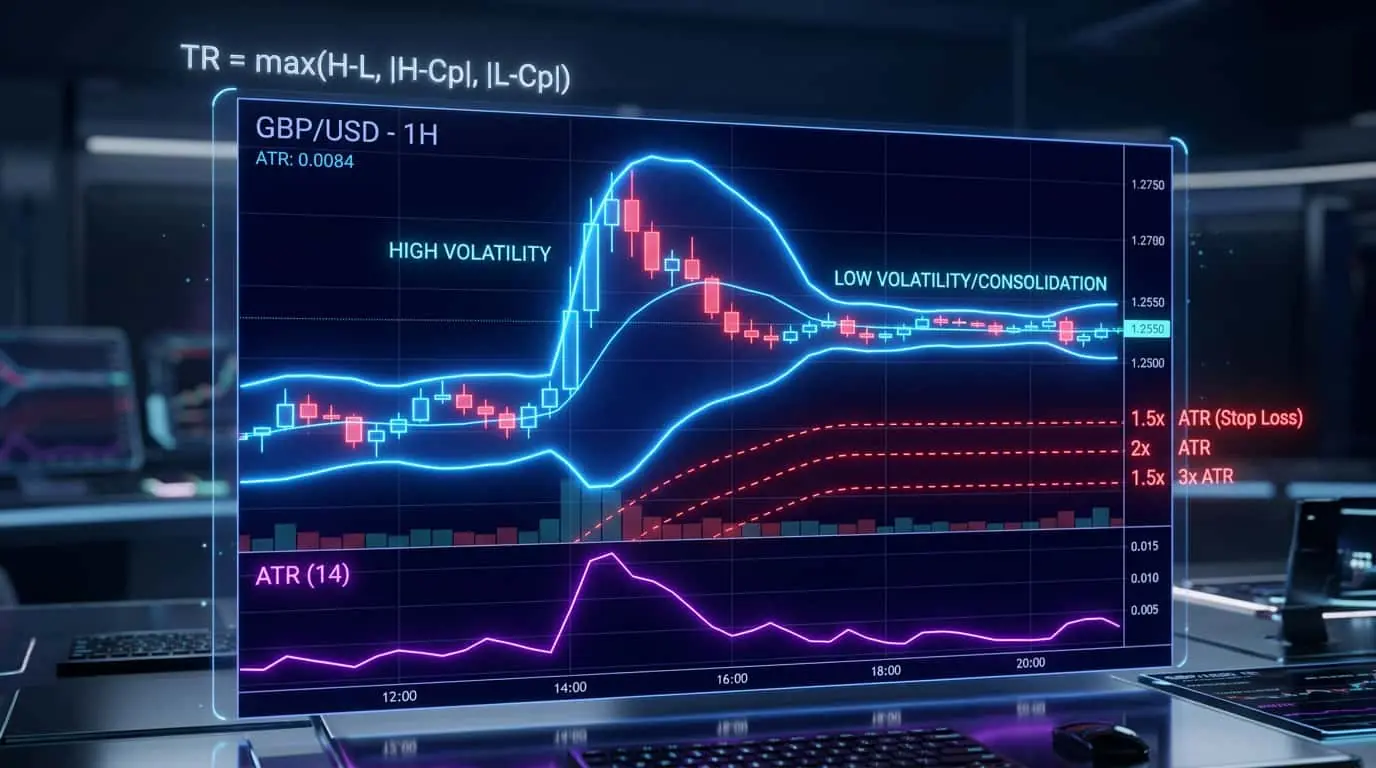
NinjaTrader 8 provides built-in candlestick pattern recognition through its CandlestickPattern indicator. This indicator can automatically detect and mark common patterns directly on your chart, saving hours of manual scanning. To add it, go to Indicators and search for CandlestickPattern. You can configure which patterns to detect, and NinjaTrader will overlay markers on bars where patterns appear. For NinjaScript developers, the CandlestickPattern indicator can be accessed programmatically to build automated entries based on specific patterns. For example, to detect a bullish engulfing at support: check if the current bar's close is above its open, the previous bar's close is below its open, and the current bar's body engulfs the previous bar's body, all while price is within 5 ticks of a support level. A practical NinjaTrader workflow for candlestick-based trading is to combine the CandlestickPattern indicator with the PivotPoints indicator and an ATR-based stop loss. When a reversal candlestick pattern appears at a pivot support level, enter long with a stop at 1.5x ATR below the entry. This three-layer approach (candlestick pattern + structural level + volatility-adapted stop) creates a systematic trading method that requires no subjective judgment. One advanced technique in NinjaTrader is using the Market Analyzer to scan multiple instruments simultaneously for candlestick patterns at key levels. You can create a column that calculates whether a pattern has formed and whether price is near a pivot level, giving you real-time alerts across your entire watchlist without monitoring every chart individually.
Pro Tip
Record every candlestick pattern trade in your NinjaTrader trading journal with the pattern name, context quality (A, B, or C grade), and outcome. After 50-100 trades, you will have personalized reliability statistics for each pattern in your specific market and timeframe, which is far more valuable than generic statistics.
Mistake
Trading candlestick patterns in isolation without checking context
Correction
Always verify that the pattern appears at a significant technical level (support, resistance, Fibonacci, moving average) and is confirmed by volume. A pattern without context is just a shape with no predictive value.
Mistake
Trying to memorize every candlestick pattern
Correction
Focus on the 5-8 most common and reliable patterns. Understanding the psychology behind each pattern (buyer/seller dynamics) is more valuable than memorizing exotic formations that rarely appear.