TL;DR
Profit factor is the ratio of gross profits to gross losses. A value above 1.0 means a strategy is profitable. Professional traders aim for 1.5-2.5. It is one of the most reliable single-number measures of strategy performance.
Table of Contents
Profit factor is the ratio of gross profits to gross losses over a given period or set of trades. It is calculated by dividing the total money gained on winning trades by the total money lost on losing trades. A profit factor greater than 1.0 means a strategy is profitable overall, while a value below 1.0 means the strategy is losing money. A profit factor of exactly 1.0 represents breakeven (before commissions). Profit factor is one of the most widely used performance metrics in trading because it distills a strategy's overall efficiency into a single, intuitive number. Unlike win rate, which only measures how often you win, profit factor captures both the frequency and magnitude of wins and losses, providing a more complete picture of strategy performance.
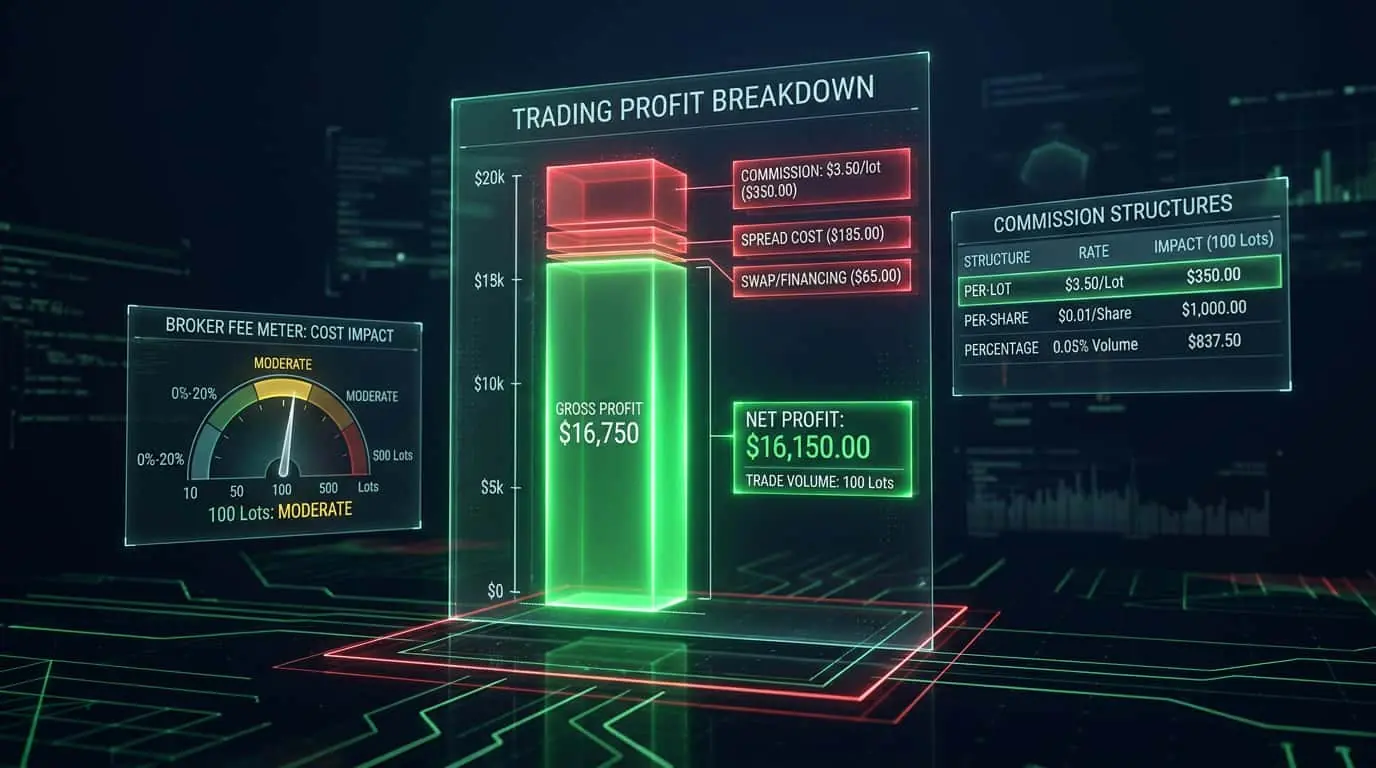
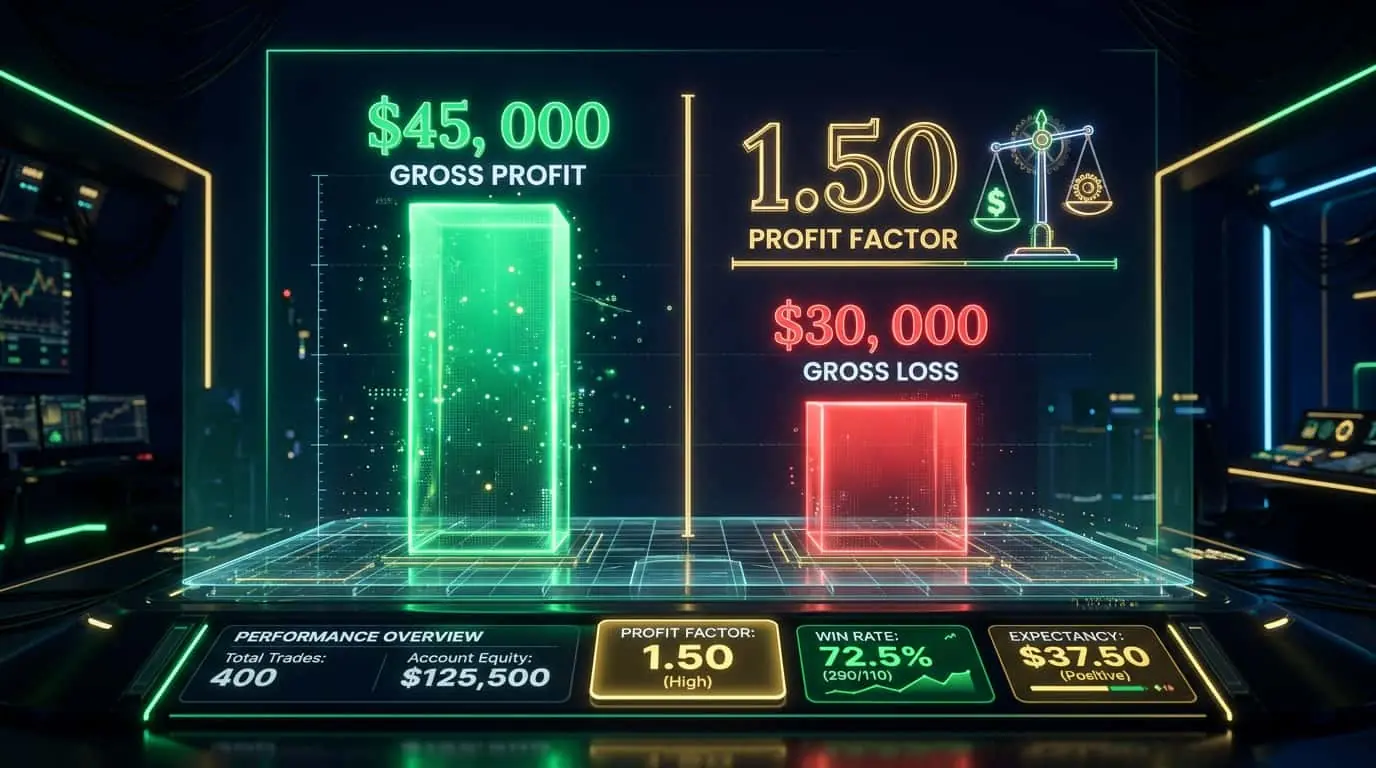
The calculation is straightforward: sum all profits from winning trades, sum all losses from losing trades (as a positive number), and divide profits by losses. For example, if a strategy produced $45,000 in winning trades and $30,000 in losing trades over 200 trades, the profit factor is $45,000 / $30,000 = 1.50. This means for every dollar lost, the strategy earned $1.50. It is important to calculate profit factor both before and after commissions. A strategy with a profit factor of 1.30 before commissions might drop to 1.10 or below after accounting for commissions, spreads, and slippage. The net profit factor (after all costs) is the figure that matters for real-world trading. Some traders also calculate a rolling profit factor (e.g., over the last 50 or 100 trades) to detect whether a strategy's edge is improving, stable, or degrading over time.
Profit Factor = Gross Profits / Gross LossesGross Profits — Sum of all profits from winning trades
Gross Losses — Sum of all losses from losing trades (expressed as a positive number)
Pro Tip
Always calculate profit factor after commissions and slippage. A 1.40 profit factor before costs might be 1.15 after costs, which is barely profitable and may not be worth the time and effort of trading.
Understanding what different profit factor values mean in practice helps you evaluate strategies objectively. A profit factor below 1.0 means the strategy loses money and should not be traded. A profit factor between 1.0 and 1.2 is marginally profitable and likely not worth trading after accounting for commissions, slippage, and the time invested. Between 1.2 and 1.5 represents a decent strategy that can be traded profitably with disciplined execution. Between 1.5 and 2.0 is considered good and represents the range where most successful retail traders operate. Between 2.0 and 3.0 is very good and suggests a robust edge. Above 3.0 is exceptional but rare in live trading. Profit factors consistently above 3.0 in backtesting should be viewed with suspicion, as they may indicate curve-fitting, insufficient sample size, or unrealistic assumptions about fills and slippage.
| Profit Factor | Rating | Interpretation |
|---|---|---|
| Below 1.0 | Unprofitable | Strategy loses money, do not trade |
| 1.0 - 1.2 | Marginal | Barely profitable, likely not worth trading after costs |
| 1.2 - 1.5 | Decent | Profitable with good execution and discipline |
| 1.5 - 2.0 | Good | Solid edge, typical of successful traders |
| 2.0 - 3.0 | Very good | Strong edge, robust strategy |
| Above 3.0 | Exceptional | Rare in live trading, verify data quality |
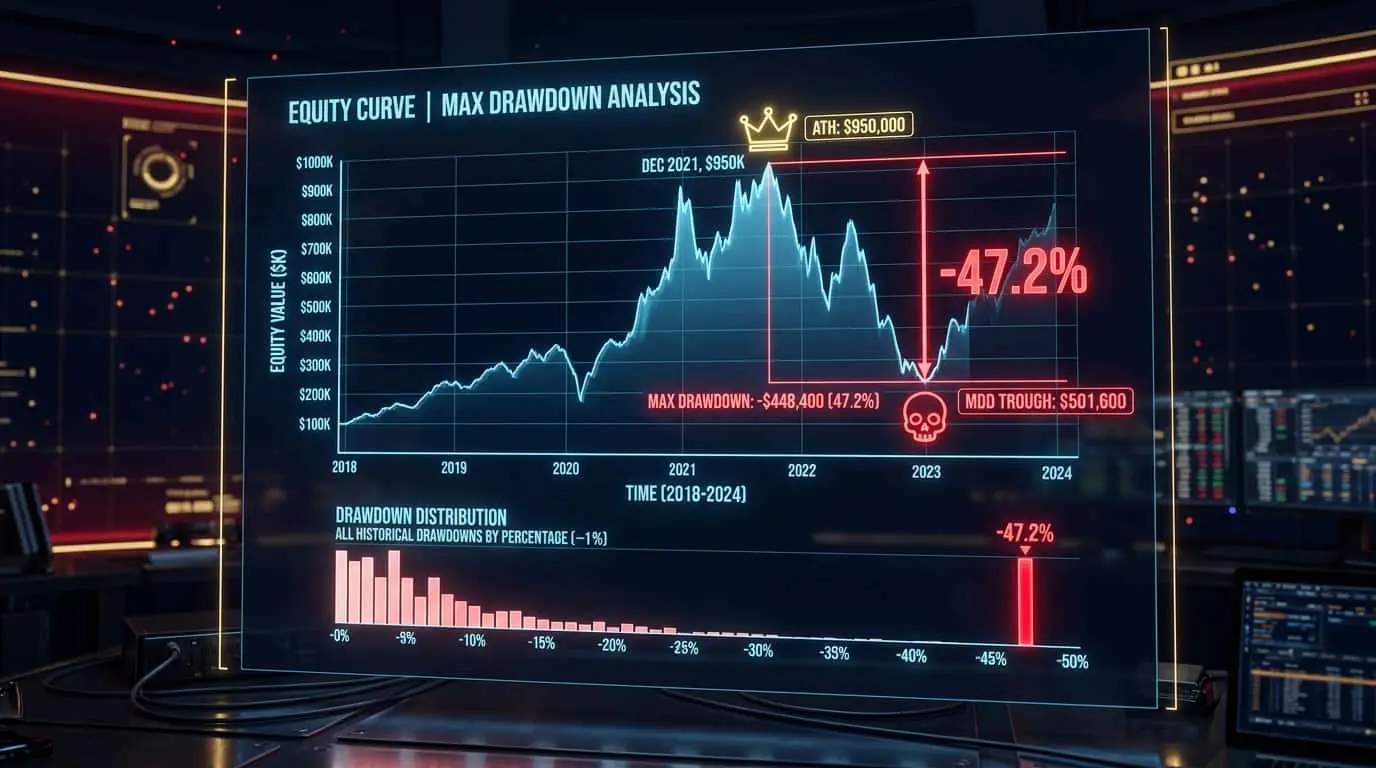
Profit factor should not be used in isolation. It works best when combined with other metrics to form a complete picture of strategy performance. Win rate tells you how often you win but not how much. Risk-reward ratio tells you the size of wins versus losses but not the frequency. Profit factor combines both dimensions but does not tell you about the distribution of returns or the maximum drawdown. A strategy with a 1.8 profit factor might have a smooth equity curve or a volatile one with deep drawdowns. The Sharpe ratio and Sortino ratio capture risk-adjusted returns, while maximum drawdown reveals the worst-case scenario. Expectancy (the average profit per trade) is closely related to profit factor and can be derived from it. The ideal evaluation uses profit factor alongside maximum drawdown, win rate, average R:R, number of trades (sample size), and the equity curve shape to form a holistic assessment.
Profit factor typically degrades from backtesting to live trading. A common rule of thumb is to expect a 20-30% reduction in profit factor when transitioning from backtest to live performance. This degradation occurs because backtests often underestimate slippage, do not account for partial fills, assume perfect execution, and may include look-ahead bias or curve-fitting. A strategy that backtests at 2.0 profit factor might realistically produce 1.4-1.6 in live trading. For this reason, professional traders typically only pursue strategies that backtest above 1.5 profit factor, knowing that real-world performance will be lower. Monitoring profit factor in real-time (rolling 50-100 trade windows) helps detect when a strategy is losing its edge. If the live profit factor drops below 1.2 for an extended period, the strategy may need adjustment or retirement.
Pro Tip
Before going live, apply a 20-30% discount to your backtest profit factor. If the discounted value is still above 1.3, the strategy is worth pursuing. If the discounted value falls below 1.2, the real-world edge is likely too thin to be reliable.
Profit factor benchmarks vary significantly across trading styles and markets. Scalpers who take 50-200 trades per day typically operate with profit factors between 1.15 and 1.40 because the sheer volume of trades compensates for the thin edge per trade. A scalper with a 1.25 profit factor taking 100 trades per day is generating substantial returns despite the seemingly modest ratio. Day traders who take 2-10 trades per day generally target profit factors between 1.40 and 2.00. Swing traders who hold positions for several days to weeks often achieve higher profit factors (1.50-2.50) because they capture larger moves relative to their stop losses. In futures markets like the E-mini S&P 500 (ES), achieving a sustained profit factor above 1.50 after commissions and slippage is considered excellent. In forex, where spread costs are lower for major pairs, slightly higher profit factors are achievable. Crypto markets, with their higher volatility, can produce elevated backtest profit factors that often degrade more severely in live trading due to slippage on exchanges with thinner order books. The key insight is that profit factor must always be evaluated in context: a 1.30 profit factor on a high-frequency scalping strategy can generate more total profit than a 2.50 profit factor on a strategy that only signals once per week.
| Trading Style | Typical PF Range | Trades/Month | Monthly R Expectation |
|---|---|---|---|
| Scalping | 1.15 - 1.40 | 500 - 2000+ | High volume compensates for thin edge |
| Day Trading | 1.40 - 2.00 | 40 - 200 | Balanced volume and edge |
| Swing Trading | 1.50 - 2.50 | 10 - 40 | Fewer trades, larger per-trade profit |
| Position Trading | 1.60 - 3.00 | 3 - 10 | Rare trades, needs strong edge per trade |
Improving profit factor requires either increasing the size of winning trades, decreasing the size of losing trades, or adjusting the win/loss ratio. The most effective approach is to focus on cutting losers short while letting winners run, which directly improves the ratio of gross profits to gross losses. Start by examining your largest losing trades: if the bottom 10% of your losses account for a disproportionate share of total losses, tighter stop management or maximum loss rules could dramatically improve your profit factor. For example, a trader with $80,000 in gross profits and $60,000 in gross losses has a profit factor of 1.33. If they implement a maximum loss per trade rule that eliminates $10,000 of their worst losses (reducing gross losses to $50,000), the profit factor improves to 1.60 — a 20% improvement from a single rule change. Another powerful technique is trade filtering: removing the lowest-quality setups from your playbook. If you take five types of setups and one consistently underperforms, eliminating it removes its losses while preserving the profits from better setups. Review your trade journal and calculate the profit factor for each setup type independently. You may discover that two or three of your setups have profit factors above 2.0 while others are below 1.0, dragging down the overall number. Eliminating unprofitable setup types is one of the fastest ways to improve overall profit factor. Finally, consider exit optimization: many traders focus on entry signals but neglect their exit strategy. Trailing stops, partial profit taking at logical levels, and time-based exits can all improve profit factor by capturing more profit on winning trades without significantly increasing losses.
Pro Tip
Calculate profit factor separately for each day of the week, each session, and each setup type. You will almost certainly discover that some combinations are highly profitable while others are breakeven or negative. Eliminate the weak links to boost your overall profit factor.
While profit factor is one of the most useful single metrics in trading, it has important limitations that traders must understand. First, profit factor does not account for the sequence of wins and losses. Two strategies can both have a 1.80 profit factor, but one may produce steady returns while the other alternates between large winning streaks and devastating losing streaks. The equity curve and maximum drawdown capture this distinction that profit factor misses. Second, profit factor is sensitive to outliers. A single enormous winning trade can inflate the profit factor and mask an otherwise mediocre strategy. To guard against this, calculate profit factor with the top 1-2 trades removed. If the metric drops significantly, the strategy may be relying on rare, unrepeatable events. Third, profit factor does not reflect the frequency of trading opportunities. A strategy with a 3.0 profit factor that generates only 5 trades per year is less useful than one with a 1.5 profit factor generating 200 trades per year. The total expected return (profit factor combined with trade frequency and average trade size) is a better measure of practical value. Fourth, profit factor can be artificially inflated by using very tight stop losses: the gross losses decrease, inflating the ratio, but the win rate typically drops to a level that makes the strategy impractical. Always examine profit factor alongside win rate, average R:R, maximum drawdown, Sharpe ratio, and the equity curve to form a comprehensive evaluation. No single metric tells the complete story of a strategy's quality.
Mistake
Evaluating profit factor without considering commissions and slippage
Correction
Always calculate net profit factor after all trading costs. A gross profit factor of 1.40 might be only 1.10 net, which is barely breakeven.
Mistake
Trusting a high profit factor from a small number of trades
Correction
A profit factor from fewer than 50 trades is unreliable. A few outlier trades can inflate the number. Require at least 100 trades, preferably 200+, before trusting the metric.