TL;DR
Pivot points are mathematically calculated support and resistance levels derived from the previous period's high, low, and close. They are used by floor traders and day traders to identify intraday turning points and define bias direction.
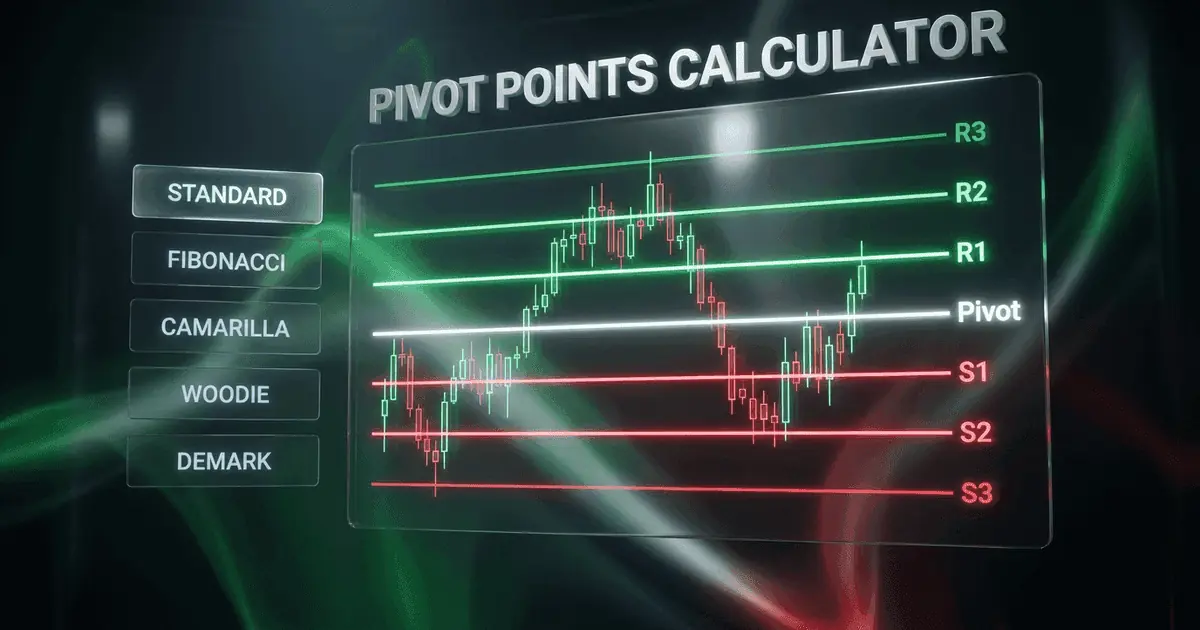
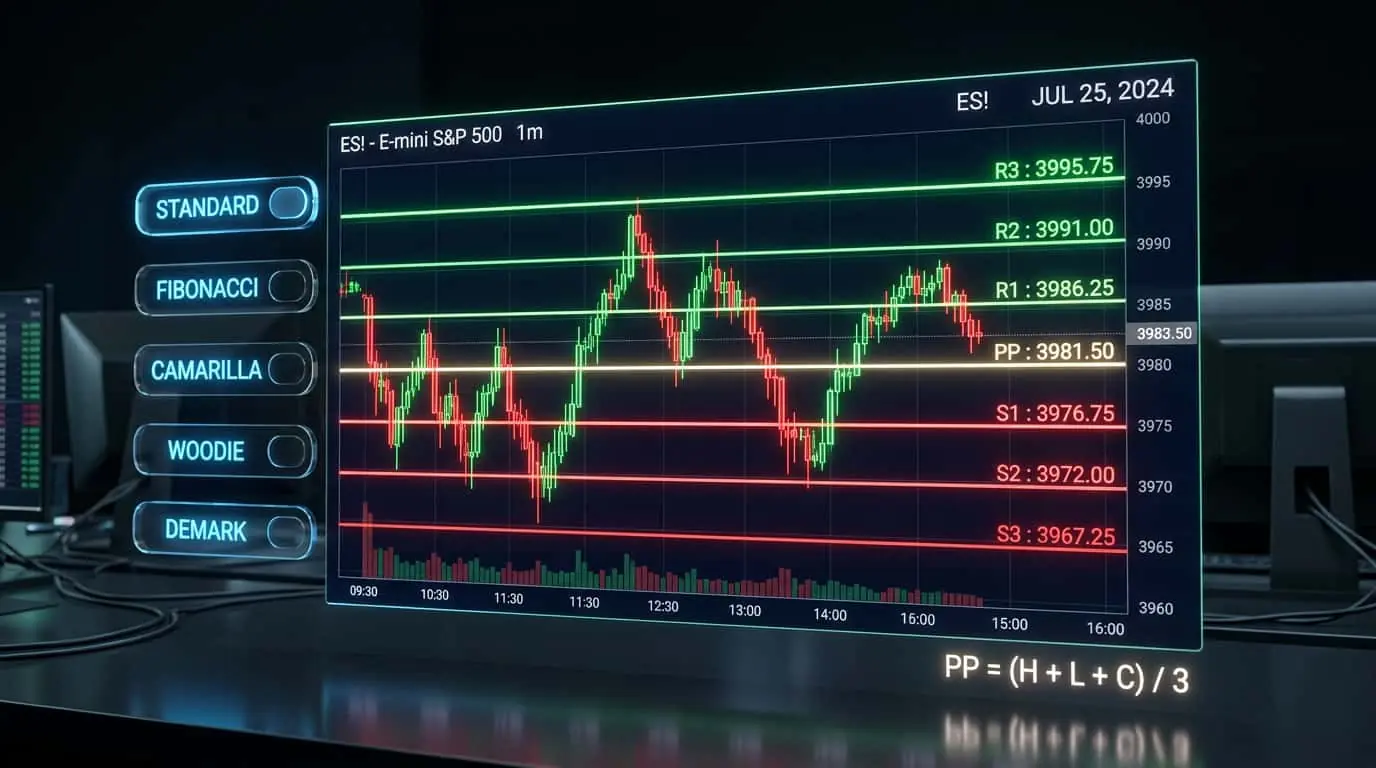
Pivot points are a set of horizontal support and resistance levels calculated from the previous trading period's high, low, and close prices. Originally developed by floor traders in the commodity pits of Chicago, pivot points provided a quick, objective way to determine key price levels before electronic charting was available. The central pivot point (PP) represents the equilibrium price for the current session. Price trading above the pivot suggests bullish bias, while price below the pivot indicates bearish bias. Surrounding the central pivot are support levels (S1, S2, S3) below and resistance levels (R1, R2, R3) above. These levels act as potential turning points where price may reverse or accelerate. Pivot points remain one of the most widely used technical tools among professional day traders and institutional traders because they are objective, forward-looking, and require no subjective interpretation.
The Standard pivot point method, also known as the Floor Trader method, is the most widely used calculation. It starts by computing the central pivot as the average of the previous period's high, low, and close. From this central point, three support levels and three resistance levels are derived. The first support and resistance levels (S1 and R1) are calculated using the pivot and the previous high/low. The second and third levels extend further from the pivot, capturing a wider price range for more volatile sessions. These calculations produce seven horizontal lines on your chart that serve as objective reference points for the trading day.
PP = (High + Low + Close) / 3PP — Central pivot point
High — Previous period high
Low — Previous period low
Close — Previous period close
| Level | Formula |
|---|---|
| R3 | (High - Low) x 2 + PP |
| R2 | PP + (High - Low) |
| R1 | (PP x 2) - Low |
| PP | (High + Low + Close) / 3 |
| S1 | (PP x 2) - High |
| S2 | PP - (High - Low) |
| S3 | PP - (High - Low) x 2 |
Beyond the Standard method, several alternative pivot point calculations exist, each with different strengths. The Woodie method places more weight on the closing price, making it more responsive to where the market settled. The Camarilla method produces levels that are closer together, designed specifically for mean-reversion and range-bound trading. The Fibonacci method applies Fibonacci ratios to the previous range, combining pivot point analysis with Fibonacci mathematics. Each method produces slightly different levels, and the best choice depends on your trading style and the market you are trading. Scalpers and range traders often prefer Camarilla pivots because the tighter levels suit their style. Trend traders may prefer Standard or Fibonacci pivots because the wider levels align better with trending moves.
| Method | Best For | Key Characteristic |
|---|---|---|
| Standard | Day trading, general use | Equal weight to H, L, C; widely followed |
| Woodie | Close-focused analysis | Extra weight on closing price; more reactive |
| Camarilla | Scalping, range trading | Tight levels ideal for mean-reversion |
| Fibonacci | Trend trading | Uses 38.2% and 61.8% ratios for S/R levels |
Pro Tip
Use the Standard method as your primary reference because it is the most widely followed. When Standard pivot levels align with Camarilla or Fibonacci levels, that confluence zone becomes a very strong support or resistance area.
The most fundamental pivot point strategy is the directional bias approach. At the open, if price is above the central pivot, the session is considered bullish, and traders look for long entries at support levels (S1, S2). If price is below the pivot, the session is bearish, and traders look for shorts at resistance levels (R1, R2). Another common strategy is pivot bounce trading: when price approaches a pivot level and shows signs of rejection (wicks, reversal candles, decreasing volume), traders enter in the opposite direction with a stop beyond the level. Pivot breakout trading works by entering when price breaks through a level with strong momentum and volume, targeting the next level. For example, if price breaks above R1 with conviction, the target becomes R2. The central pivot itself is the most important level because it defines the session bias and often acts as a magnet that attracts price during consolidation periods.
To fully understand pivot point methods, consider a concrete example using the same prior-session data across all five methods. Suppose the previous session had High = 5,050, Low = 4,950, and Close = 5,020. The range (High - Low) is 100 points. With the Standard method, PP = (5,050 + 4,950 + 5,020) / 3 = 5,006.67, R1 = (2 x 5,006.67) - 4,950 = 5,063.34, S1 = (2 x 5,006.67) - 5,050 = 4,963.34, R2 = 5,006.67 + 100 = 5,106.67, and S2 = 5,006.67 - 100 = 4,906.67. With the Woodie method, PP = (High + Low + 2 x Close) / 4 = (5,050 + 4,950 + 10,040) / 4 = 5,010, which gives extra weight to the close and shifts the pivot higher when the close is near the high. With Camarilla, the pivot is the same standard PP but the support and resistance levels use fractional multipliers of the range: R1 = Close + Range x 1.1/12 = 5,029.17, S1 = Close - Range x 1.1/12 = 5,010.83, R2 = Close + Range x 1.1/6 = 5,038.33, S2 = Close - Range x 1.1/6 = 5,001.67. Notice how Camarilla levels are much tighter, designed for intraday mean-reversion scalping. The Fibonacci method uses PP = Standard PP, then R1 = PP + 0.382 x Range = 5,044.87, R2 = PP + 0.618 x Range = 5,068.47, S1 = PP - 0.382 x Range = 4,968.47, S2 = PP - 0.618 x Range = 4,944.87. The DeMark method is unique: if Close > Open, X = 2 x High + Low + Close; if Close < Open, X = High + 2 x Low + Close; if Close = Open, X = High + Low + 2 x Close. Then PP = X / 4, and only one support and one resistance are calculated.
| Method | PP | S1 | R1 | S2 | R2 |
|---|---|---|---|---|---|
| Standard | 5,006.67 | 4,963.34 | 5,063.34 | 4,906.67 | 5,106.67 |
| Woodie | 5,010.00 | 4,970.00 | 5,070.00 | 4,930.00 | 5,110.00 |
| Camarilla | 5,006.67 | 5,010.83 | 5,029.17 | 5,001.67 | 5,038.33 |
| Fibonacci | 5,006.67 | 4,968.47 | 5,044.87 | 4,944.87 | 5,068.47 |
| DeMark | 5,010.00 | 4,970.00 | 5,070.00 | - | - |
Let us walk through three complete pivot point trade setups using ES (E-mini S&P 500) futures with Standard pivots. Setup 1: Bullish Bias Trade. The prior session had H=5,050, L=4,950, C=5,020. Today's PP = 5,006.67. ES opens at 5,015, above the pivot, establishing bullish bias. Price drifts down to S1 at 4,963.34 in the first hour. A hammer candlestick forms at S1 with increasing volume. You enter long at 4,965, stop at 4,948 (below S2 area), target PP at 5,007. Risk = 17 points ($850 per contract), reward = 42 points ($2,100), giving a 2.5:1 risk-reward ratio. Setup 2: Pivot Rejection Short. ES opens at 4,998, below PP at 5,006.67. Price rallies to the pivot and forms a bearish engulfing candle at 5,008. You short at 5,005, stop at 5,020 (above PP zone), target S1 at 4,963. Risk = 15 points ($750), reward = 42 points ($2,100), a 2.8:1 ratio. Setup 3: R1 Breakout. ES opens above PP and rallies to R1 at 5,063.34. Price consolidates for 20 minutes then breaks above R1 on 2x average volume. You enter long at 5,066, stop at 5,055 (below R1), target R2 at 5,106.67. Risk = 11 points ($550), reward = 40.67 points ($2,033), a 3.7:1 ratio. In all three setups, the pivot levels provide the structure for entries, stops, and targets, removing subjectivity from the trade plan.
Pro Tip
Track which pivot levels your specific market respects most consistently. In ES futures, the central pivot and R1/S1 produce the most reliable reactions. In NQ (Nasdaq) futures, the wider range often means R2/S2 are more relevant. Keep a log of pivot reactions for your market over 20+ sessions to identify these patterns.
Pivot points are particularly effective in futures and forex markets because these markets have clearly defined trading sessions. For futures traders using NinjaTrader, daily pivot points are calculated from the previous day's regular trading hours (RTH) session data (9:30 AM to 4:15 PM ET for equity index futures). The globex/electronic session often reacts strongly to these RTH-derived pivot levels. For forex, pivots are typically calculated from the New York close (5:00 PM ET) to the next New York close, which represents the standard 24-hour forex trading day. Weekly and monthly pivot points are also widely used, especially by swing traders. Weekly pivots are calculated from the previous week's high, low, and close, and monthly pivots from the previous month's data. Higher-timeframe pivots produce stronger, more reliable support and resistance levels because they represent broader market consensus. When a daily pivot level aligns with a weekly pivot level, the resulting confluence zone is among the strongest intraday support or resistance you will find. Many professional futures traders plot daily, weekly, and monthly pivots simultaneously and only take trades at levels where two or more timeframes converge. In NinjaTrader, you can add the PivotPoints indicator from the indicator list and configure it for different calculation methods and session types. Set the calculation to use RTH data for the most institutionally relevant levels.
Mistake
Using the wrong session data for pivot calculations
Correction
For futures, use Regular Trading Hours (RTH) data, not 24-hour globex data. For forex, use the New York close (5 PM ET). Incorrect data produces levels that do not align with institutional reference points.
Mistake
Treating pivot levels as exact prices rather than zones
Correction
Pivot levels are approximate zones, not exact prices. Allow for a few ticks or pips of overshoot and look for price action confirmation (rejection candles, volume patterns) before entering trades.