TL;DR
RSI is a momentum oscillator ranging from 0 to 100 that measures the speed and magnitude of recent price changes. Readings above 70 suggest overbought conditions, below 30 suggest oversold, and divergences between RSI and price signal potential reversals.
The Relative Strength Index (RSI) is a momentum oscillator developed by J. Welles Wilder Jr. and introduced in his 1978 book 'New Concepts in Technical Trading Systems.' RSI measures the speed and magnitude of recent price changes to evaluate whether an asset is overbought or oversold. The indicator oscillates between 0 and 100, with traditional interpretation placing readings above 70 in overbought territory and below 30 in oversold territory. RSI is one of the most widely used technical indicators in the world, favored by both discretionary traders and algorithmic systems for its versatility and reliability. Unlike price itself, RSI normalizes the measurement of momentum into a bounded range, making it easy to compare momentum across different assets, timeframes, and market conditions.
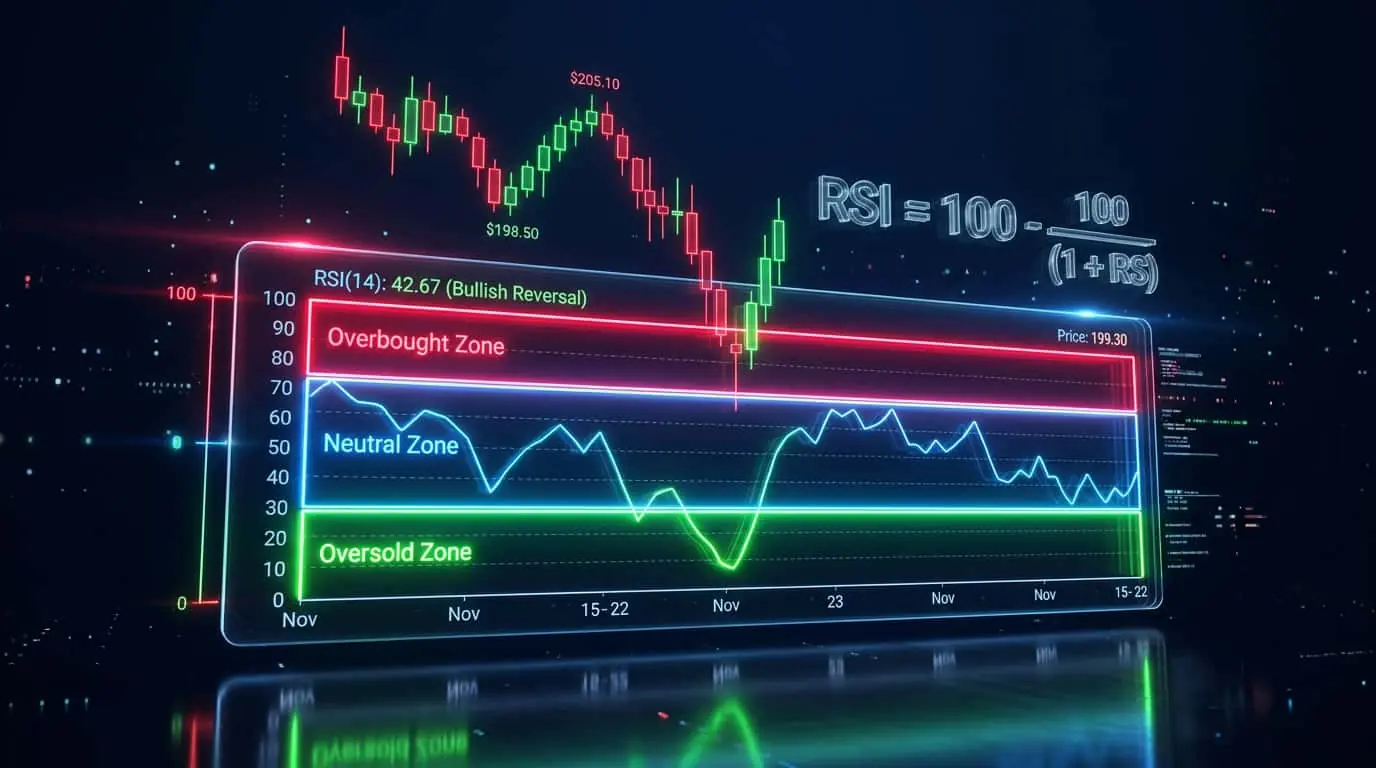
RSI is calculated using a two-step process. First, the average gain and average loss over the lookback period (typically 14 periods) are computed. The average gain is the sum of all positive price changes divided by the period, and the average loss is the sum of all negative price changes divided by the period (expressed as a positive number). Second, the Relative Strength (RS) is calculated by dividing the average gain by the average loss. Finally, RSI is derived from RS using the formula below, which bounds the result between 0 and 100. After the initial calculation, subsequent values use a smoothing method where the previous average gain and average loss are multiplied by 13, the current gain or loss is added, and the sum is divided by 14. This smoothing makes RSI more stable and less prone to sudden jumps.
RSI = 100 - [100 / (1 + RS)], where RS = Average Gain / Average LossRS — Relative Strength: average gain divided by average loss
Average Gain — Mean of positive price changes over 14 periods
Average Loss — Mean of negative price changes over 14 periods (positive number)
The traditional interpretation of RSI uses the 70 and 30 levels as overbought and oversold thresholds. When RSI rises above 70, the asset may be overbought, meaning it has rallied significantly and could be due for a pullback. When RSI falls below 30, the asset may be oversold, meaning it has declined significantly and could be due for a bounce. However, these levels need context. In strong uptrends, RSI frequently rises above 70 and stays there, which is a sign of momentum, not an automatic sell signal. Similarly, in strong downtrends, RSI can remain below 30 for extended periods. Many professional traders adjust the thresholds based on the trend: using 80/40 in uptrends (only looking for oversold buys near 40) and 60/20 in downtrends (only looking for overbought sells near 60). This adjustment accounts for the upward bias in RSI during uptrends and the downward bias during downtrends.
| RSI Zone | Interpretation | Action |
|---|---|---|
| Above 80 | Extremely overbought | High probability of pullback, consider reducing longs |
| 70-80 | Overbought | Monitor for reversal signals, tighten stops |
| 40-60 | Neutral zone | Trend direction determines bias |
| 20-30 | Oversold | Monitor for reversal signals, potential buying opportunity |
| Below 20 | Extremely oversold | High probability of bounce, consider long entries |
Pro Tip
In strong trends, use RSI as a momentum confirmation tool rather than a reversal tool. In an uptrend, RSI readings between 40 and 50 often represent pullback buying opportunities. Do not short just because RSI is above 70 in a strong uptrend.
RSI divergence is one of the most powerful signals in technical analysis. Divergence occurs when price and RSI move in opposite directions, suggesting that the current trend is losing momentum and a reversal may be approaching. Bullish divergence happens when price makes a lower low but RSI makes a higher low, indicating that selling momentum is weakening. Bearish divergence happens when price makes a higher high but RSI makes a lower high, indicating that buying momentum is fading. There is also hidden divergence: hidden bullish divergence occurs when price makes a higher low but RSI makes a lower low, which is actually a trend continuation signal. Hidden bearish divergence occurs when price makes a lower high but RSI makes a higher high. Regular divergence signals reversals, while hidden divergence signals trend continuation. Divergence signals are stronger on higher timeframes and when confirmed by other factors like support/resistance levels or candlestick patterns.
Working through the RSI calculation with real numbers builds intuition for how the indicator behaves. Suppose we have 14 periods of price data with the following daily closes: 44, 44.34, 44.09, 43.61, 44.33, 44.83, 45.10, 45.42, 45.84, 46.08, 45.89, 46.03, 45.61, 46.28. First, compute the period-to-period changes: +0.34, -0.25, -0.48, +0.72, +0.50, +0.27, +0.32, +0.42, +0.24, -0.19, +0.14, -0.42, +0.67. Separate gains from losses. Gains: 0.34, 0, 0, 0.72, 0.50, 0.27, 0.32, 0.42, 0.24, 0, 0.14, 0, 0.67. Losses: 0, 0.25, 0.48, 0, 0, 0, 0, 0, 0, 0.19, 0, 0.42, 0. Average Gain = (0.34+0.72+0.50+0.27+0.32+0.42+0.24+0.14+0.67) / 14 = 3.62/14 = 0.2586. Average Loss = (0.25+0.48+0.19+0.42) / 14 = 1.34/14 = 0.0957. RS = 0.2586 / 0.0957 = 2.702. RSI = 100 - [100 / (1 + 2.702)] = 100 - [100 / 3.702] = 100 - 27.01 = 72.99. This initial RSI of approximately 73 indicates mildly overbought conditions. For the next period, if the close is 46.00 (a loss of 0.28), the smoothed Average Gain = (0.2586 x 13 + 0) / 14 = 0.2401, and the smoothed Average Loss = (0.0957 x 13 + 0.28) / 14 = 0.1088. New RS = 0.2401 / 0.1088 = 2.207. New RSI = 100 - [100 / 3.207] = 68.82. One down bar dropped RSI from 73 to 68.82, moving it out of overbought territory. This demonstrates how RSI smoothing prevents dramatic jumps while still reflecting changing momentum.
Smoothed Avg Gain = [(Previous Avg Gain x 13) + Current Gain] / 14Previous Avg Gain — Average gain from the prior period
Current Gain — Gain for the current period (0 if loss)
14 — Default RSI lookback period
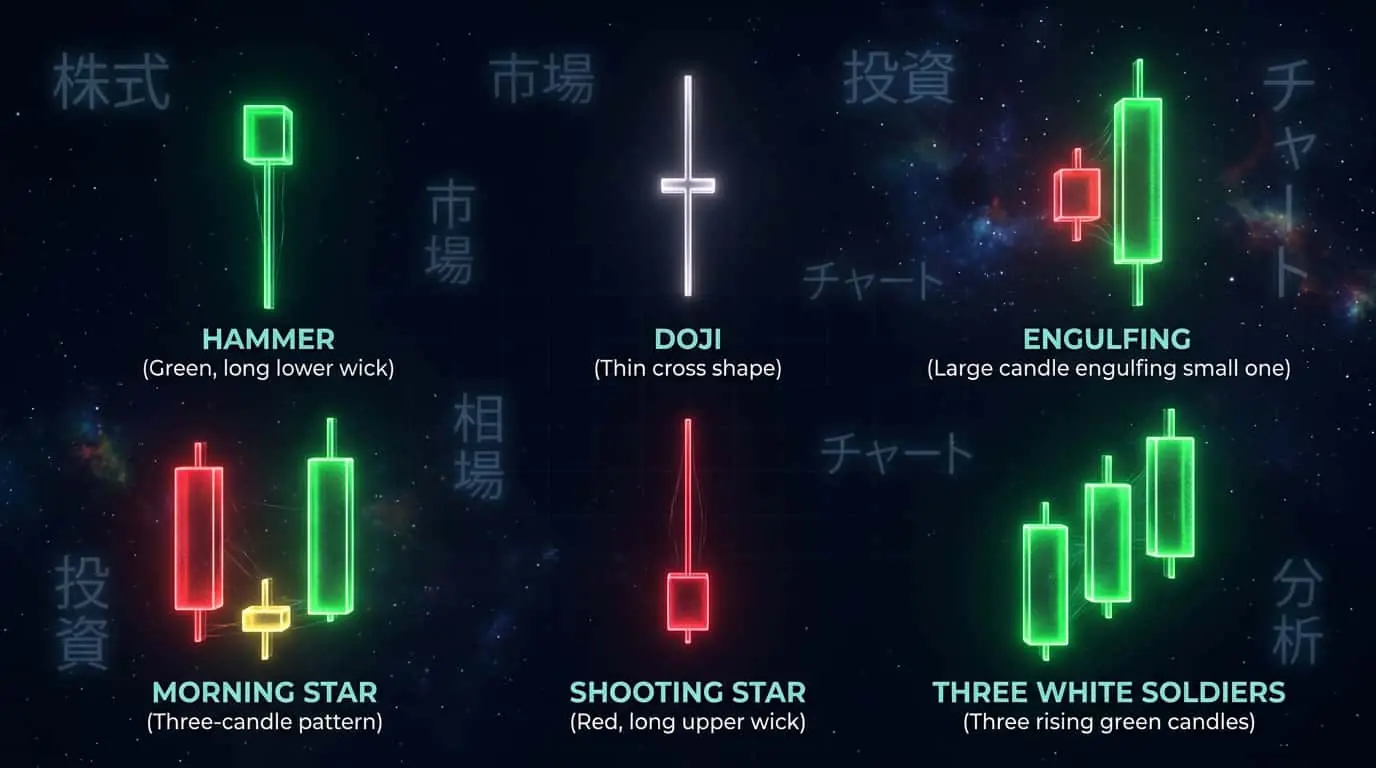
RSI divergence examples with specific prices make this concept easier to apply in real trading. Bullish divergence example: ES futures makes a low at 4,920 on January 15 with RSI at 25. Price bounces to 4,980, then drops again to a new low at 4,905 on January 28. However, RSI at the second low reads 31, higher than the first reading of 25. Price made a lower low (4,905 vs 4,920) but RSI made a higher low (31 vs 25). This bullish divergence signals weakening selling pressure. If a bullish engulfing candle forms at the second low, it confirms the divergence and triggers a long entry at 4,910 with a stop at 4,895 and a target of 4,980 (the recent swing high), delivering a 4.7:1 reward-to-risk ratio. Bearish divergence example: NQ futures rallies to 17,800 on February 5 with RSI at 78. Price pulls back, then rallies to a higher high at 17,900 on February 12. But RSI only reaches 72, lower than the previous 78. Price made a higher high but RSI made a lower high: bearish divergence. This warns that despite higher prices, buying momentum is fading. A short entry at 17,880 with a stop at 17,920 and a target of 17,700 provides a 4.5:1 ratio. Hidden divergence works differently. In an uptrend, price pulls back from 5,100 to 5,050 (a higher low compared to the prior swing low at 5,020). RSI drops to 35, lower than its reading of 42 at the prior price low. This hidden bullish divergence (higher price low, lower RSI low) signals that the uptrend will continue, and the pullback is a buying opportunity, not a reversal.
| Divergence Type | Price Pattern | RSI Pattern | Signal | Reliability |
|---|---|---|---|---|
| Regular Bullish | Lower low | Higher low | Reversal up | High at support levels |
| Regular Bearish | Higher high | Lower high | Reversal down | High at resistance levels |
| Hidden Bullish | Higher low | Lower low | Uptrend continuation | Moderate, best with trend |
| Hidden Bearish | Lower high | Higher high | Downtrend continuation | Moderate, best with trend |
Pro Tip
In NinjaTrader, you can visually identify RSI divergence by adding the RSI indicator panel below your price chart and drawing trendlines on both the price chart and the RSI panel. When the trendlines slope in opposite directions, divergence is present. Some NinjaTrader add-ons automatically detect and mark divergences, saving considerable screen time.
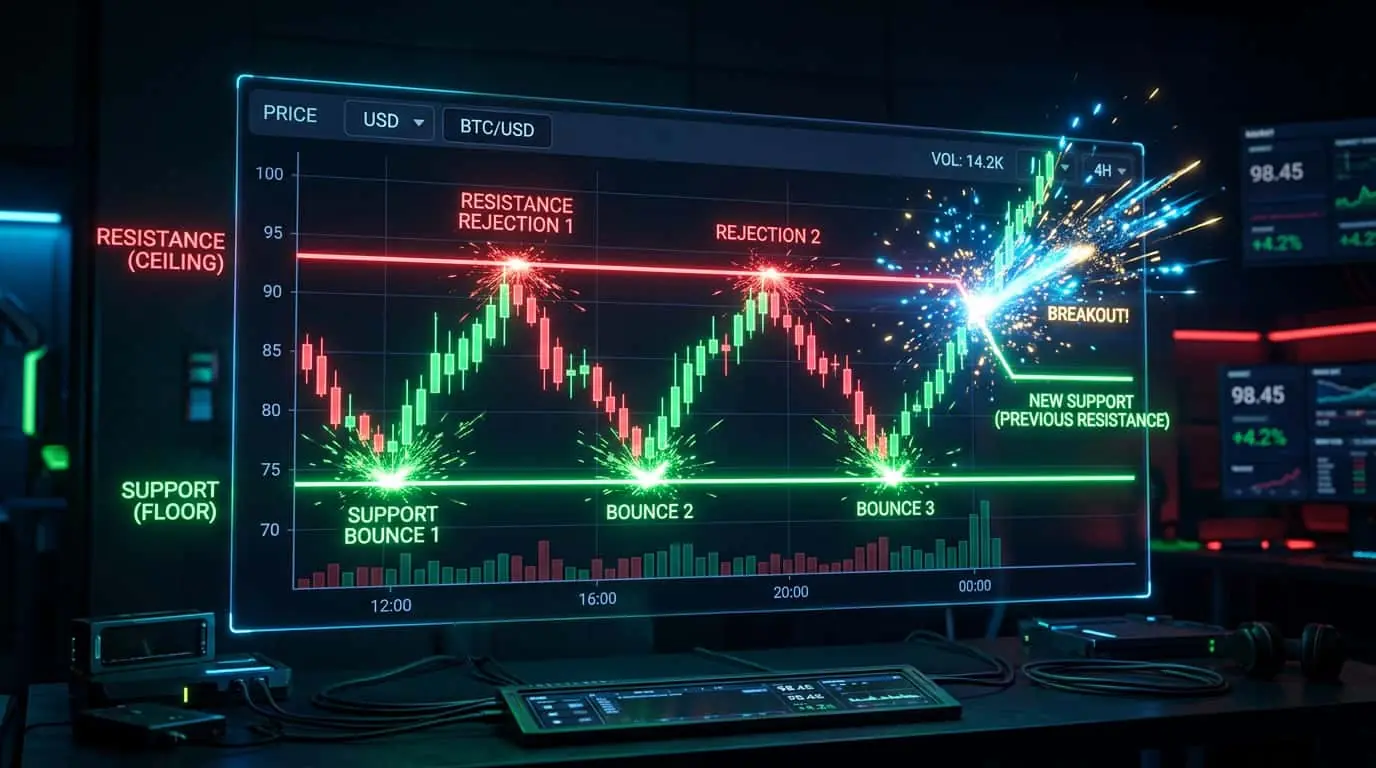
The most effective use of RSI combines it with price action analysis rather than using it in isolation. A powerful approach is to look for RSI readings at extreme levels (below 30 or above 70) that coincide with price reaching a key support or resistance level. For example, if price pulls back to a major support level and RSI simultaneously drops below 30, this confluence of oversold momentum at a structural support creates a high-probability buying opportunity. Another approach is using RSI to confirm breakouts: if price breaks above a resistance level and RSI simultaneously breaks above its own resistance or moves above 50 from below, the breakout is more likely to be genuine. RSI failure swings, where RSI makes a low, bounces, pulls back without reaching the low, and then breaks above the bounce high, are considered reliable reversal patterns even without looking at the price chart.
Mistake
Selling every time RSI reaches 70 or buying every time it reaches 30
Correction
In strong trends, RSI can remain overbought or oversold for extended periods. Use the overbought/oversold levels as alerts, not automatic trade signals. Always consider the trend direction and look for price action confirmation.
Mistake
Ignoring divergence because price is still moving in the trend direction
Correction
Divergence often appears while the trend is still active. It is an early warning signal that momentum is fading. Do not counter-trade immediately, but tighten stops, reduce position size, and prepare for a potential reversal.