TL;DR
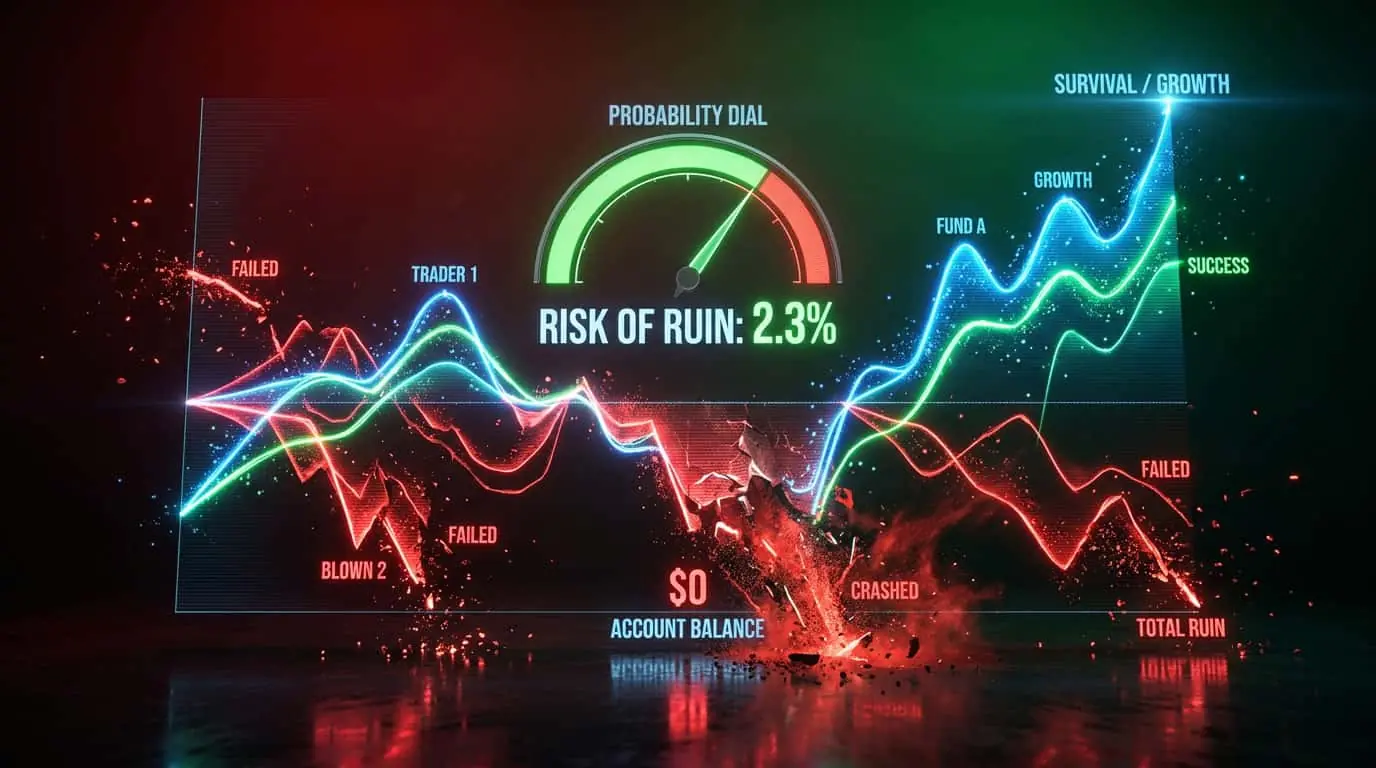
Risk of ruin is the probability that a trader will lose enough capital to be unable to continue trading. Even a profitable strategy can lead to ruin if the risk per trade is too high. Keeping risk per trade at 1-2% makes the risk of ruin virtually zero for any strategy with positive expectancy.
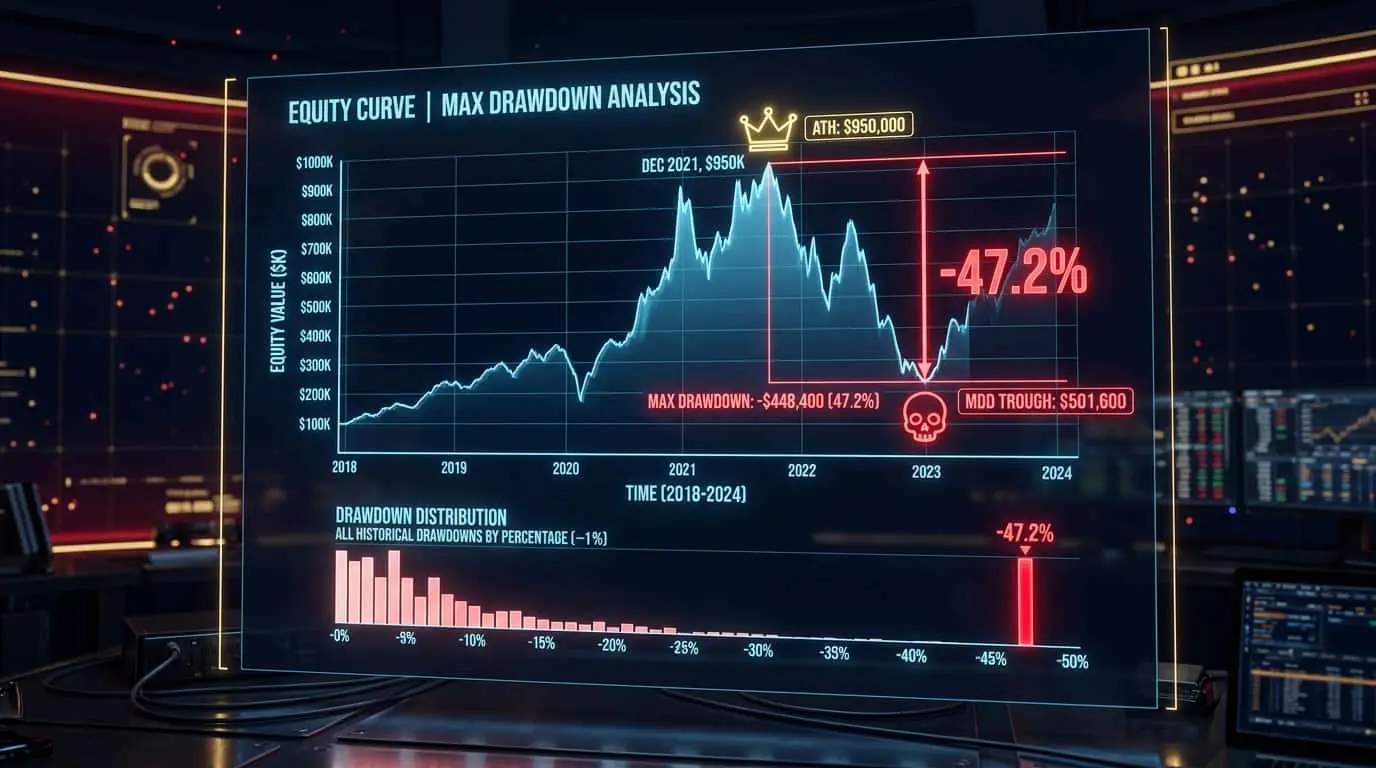
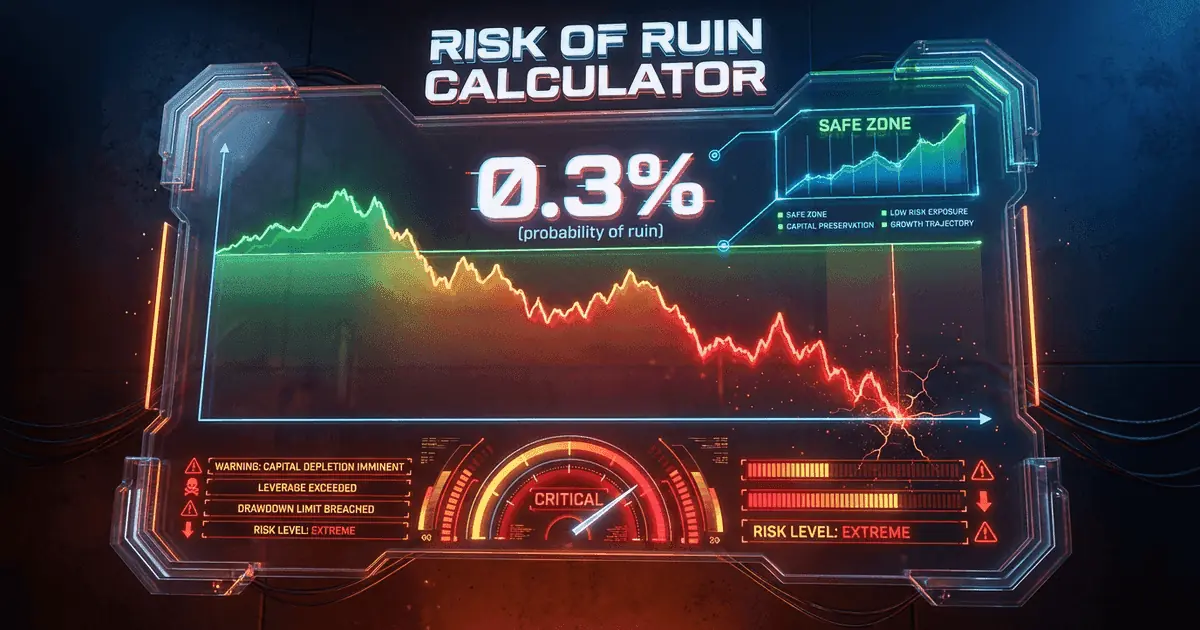
Risk of ruin is the probability that a trader will lose a sufficient amount of capital to be unable to continue trading, effectively going bankrupt or reaching a point where the account can no longer support the minimum trade size. It is one of the most important concepts in trading because it demonstrates that even a strategy with a proven edge can lead to account destruction if the position sizing is too aggressive. The concept originated in probability theory and gambling mathematics (known as the gambler's ruin problem), but it has direct and critical applications in trading. The key insight is that risk of ruin is not just about whether your strategy is profitable on average, but about whether the path to profitability can survive the inevitable losing streaks along the way. A strategy with positive expectancy but excessive risk per trade can hit a string of losses that depletes the account before the edge has a chance to play out.
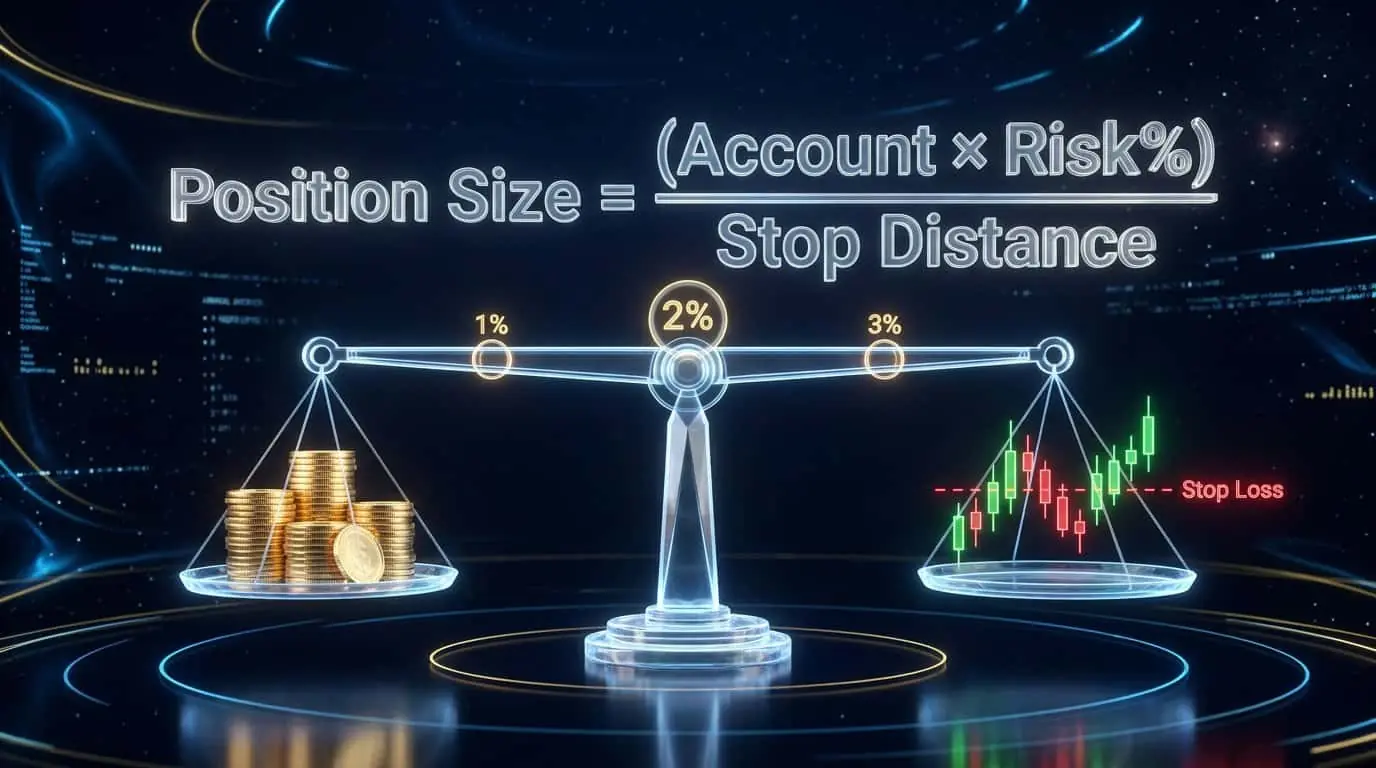
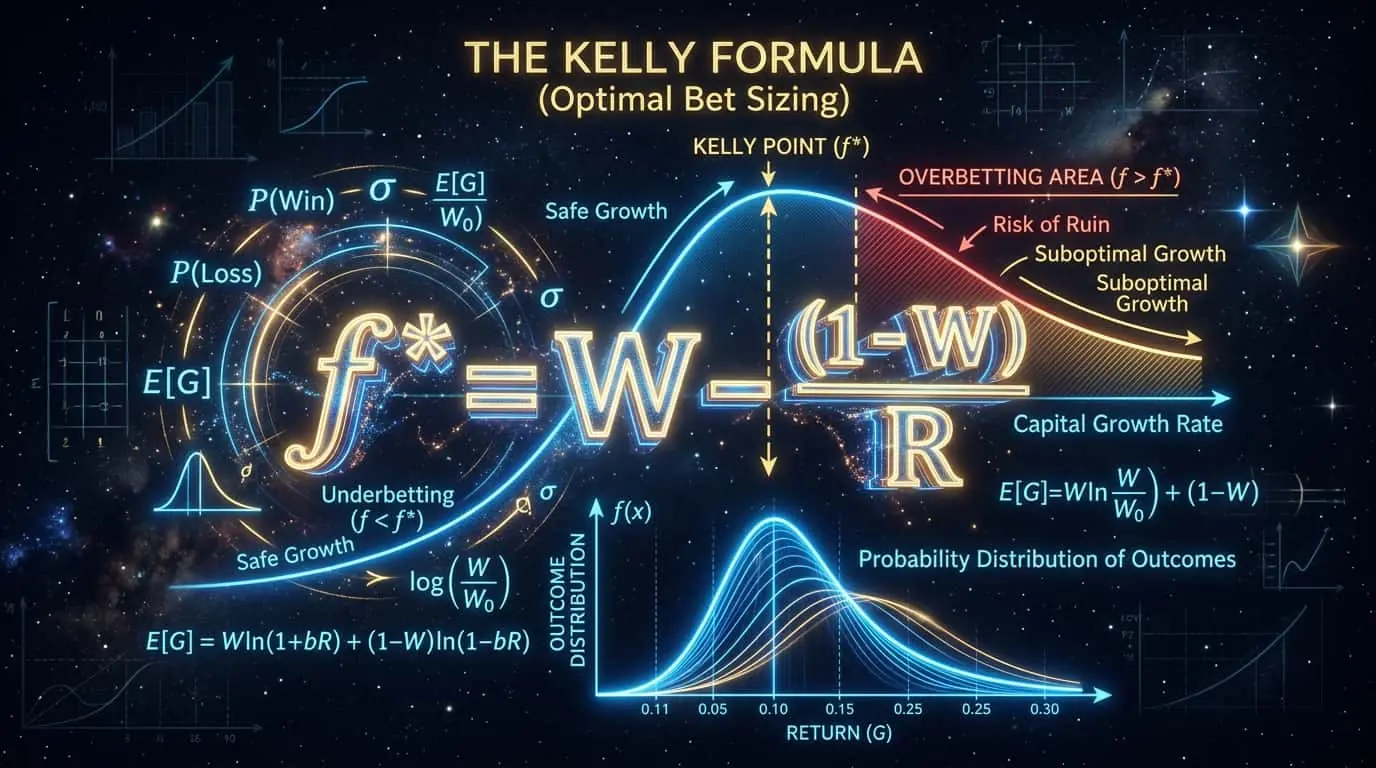
The risk of ruin can be calculated using several formulas of varying complexity. The simplified version for binary outcomes (fixed win amount and fixed loss amount) provides a useful approximation. The formula requires three inputs: the probability of winning (p), the probability of losing (q = 1 - p), and the number of units you can lose before being ruined (n, which is inversely related to your risk per trade). For a trader risking 2% per trade, n = 50 (they can lose 50 consecutive trades at 2% before theoretically reaching zero, though the actual account reaches zero faster due to compounding). The exact formula accounts for the payoff ratio (b), which adjusts the effective probabilities. More sophisticated Monte Carlo-based risk of ruin calculations simulate thousands of trade sequences to provide a more accurate estimate that accounts for the full distribution of trade outcomes, not just binary wins and losses.
Risk of Ruin = ((1 - Edge) / (1 + Edge))^N, where Edge = (W x R - L) / RW — Win rate as a decimal
L — Loss rate (1 - W)
R — Average win / average loss ratio
N — Number of risk units in the account (e.g., 50 for 2% risk)
The relationship between risk per trade and risk of ruin is dramatic and nonlinear. For a strategy with a 50% win rate and 1:1.5 R:R (positive expectancy), the risk of ruin changes drastically with position sizing. At 10% risk per trade, the risk of ruin is approximately 13.5%. At 5% risk per trade, it drops to about 1.8%. At 2% risk per trade, it falls to approximately 0.04% (essentially zero). At 1% risk per trade, it becomes negligibly small. This demonstrates why professional traders insist on small risk percentages: the mathematical protection against ruin is enormous. Even a mediocre strategy with a small edge becomes virtually ruin-proof at 1-2% risk per trade, while the same strategy at 10% risk has a meaningful chance of blowing up the account.
| Risk per Trade | Risk of Ruin (50% WR, 1:1.5 R:R) | Classification |
|---|---|---|
| 1% | < 0.01% | Virtually impossible |
| 2% | 0.04% | Negligible |
| 3% | 0.4% | Very low |
| 5% | 1.8% | Low but real |
| 10% | 13.5% | Dangerously high |
| 15% | 30%+ | Unacceptable |
| 25% | 60%+ | Account destruction likely |
Pro Tip
Your goal should be a risk of ruin below 1%. For any strategy with positive expectancy, risking 2% or less per trade achieves this. If your calculated risk of ruin is above 5%, you are over-sizing your positions.
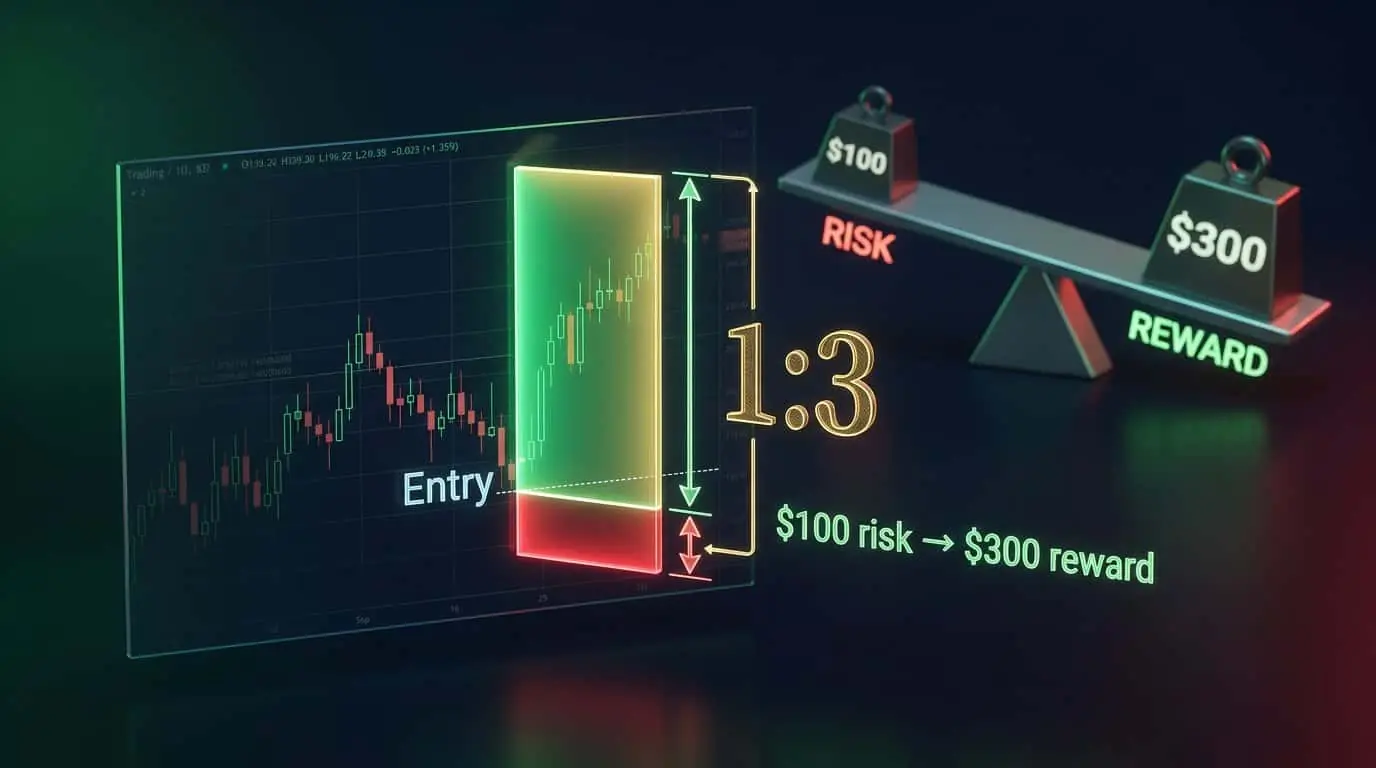
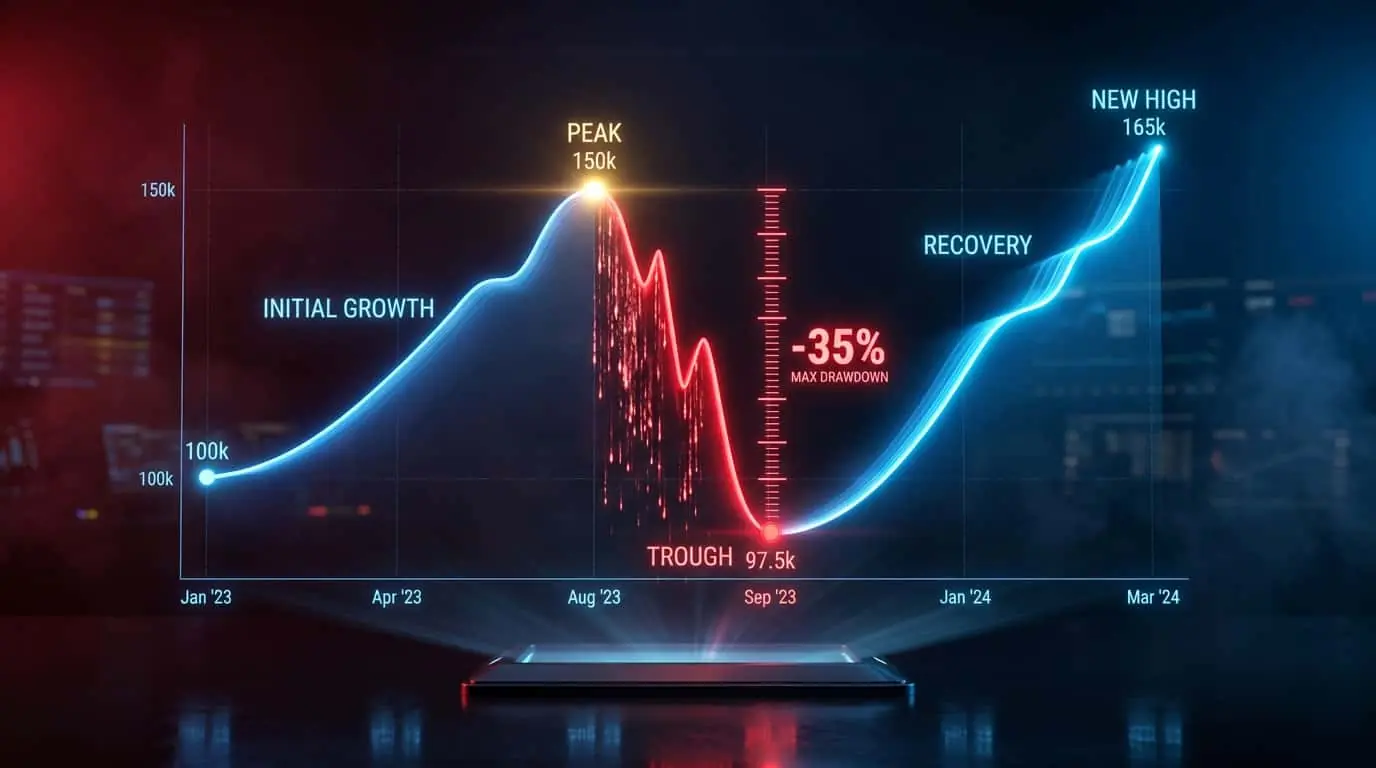
Different trading strategies have different risk of ruin profiles based on their win rate and R:R characteristics. High win rate, low R:R strategies (like scalping at 70% WR, 1:0.8 R:R) have lower risk of ruin at moderate position sizes because the frequent wins maintain the account balance. Low win rate, high R:R strategies (like trend following at 35% WR, 1:3 R:R) can have higher risk of ruin despite positive expectancy because the long losing streaks between winners can be devastating. The expected maximum losing streak for a strategy is approximately log(N) / log(1/L), where N is the total number of trades and L is the loss rate. A strategy with a 60% loss rate over 1,000 trades can expect a maximum losing streak of approximately 15 trades. At 2% risk per trade, this would create a 26% drawdown, which is painful but survivable. At 5% risk, the same streak creates a 54% drawdown, which is potentially catastrophic.
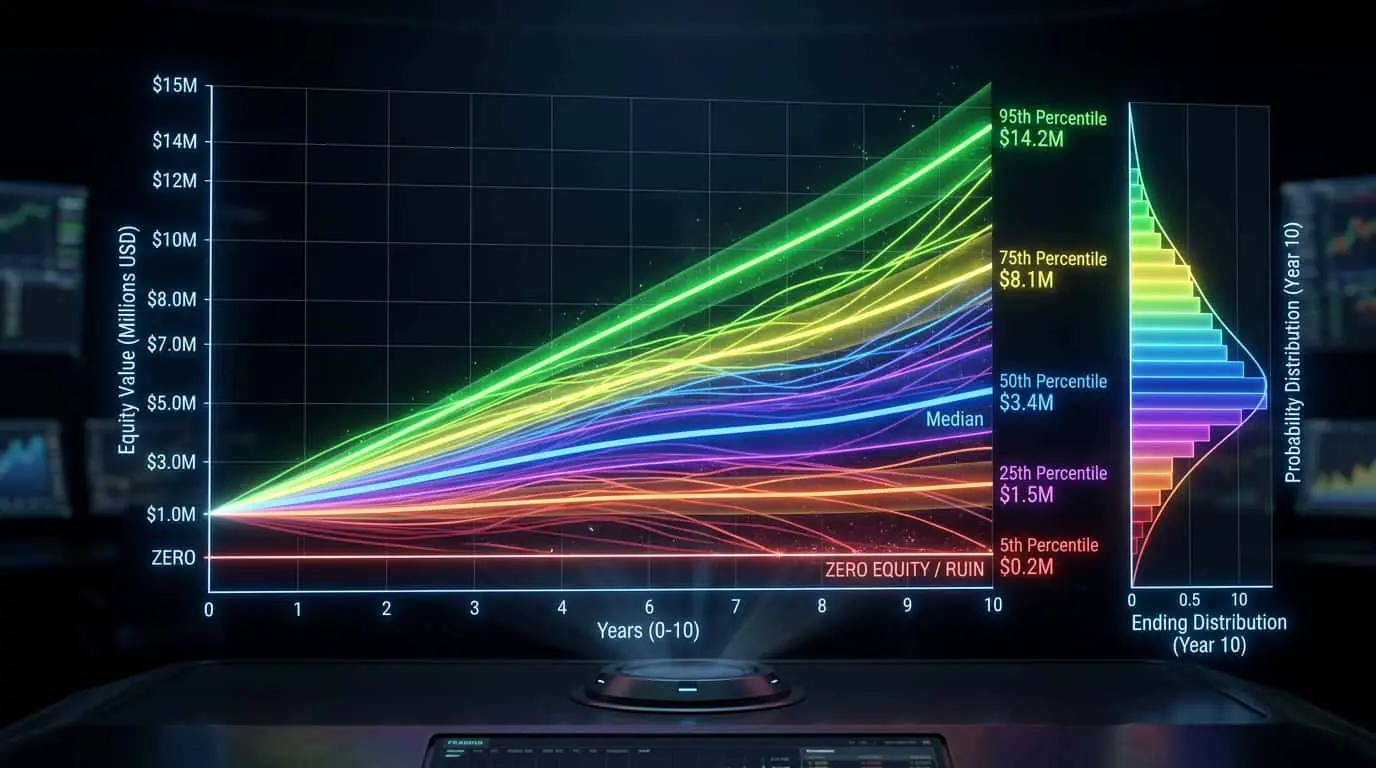
While formulas provide useful approximations, Monte Carlo simulation offers the most accurate assessment of risk of ruin. A Monte Carlo risk of ruin analysis takes your actual trade results (or a representative distribution) and randomly reorders them thousands of times to see how many of those sequences result in account ruin. This approach captures nuances that formulas miss, such as non-binary trade outcomes (partial wins, breakeven trades), clustered wins and losses, and the compounding effect of percentage-based position sizing. To run a Monte Carlo risk of ruin analysis, you need a database of at least 100 trade results. The simulation randomly shuffles these trades 5,000 to 10,000 times, tracking the equity curve for each shuffle. The percentage of equity curves that hit your ruin threshold (typically a 50% or greater drawdown) is your Monte Carlo risk of ruin. This number is more reliable than formula-based estimates because it uses your actual trade distribution rather than simplifying assumptions.
Pro Tip
Use our Monte Carlo Simulator to estimate risk of ruin with your actual trade data. Run at least 5,000 iterations for reliable results and set your ruin threshold at the maximum drawdown you can psychologically and financially tolerate.
The most effective way to reduce risk of ruin is to reduce risk per trade. Moving from 5% to 2% risk per trade can reduce your risk of ruin by 90% or more. Beyond position sizing, several other practices reduce risk of ruin. Diversifying across uncorrelated strategies or instruments reduces the chance that all positions lose simultaneously. Maintaining a cash reserve that is not used for trading provides a buffer against unexpected losses. Monitoring strategy performance and reducing size when the strategy appears to be degrading (using techniques like equity curve trading) prevents a declining strategy from causing excessive damage. Setting a maximum drawdown threshold and having a plan to stop trading if it is reached (either temporarily or permanently for that strategy) provides a final safety net. The combination of conservative position sizing, diversification, and hard drawdown limits makes ruin virtually impossible for any strategy with genuine positive expectancy.
Mistake
Ignoring risk of ruin because the strategy has positive expectancy
Correction
Positive expectancy does not guarantee survival. Calculate your risk of ruin explicitly and ensure it is below 1% by using appropriate position sizing (1-2% per trade).
Mistake
Using risk of ruin formulas with insufficient trade data
Correction
Risk of ruin calculations require reliable estimates of win rate and R:R, which need at least 100+ trades. Use Monte Carlo simulation with your actual trade data for more accurate results.