TL;DR
The Kelly Criterion is a mathematical formula that calculates the optimal percentage of capital to risk per trade to maximize long-term growth. Full Kelly is too aggressive for most traders, so practitioners use fractional Kelly (typically half or quarter) to reduce volatility while capturing most of the growth.
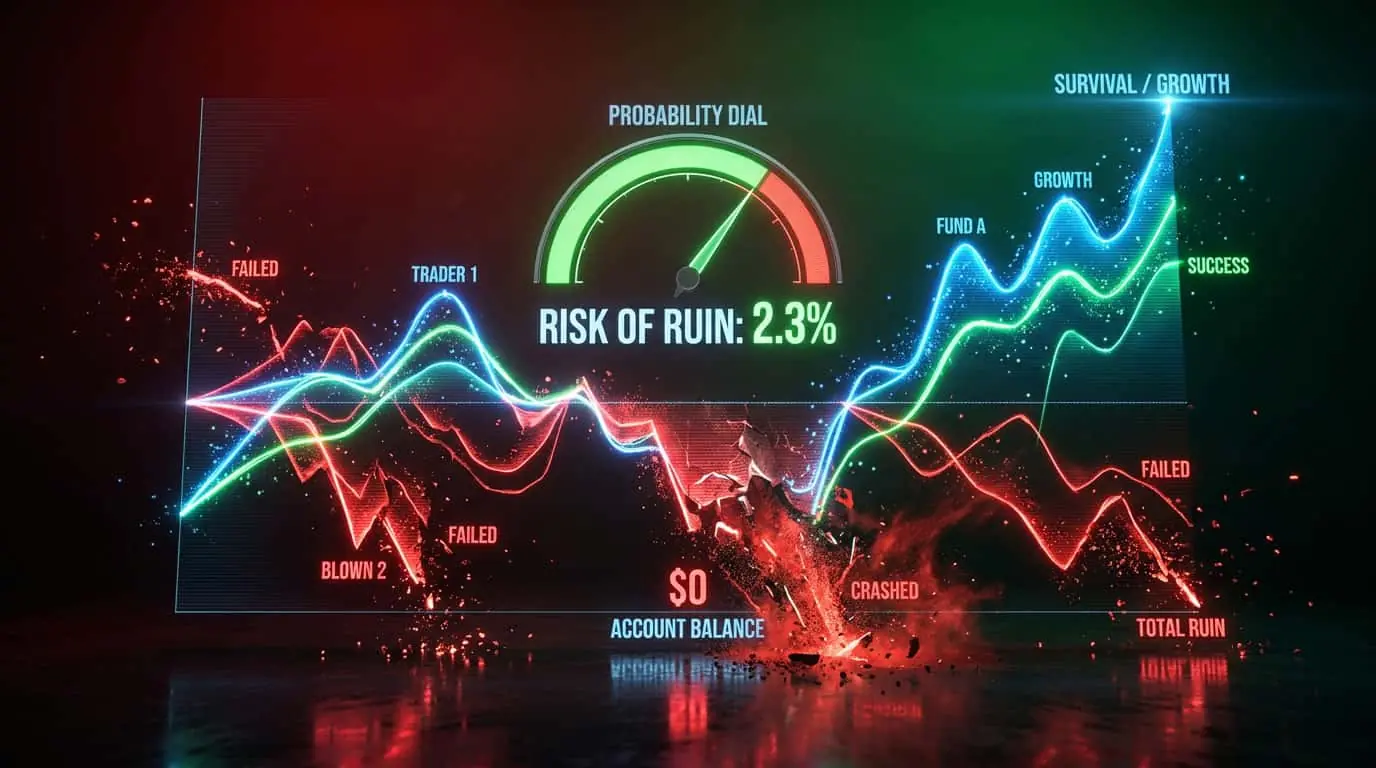
The Kelly Criterion is a mathematical formula that calculates the optimal percentage of capital to risk on each trade to maximize the long-term geometric growth rate of a portfolio. Developed by John L. Kelly Jr. at Bell Laboratories in 1956, it was originally designed for signal noise problems in telecommunications but was quickly adopted by gamblers and later by traders and investors. The formula determines the ideal bet size based on the probability of winning and the payoff ratio, balancing the trade-off between growth and risk. The key insight of the Kelly Criterion is that both under-betting and over-betting reduce long-term growth. Risking too little leaves potential growth on the table, while risking too much increases the probability of ruin due to excessive volatility. The Kelly percentage represents the mathematically optimal point between these two extremes. A negative Kelly value indicates that the strategy has no edge and should not be traded at all.
The Kelly Criterion formula for trading is adapted from the original gambling formula to account for the asymmetry between wins and losses in trading. The trading-specific formula is: Kelly % = W - [(1 - W) / R], where W is the win rate expressed as a decimal and R is the ratio of average win to average loss. This formula assumes that wins and losses are independent events (which is approximately true for most trading strategies) and that the win rate and payoff ratio are stable over time (which requires a sufficiently large sample of trades). For the formula to be reliable, you need a minimum of 100 trades, and preferably 200 or more, to establish stable estimates of your win rate and R ratio. Using Kelly with small sample sizes produces unreliable results because the input parameters are imprecise.
Kelly % = W - [(1 - W) / R]W — Win rate as a decimal (e.g., 0.55 for 55%)
R — Ratio of average win to average loss (e.g., 1.5 means average win is 1.5x average loss)
Pro Tip
The Kelly formula requires accurate inputs. If your win rate or R ratio estimates are off by even a small amount, the optimal bet size changes significantly. This is another reason to use fractional Kelly in practice: it provides a buffer against estimation errors.
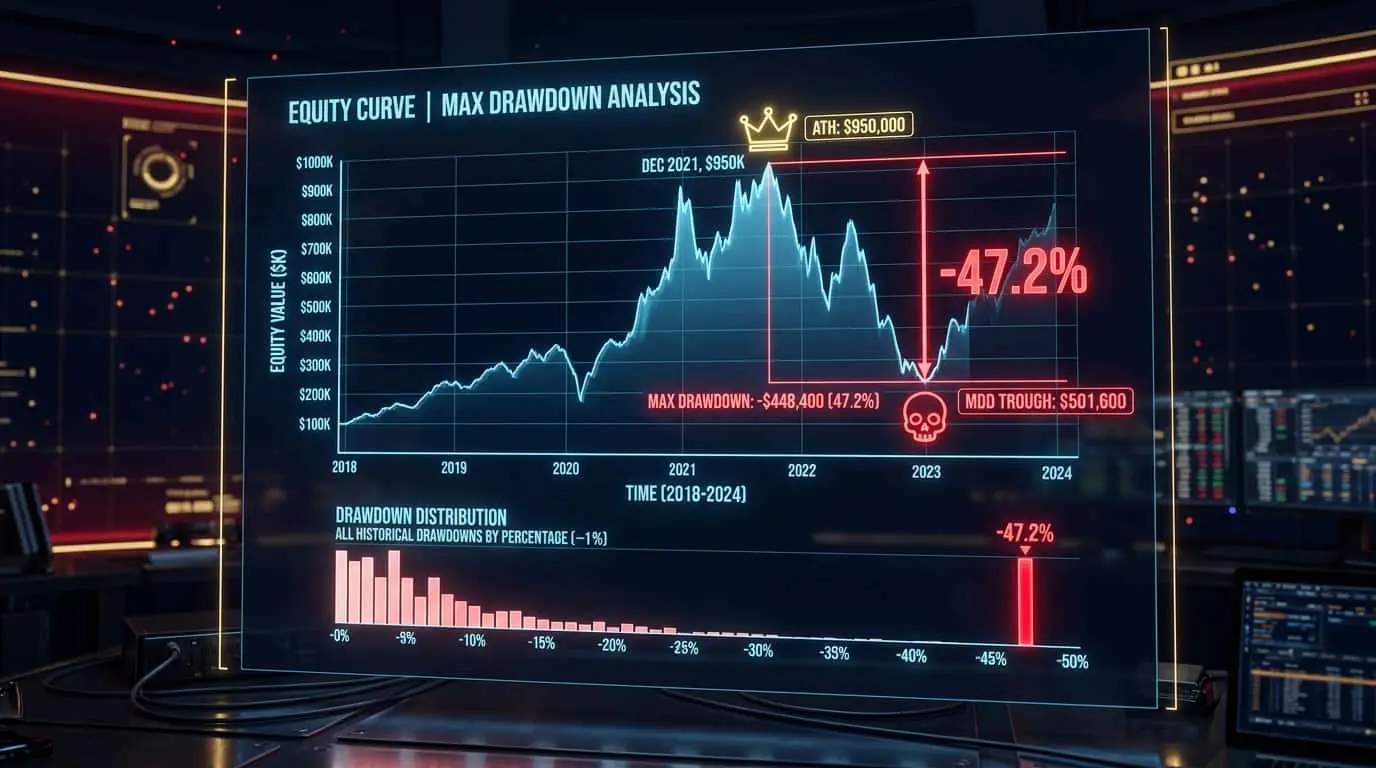
While the full Kelly percentage maximizes long-term growth, it produces extremely volatile equity curves. The drawdowns under full Kelly are severe: there is a 50% probability of a 50% drawdown at some point. This level of volatility is psychologically unbearable for most traders and can trigger margin calls or prop firm violations. For this reason, virtually no professional trader uses full Kelly. Instead, they use fractional Kelly, typically half-Kelly (50% of the full Kelly amount) or quarter-Kelly (25%). Half-Kelly achieves approximately 75% of the growth rate of full Kelly while cutting the variance roughly in half. Quarter-Kelly achieves about 50% of the growth rate with drastically reduced drawdowns. The reduced growth rate is a worthwhile trade-off because the smoother equity curve allows traders to maintain discipline and avoid emotional mistakes during drawdowns.
| Kelly Fraction | Growth Rate vs. Full | Drawdown Reduction | Recommended For |
|---|---|---|---|
| Full Kelly (100%) | 100% | None (maximum volatility) | Theoretical only, not recommended |
| Half Kelly (50%) | ~75% | ~50% reduction | Experienced traders with proven edge |
| Quarter Kelly (25%) | ~50% | ~75% reduction | Most retail traders |
| Tenth Kelly (10%) | ~25% | ~90% reduction | Very conservative or uncertain edge |
Let us calculate Kelly for a real trading scenario. A swing trader has taken 250 trades over the past year with the following results: win rate of 48% (W = 0.48), average winning trade of $720, and average losing trade of $360. The R ratio is $720 / $360 = 2.0. Applying the Kelly formula: Kelly % = 0.48 - [(1 - 0.48) / 2.0] = 0.48 - [0.52 / 2.0] = 0.48 - 0.26 = 0.22, or 22%. This means full Kelly recommends risking 22% of the account per trade, which is extremely aggressive. At half-Kelly, the risk would be 11%. At quarter-Kelly, 5.5%. If this trader has a $50,000 account and uses quarter-Kelly, they would risk $50,000 x 0.055 = $2,750 per trade. With a $360 average loss (or equivalently, a stop loss distance that creates a $360 loss per unit), the position size would be $2,750 / $360 = 7.6 contracts, rounded to 7 or 8 contracts. This is still an aggressive allocation, but it is within the realm of reasonable risk for a strategy with a demonstrated edge.
Pro Tip
Recalculate your Kelly percentage every quarter as your win rate and R ratio evolve. A strategy's edge can change over time, and your position sizing should adapt accordingly.
The Kelly Criterion has several important limitations that traders must understand. First, it assumes that you know your exact win rate and payoff ratio, but in trading, these are estimates derived from historical data that may not reflect future performance. Second, it assumes that trade outcomes are independent, meaning the result of one trade does not affect the next. While this is mostly true, correlated positions (multiple trades in the same sector or currency) violate this assumption. Third, the Kelly formula assumes a binary outcome (win or lose a fixed amount), but real trades have a distribution of outcomes. Some trades are partial winners or partial losers, and some hit breakeven. Fourth, Kelly maximizes the geometric growth rate over an infinite time horizon. If your time horizon is finite (which it always is), the optimal bet size may be different. Despite these limitations, Kelly remains one of the most useful frameworks for position sizing because it provides a mathematically grounded anchor point. Even if you do not use the exact Kelly percentage, understanding where your current risk level falls relative to Kelly helps you assess whether you are over-betting or under-betting.
Many traders use a fixed risk percentage (e.g., always risk 1% or 2% per trade) without reference to their strategy's actual edge. The Kelly Criterion reveals whether this fixed percentage is appropriate. If your Kelly percentage is 15% and you are risking 1%, you are significantly under-betting and leaving growth on the table. If your Kelly percentage is 3% and you are risking 5%, you are over-betting and increasing your risk of ruin. The ideal approach is to calculate your full Kelly, then choose a fraction (half or quarter) as your actual risk percentage. This creates a position sizing method that is calibrated to your specific edge rather than an arbitrary percentage. However, many professional traders argue that the simplicity and conservatism of fixed 1-2% risk is valuable precisely because it works regardless of edge size and provides ample protection against estimation errors. The practical recommendation is to use Kelly as a diagnostic tool: calculate it to understand your edge, then use a fixed percentage that falls within the quarter-Kelly to half-Kelly range.
Mistake
Using full Kelly percentage for actual trading
Correction
Full Kelly produces extreme volatility with a 50% chance of a 50% drawdown. Use half-Kelly (75% of growth, half the variance) or quarter-Kelly (50% of growth, much smoother equity curve) instead.
Mistake
Calculating Kelly with insufficient trade data
Correction
With fewer than 100 trades, your win rate and R ratio estimates are unreliable. Use a conservative fixed percentage (0.5-1%) until you have at least 100 trades to calculate Kelly reliably.
Mistake
Not recalculating Kelly as strategy performance changes
Correction
Market conditions and strategy performance evolve over time. Recalculate your Kelly inputs quarterly using your most recent 100-200 trades to ensure your position sizing reflects your current edge.